
Introduction
Brain.fm is marketed as “functional music” backed by neuroscience, Brain.fm claims to do more than sound good. It guides your brain into states of focus, relaxation, or sleep using engineered audio patterns, like focus music. But does it deliver, or is it just another productivity trend?
To find out I tried Brain.fm myself for more than 30 days. I used it while I worked on this website, wrote blogs and a lot more.
In this Brain.fm review, we’ll break down everything you need to know, from features and performance to pricing and real-world usability. I will share my perspective on Brain.fm. So you can decide if it’s worth adding to your workflow.
Features Overview
Scientifically Designed Music
Unlike traditional playlists, Brain.fm uses algorithmically generated audio designed to influence brainwave activity. The idea is simple and powerful: instead of passively listening to music, you use sound as a tool to shift your mental state.
Their tracks are built around:
- Neural phase-locking (brain synchronization)
- Minimal distraction (no lyrics, reduced variability)
- Consistent rhythmic patterns
This appeals to people who find typical ambient music too engaging or repetitive.
Brain.fm offers three primary modes:
- Focus Mode – designed for deep work sessions like coding, writing, or studying. This is where most users spend their time.
- Relax Mode – ideal for decompressing after work or managing stress without a complete mental shutdown.
- Sleep Mode – helps users wind down and fall asleep faster, especially useful for those with racing thoughts.
Each mode includes customizable session lengths, typically ranging from 10 minutes to several hours.
Brain.fm may be a good fit if you want audio specifically designed for focused work, but it isn’t the only option available. If you’re still deciding which service best suits your needs, read our Focus Music Buyer’s Guide, where we compare different approaches to focus audio and explain what to consider before choosing a service.
ADHD-Friendly Design
One standout feature is Brain.fm’s focus on ADHD users. Unlike many productivity tools that assume a “one-size-fits-all” brain, Brain.fm allows adjustments such as:
- Increased stimulation levels
- More rhythmic intensity
- Faster engagement curves
For users who struggle with attention regulation, this tailored approach can make a noticeable difference. I do not have ADHD myself so on this topic I can not give you my experience, but Brain.fm has a an explained about why their music works well for people with ADHD.
They have a in peer-reviewed studies to increase focus-related brainwaves by 119% and improve sustained attention tasks in users with ADHD symptoms.
if you have ADHD you can try it out for 30 days free here. Hit the Get Started button on their site, fill out some info real quick, and you can start right away.
Session Customization
What I appriaciate about brain.fm is that they give users control over a lot of things.
- Session length: you can choose between 30 minutes, 1 hour, 2 hours, or unlimited. I personally like the unlimited option, because I work for as long as possible and don’t get stressed about time.
- Music style: within each mode, you can choose sub-genres (cinematic, wind chimes, rain, electronic, etc.).
- Intensity: some modes let you dial between subtle and immersive.
- Background sounds: option to layer nature sounds beneath the music
This flexibility adapts to a range of workflows, from Pomodoro-style sessions to long, uninterrupted deep work blocks.
Distraction Blocker Integration
Brain.fm has partnered with focus tools and integrates with productivity apps on some platforms. The built-in session timer creates a natural Pomodoro-style framework for timed work blocks.
Offline Access and Mobile App
Brain.fm is available on desktop and mobile (iOS and Android), with offline downloads included in paid plans. This is especially useful for:
- Traveling professionals
- Students working in libraries
- Developers working in low-connectivity environments
- Those working in areas with spotty internet
Performance Analysis
Does It Actually Improve Focus?
This is where Brain.fm stands apart from other music apps.
My answer to this questions would be a real yes.
- It’s faster entry into flow states, and get me focused on the tasks faster.
- Reduced the need to switch tracks, especially because the tracks are longer than normal tracks.
- Less mental fatigue over long sessions
Practically, I think Brain.fm works best when:
- You’re doing cognitively demanding tasks
- You need consistency rather than variety
- External distractions like office noise disrupt your concentration
Interested in finding out how it can help you? Hit the button below.
Compared to Traditional Music
Let’s compare Brain.fm to common alternatives:
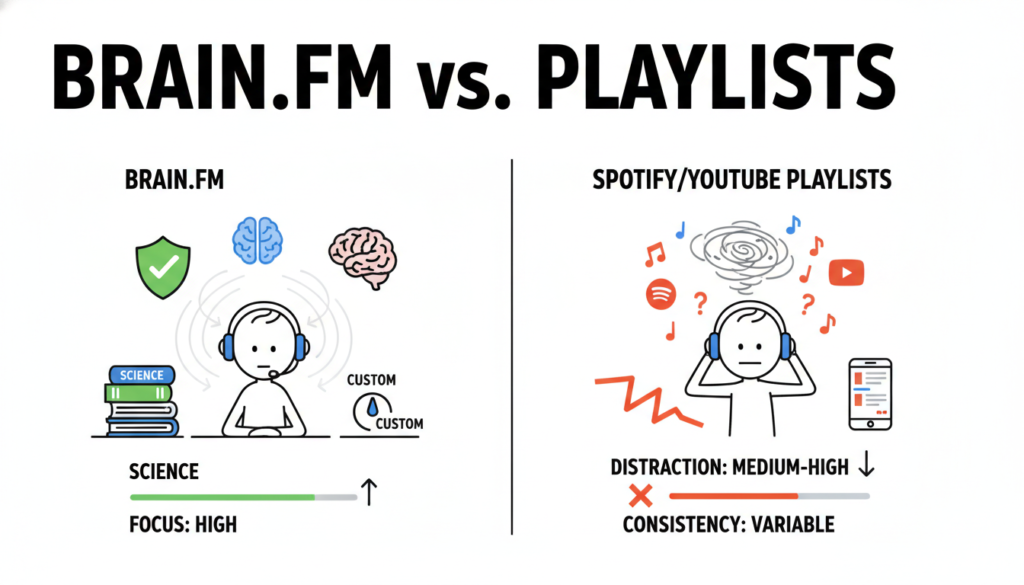
Traditional playlists often fail because:
- Songs vary in tempo and intensity
- Lyrics pull attention away
- Repetition leads to fatigue
Brain.fm avoids all three issues. For example, their tracks have no lyrics.
Real-World Use Cases
Remote Developers: Brain.fm shines during long coding sessions where interruptions break mental context. The steady audio helps maintain flow without cognitive interference.
Graduate Students and researchers: for research, reading, and writing, the consistent background reduces the urge to multitask or check notifications.
Freelance Creators: writers and designers often struggle with “getting started.” Brain.fm helps lower that activation energy.
ADHD Users: perhaps the biggest impact is here. Many report improved task initiation and sustained attention, two major challenges in ADHD.
Pros and Cons
Pros
1. Truly Non-Distracting Audio: No lyrics, no sudden changes, just steady, engineered sound.
2. Backed by Research: While not a miracle solution, Brain.fm’s approach is grounded in neuroscience principles.
3. ADHD Optimization: Few tools explicitly cater to neurodivergent users. This is a big win.
4. Easy to Use: Minimal setup, intuitive interface, and quick session starts. You can get started within 10 seconds after opening brain.fm. That’s what I love: that it is so easy to use and get going.
5. Consistent Results : Unlike playlists, it doesn’t depend on song selection or mood.
6. Offline access: Web, iOS, Android, desktop apps, and offline downloads. I did not personally tested the offline features yet, but they do offer it.
Because it is my mission to help you gain more focus, I only find it fair to tell you also my cons about Brain.fm. Although the Pros do outrank the cons, if you ask me.
Cons
1. Subscription Required: No lifetime purchase option, ongoing cost may deter some users.
2. Limited Music Variety: If you enjoy musical diversity, Brain.fm can feel repetitive over time. Tip: When you feel like that, skip to the next track.
3. Not Ideal for Creative Inspiration: Great for focus, less effective for brainstorming or emotional creativity. But I also have to mention they have subcategories with motivation and creativity tracks.
4. Subtle Effects for Some Users. Not everyone experiences dramatic improvements—it varies by individual.
User Experience
Interface and Design
Brain.fm keeps things simple:
- Clean dashboard
- Quick session start
- Minimal distractions
This aligns perfectly with its purpose: no clutter and no friction.
Onboarding
If you start using Brain.fm (new users) you are guided through:
- Choosing goals (focus, relax, sleep)
- Adjusting intensity
- Selecting session duration
The process takes less than 2 minutes, making it easy to get started immediately.
Daily Use
Most users integrate Brain.fm into routines like:
- Morning deep work sessions
- Productivity blocks throughout the day
- Evening wind-down rituals
Sessions are customizable, fitting both structured schedules and flexible workflows.
Value for Money
Pricing Overview
Here is what Brain.fm mostly offers:
- Monthly: $14.99
- Annual: $99.99 (~$8.33/month)
- 30-day free trial (cancel anytime)
Brain.fm also offers a student discount (20% with .edu verification)
If you look at it, Brain.fm is cheaper than Spotify and, in my view, offers much more value because of the focus, concentration, brain support, and habits it builds. Want to consider if it is worth your money? You can sign up here for the 30-day free trial.
Is It Worth It?
It depends on how much you value focus.
If Brain.fm helps you:
- Finish work faster
- Maintain deep focus longer
- Reduce mental fatigue
Then even a small productivity boost can justify the cost, especially for:
- Freelancers billing by output
- Developers working on complex systems
- Remote workers with no office noise structure to anchor focus
- ADHD adults using it as a daily focus aid (potentially replacing or supplementing other tools)
- Students in intensive writing or research phases or under time pressure.
- Frequent fliers or commuters who use the offline mode for productive transit time
If you do 2+ hours of focused cognitive work per day, the annual plan works out to roughly $0.55 per workday! A trivial cost against any productivity gain. Try it out for yourself!
Cost vs Alternatives
Free alternatives exist (e.g., YouTube playlists), but they lack:
- Scientific design
- Consistency
- Personalization
In many cases, users end up wasting time switching tracks or getting distracted.
Final Verdict
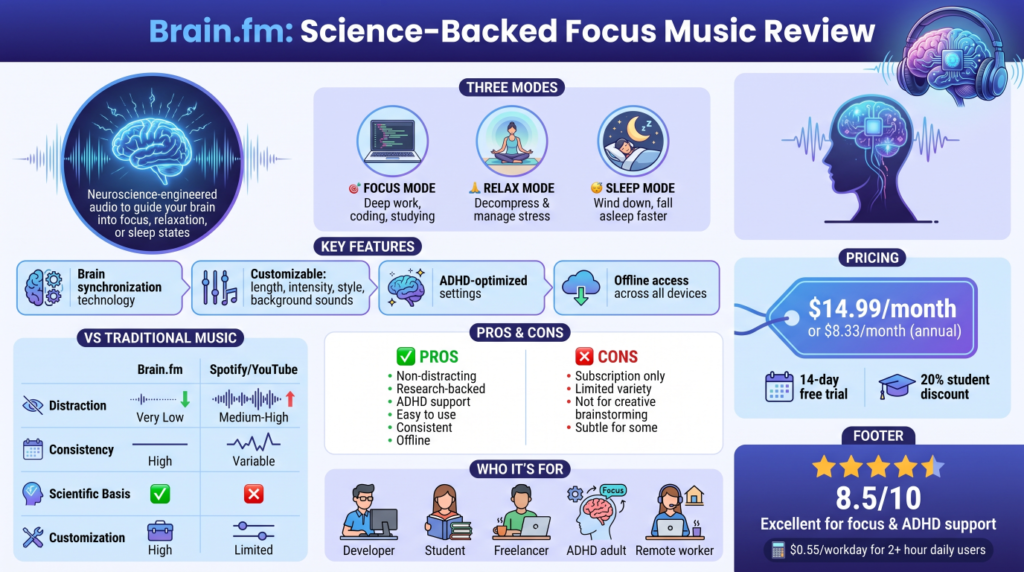
Brain.fm earns a strong recommendation for remote developers, students, freelance writers, and adults with ADHD seeking better focus. Its science-backed approach, a variety of task modes, and ability to induce flow states set it apart from generic music or noise apps.
It won’t transform a chaotic life into peak productivity overnight. Sleep, exercise, and environment are also important, but they reliably help create the optimal auditory environment for complex cognitive tasks and maintaining deep focus.
Rating: 8.5/10
Excellent for focus and ADHD support. Minor deductions for cost and potential repetitiveness.
Ready to try it for yourself? Start your free 30-day Brain.fm trial here and experience the difference in your next deep work session.
If you’re a student or on a budget, check for discounts. For teams, contact them directly.
Don’t let distractions steal another productive day. Your brain will thank you later. (Results may vary; combine with good habits for best outcomes.)
This Brain.fm review is based on official documentation, peer-reviewed studies, and aggregated user experiences. Individual results depend on personal factors.
Some of the links on Best Focus Music are affiliate links. This means that if you click a link and buy something, we may earn a small commission — at no extra cost to you. We only recommend products we genuinely think are worth your time.
We are a participant in the Amazon Associates Program, an affiliate advertising program designed to provide a means for sites to earn advertising fees by linking to Amazon.com and affiliated sites. We may also work with other affiliate networks and individual brands from time to time.