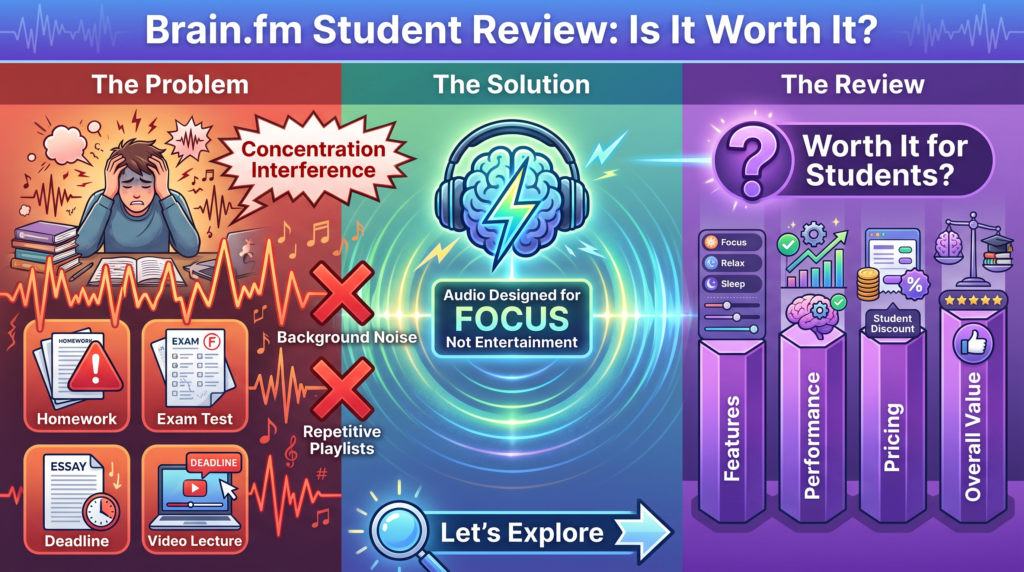
It’s difficult enough to study without having constant distractions. If you’re doing your homework for exams, writing essays, or taking online lectures, background noise and repetitive playlists can soon interfere with your ability to concentrate.
Brain.fm says that it solves that problem by using audio that is specially designed for focus rather than for entertainment. However, is it really worth using this focus music as a student?
In this review, we’ll explore Brain.fm’s features, performance, pricing, and overall value to help you decide whether it’s the right study companion.
What Is Brain.fm?
Brain.fm is an audio service that operates on a subscription basis and produces music aimed at helping with concentration, relaxation, and sleep. Different from Spotify or Apple Music, it does not concentrate on entertainment; rather, each listening session is intended to establish a steady background atmosphere that aids mentally demanding activities.
Students, programmers, writers, designers, and people who work from home are among its main users, since they usually spend hours on tasks that demand sustained attention.
A major benefit is simplicity; rather than going through thousands of playlists, you just select your aim:
- Focus
- Relax
- Sleep
- Meditation
After that you choose the length of session that you prefer and begin listening just a few seconds later.
Why Students Are Looking Beyond Traditional Playlists
Many students rely on YouTube study mixes, lo-fi playlists, or classical music while revising.
Although these methods are suitable for some individuals, they also have limitations.
Traditional playlists often include:
- Songs with lyrics
- Sudden changes in tempo
- Familiar tracks that grab your attention
- Advertisements on free plans
Although these interruptions might appear to be minor, they are capable of diverting your attention from complicated activities such as solving equations, reading academic papers, or writing assignments.
Instead, specialized music platforms for focus offer a more steady background soundtrack with the aim of minimizing unnecessary distractions.
Common Study Challenges Students Face
Focusing doesn’t always depend on being motivated. Although many students really do want to study, they have difficulty keeping their concentration going for long periods. One notification, a conversation nearby, or simply the urge to switch between browser tabs can break up a productive study session.
The environment also has an important influence. There are students who study in busy libraries, in shared apartments, in cafés, or in the various areas of the university where it is hard to avoid background noise. Other students work from home next to their family members or roommates, which leads to more distractions during the day.
Music can contribute to a more consistent working environment, but not all kinds of music have the same effect; although lively playlists may boost motivation when exercising, they aren’t always suitable for reading academic papers or solving complex problems, which is why many students start to seek out alternatives that promote concentration without continuously demanding their attention.
Features Overview
Purpose-Built Audio Sessions
Brain.fm does not base itself on user-created playlists.
Instead, every listening session is created around a specific goal.
Students can choose sessions designed for:
- Deep study
- Reading
- Writing
- Homework
- Revision
- Relaxation between study blocks
You no longer have to keep looking for new playlists each time you decide to study.
Simple Interface
A standout feature of Brain.fm is its simple design.
Within seconds you can:
- Select your activity
- Choose session duration
- Adjust intensity settings
- Begin listening immediately
It all seems obvious and so easy that you can establish a daily study routine.
Cross-Platform Support
Brain.fm is available on:
- Windows
- Mac
- iPhone
- Android
- Web browser
It therefore makes it easy for students to study at home, in the library, or when traveling.
Offline Listening
Users with premium access can download the sessions for offline use.
This is especially useful for:
- University libraries
- Train journeys
- Areas with limited internet access
Performance Analysis
Does this help you to stay focused?
This is obviously the most important question.
Brain.fm isn’t intended to magically raise your grades or take the place of good study habits. Yet a great many students have found that using background audio regularly enables them to keep their concentration going for longer than they can with ordinary playlists.
One reason is predictability.
Throughout your session the audio stays fairly consistent rather than making sudden changes in genre or having lyrics that draw your attention away.
It can help to remain concentrated while reading, taking notes, or solving problems.
Long Study Sessions
It is common for university students to spend several hours studying for their exams.
Since Brain.fm sessions go on without any major interruptions, they are appropriate for techniques such as:
- Pomodoro
- Time blocking
- Deep work sessions
- Exam revision
Many students don’t mind not having to look for a new playlist every 30 minutes.
Working in Noisy Environments
Libraries aren’t always quiet.
Not either the student houses, the cafés, or the shared apartments.
Even though Brain.fm does not physically block out surrounding sounds, many students use it together with noise-cancelling headphones in order to create a more calm working environment.
A combination of playlists usually gives a more steady listening experience than simply using ordinary playlists.
A comparison between Brain.fm and traditional study playlists
| Designed for studying | ✅ | ❌ | ❌ |
| Lyrics-free sessions | ✅ | Sometimes | Sometimes |
| Continuous sessions | ✅ | Depends on playlist | Depends on video |
| Ads-free experience | ✅ Premium | Premium | Premium |
| Offline listening | ✅ | ✅ | Limited |
Spotify and YouTube are still good platforms for finding music.
Yet neither of the platforms was designed in particular to support long concentration and has no science-based focus music.
Pros and Cons
Pros
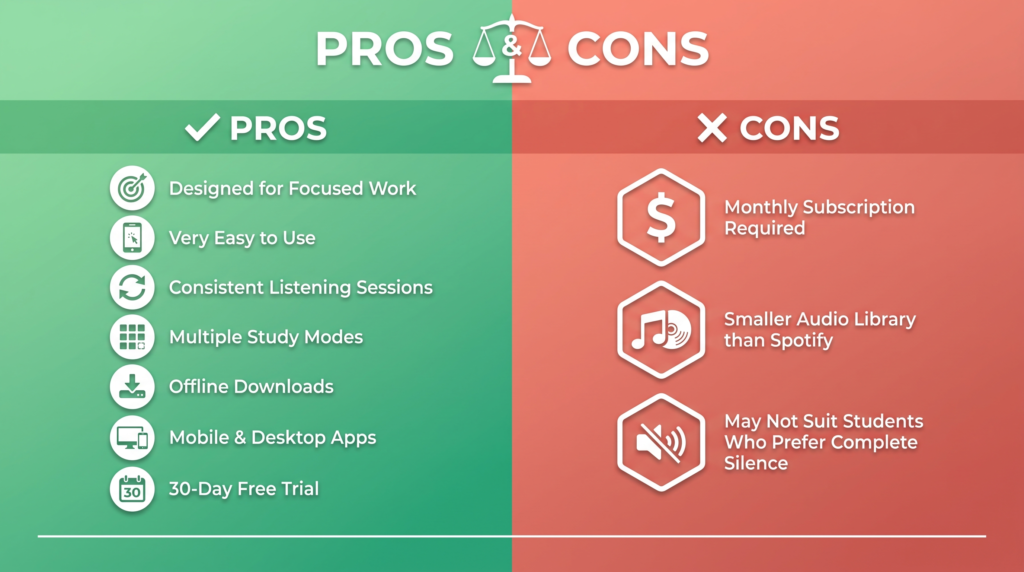
- Specifically designed for focused work
- Very easy to use
- Consistent listening sessions
- Multiple study modes
- Offline downloads
- Mobile and desktop apps
- 30-day free trial
Cons
- Monthly subscription required
- Smaller audio library than Spotify
- May not suit students who prefer complete silence
Tips for Getting the Most Out of Brain.fm
Just like any other productivity tool, Brain.fm functions most effectively when good study habits are combined with it; merely pressing play will not automatically lead to an improvement in concentration, but setting up the right study environment can make a noticeable difference.
It is advantageous for many students to set a definite aim before beginning each session; rather than deciding to “study for a while,” they should concentrate on a particular goal, for example, finishing a chapter, going over their lecture notes, or completing a practice assignment.
The Pomodoro Technique goes hand in hand with Brain.fm since working in focused periods of about 25 to 50 minutes, followed by short breaks, is useful for avoiding mental fatigue over longer study sessions.
When you are studying in a noisy place it would be a good idea to use comfortable over-ear headphones. They might not entirely eliminate the surrounding sounds, but they can still help to give you a more consistent listening experience.
Lastly, avoid switching from one playlist to another every so often; a major benefit of Brain.fm is that it offers continuous sessions, which enable you to stay focused without having to make frequent decisions regarding what to listen to next.
User Experience
One of Brain.fm’s biggest strengths is that it removes unnecessary decisions.
Instead of spending five minutes choosing a playlist before every study session, you simply press play and start working.
The clean interface makes the platform accessible even for first-time users.
Navigation feels straightforward, and switching between Focus, Relax, and Sleep modes takes only a few seconds.
The customization options are useful without becoming overwhelming, allowing students to tailor sessions to their own preferences while keeping the experience simple.
Value for Money
It is natural for students to pay close attention to subscription costs.
Brain.fm is more specialized than general music streaming services.
Whether it’s worth paying for or not depends on how frequently you study.
A dedicated productivity tool might offer more value to you than another entertainment subscription if you take several hours every day to get ready for lectures, exams, or coursework.
The main benefit is that you can leave your decision until later.
Want to give Brain.fm a try? You can have a 30-day free trial, so you can use it during actual study sessions before deciding on a subscription.
Who Should Use Brain.fm?
Brain.fm may be a good choice if you:
- Study in noisy environments
- Find lyrics distracting
- Frequently use the Pomodoro technique
- Spend several hours studying every day
- Want a simple solution without searching for playlists
It may be less suitable if:
- You prefer complete silence
- You mainly listen to music for entertainment
- You rarely study for extended periods
Final Verdict
Brain.fm isn’t designed to replace effective study habits, but it can become a valuable part of a productive study routine.
Its distraction-free sessions, simple interface, and cross-platform availability make it one of the strongest options for students who struggle with background noise or inconsistent playlists.
While the subscription may not suit every budget, the 30-day free trial provides plenty of time to decide whether it genuinely improves your ability to concentrate.
If you’re looking for a dedicated study companion rather than another music streaming service, Brain.fm is well worth considering.
Ready to test it yourself? Start Brain.fm’s 30-day free trial today, and if you’d like to compare it with other platforms first, check out our in-depth guide to the best focus music apps.
Frequently Asked Questions
Is Brain.fm good for studying?
Many students find Brain.fm useful because it provides consistent background audio without the distractions often found in traditional playlists.
Is Brain.fm better than Spotify?
Spotify offers a much larger music library, but Brain.fm focuses specifically on concentration rather than entertainment. The better choice depends on your goals.
Can I use Brain.fm during exam preparation?
Yes. Many students use Brain.fm while revising, reading textbooks, writing essays, or completing practice questions.
Does Brain.fm work without internet?
Premium subscribers can download sessions for offline listening, making it useful for studying on the go.
Is the free trial worth trying?
Yes. The 30-day free trial allows you to test Brain.fm and their focus music during your normal study routine before deciding whether a subscription is worthwhile.
Start the 30-day free trial and see how it fits into your own study sessions.
Some of the links on Best Focus Music are affiliate links. This means that if you click a link and buy something, we may earn a small commission — at no extra cost to you. We only recommend products we genuinely think are worth your time.
We are a participant in the Amazon Associates Program, an affiliate advertising program designed to provide a means for sites to earn advertising fees by linking to Amazon.com and affiliated sites. We may also work with other affiliate networks and individual brands from time to time.