
Quick Answer
What is the 3 minute rule in music? The 3 minute rule in music means that most people naturally stop paying close attention to a song after about three minutes. It’s a concept that often comes up when people talk about focus, productivity, and how we actually listen to music during work or study.
In practice, it shows that our attention tends to fade even if the music is still playing. Your brain stops actively processing it and starts treating it more like background noise.
This is also why shorter, simpler audio or looping soundscapes often work better for focus. They don’t have a clear start or end that pulls your attention back in, which makes it easier to stay locked into your work.
Understanding the Question
People search for what is the 3 minute rule in music to learn why some audio helps them focus more than others.
The idea comes from how songs are made and how people pay attention. Most songs go from intro, build up, chorus, to an ending with a length of about 2-4 minutes.
After a few minutes, your brain expects what comes next and focus drops.
This is especially relevant for people working on deep cognitive tasks such as coding, academic writing, or design.
Detailed Explanation
The 3-minute rule isn’t a strict science rule. It’s a simple thought about how attention works with music.
Most music is made to be interesting. It changes and resolves. That’s good for fun, but not for focusing for a long time.
After a few minutes, your brain tracks those changes automatically. Even if you’re not actively listening, your attention still gets pulled into the music’s structure.
That’s where focus audio behaves differently. Instead of following a typical song structure, it often removes clear progression entirely. This keeps your attention on the task instead of the audio.
So, the 3 minute rule is really about how repeating and expected music can tire your brain, not just about time.
Key Characteristics
To better understand the concept, it helps to break down what actually influences attention in music.
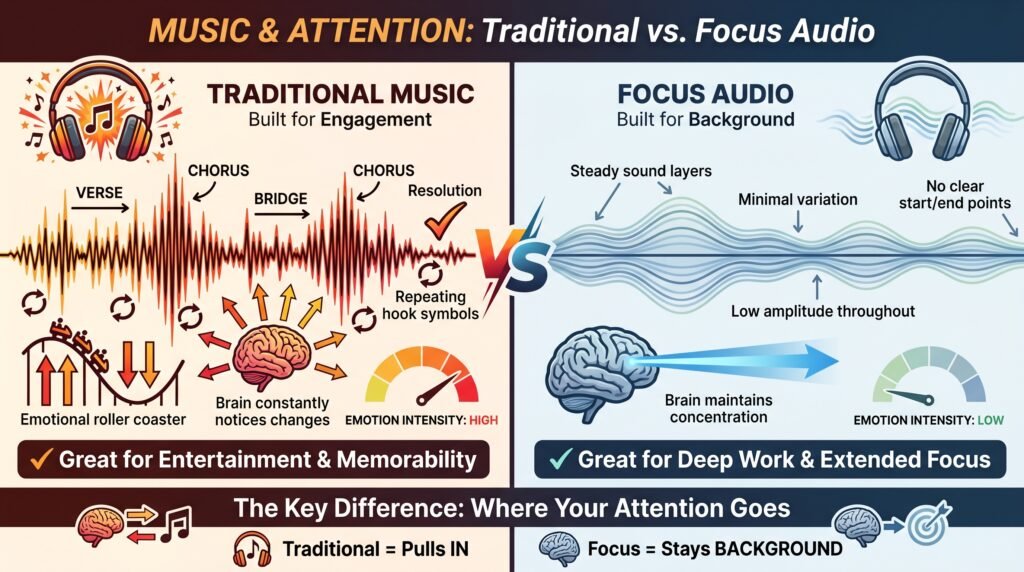
Most traditional songs are built to keep you engaged from start to finish. They’re structured in a way that feels familiar and emotionally interesting.
Most traditional songs include:
- Clear structure (verse, chorus, bridge)
- Emotional shifts
- Predictable resolution
- Repeating hooks
These elements are designed to keep listeners engaged and make the song memorable. That’s great for entertainment, but not always ideal when you’re trying to focus on work.
For deep work, these same features can become distracting over time. Your brain keeps noticing the changes, even if you’re not actively listening.
That’s why focus-oriented audio usually avoids traditional structure altogether. Instead, it’s designed to stay in the background without pulling attention away.
Instead, it relies on:
- Steady sound layers
- Minimal variation
- Low emotional intensity
- Continuous flow without a clear “start and end”
This kind of audio creates a more stable environment for your brain. It reduces mental interruptions and makes it easier to stay focused for longer periods of time. If you’d like to improve the way you actually listen during work or study sessions, read our guide on how to fully focus on music.
Real-World Examples
You can see the 3-minute effect in everyday listening behavior.
For example, people often skip songs shortly after they start, even when they actually like them. It’s not always boredom—it’s just how quickly music becomes predictable to the brain.
In work environments, this becomes even clearer. A developer working on a complex bug might notice that regular songs start feeling distracting after a few minutes, while ambient soundscapes stay much more stable in the background. If you want to block out distractions completely, noise cancelling headphones can make a big difference. Check out our Complete Guide: How to Focus Better With Noise Cancelling Headphones.
Students notice something similar during long study sessions. Structured music feels fine at first, but after a while it starts to feel mentally “louder” and harder to ignore.
That’s why tools like continuous ambient generators or adaptive focus audio are becoming more popular. They remove the constant switching and keep the sound steady in the background.
Benefits and Advantages
Understanding the 3-minute rule can actually help you choose better music for working and studying.
One of the biggest benefits is more stable focus. Instead of your brain constantly reacting to changes in songs, it stays more locked in on the task itself.
It also reduces mental fatigue. When the sound doesn’t constantly demand attention, your brain has more energy left for actual thinking and problem-solving.
Another advantage is getting started more easily. A lot of people struggle with the first 10–15 minutes of deep work, and steady background audio can make that transition feel smoother.
For people with ADHD, this can be especially useful. Consistent sound environments often help reduce internal distractions and make it easier to stay on track for longer periods. Read our other article: Do ADHD People Focus Better With Music to find out more about the topic.
It also makes your focus more consistent overall. Instead of relying on mood-based playlists that change every day, you build a steady audio setup that works the same way every time you sit down to work.
Related Concepts
The 3-minute rule connects closely with several other ideas in audio psychology and productivity.
One idea is auditory habituation, meaning your brain stops noticing the same sound after a while. This is why repeated sounds can help or just become background noise.
Another related concept is flow state, in which your attention is fully absorbed in a task. Stable audio environments can help you enter this state more easily by reducing interruptions.
There’s also cognitive load theory, which explains how your brain has limited processing capacity. Any unnecessary sound structure competes for that capacity.
Finally, tools like binaural beats and ambient soundscapes are often built around these principles, even if they don’t directly reference the 3-minute rule.
Conclusion
The 3 minute rule in music isn’t about a timer. It’s about how fast music with structure starts taking your focus.
For entertainment, that’s a good thing. For deep work, it often isn’t.
That’s why focus audio, ambient soundscapes, and adaptive music tools have become so popular. They remove structure so your brain stays locked into the task rather than the soundtrack.
If you understand this principle, it becomes much easier to choose the right type of audio for coding, studying, writing, or any other focused work.
The key point is to use audio that supports your focus, not just any music, so you can match sound to your mental state and improve productivity.
Frequently Asked Questions
Is the 3-minute rule scientifically proven?
No, it isn’t a strict scientific rule. It’s more of an observation about how people tend to lose active attention while listening to music over time.
Does this apply to all music?
No, it mainly applies to structured songs with clear changes and progression. Ambient music or generative soundscapes work differently because they don’t rely on the same song structure.
What type of music is best for focus?
Most people do well with steady, simple sounds like brown noise, ambient music, or AI-generated focus audio. The key is that it shouldn’t have strong structure, lyrics, or sudden changes.
Can focus music improve productivity?
Yes, for a lot of people it helps reduce distractions and makes it easier to stay focused for longer periods. It’s especially useful during deep work tasks like coding, studying, or writing.
Some of the links on Best Focus Music are affiliate links. This means that if you click a link and buy something, we may earn a small commission — at no extra cost to you. We only recommend products we genuinely think are worth your time.
We are a participant in the Amazon Associates Program, an affiliate advertising program designed to provide a means for sites to earn advertising fees by linking to Amazon.com and affiliated sites. We may also work with other affiliate networks and individual brands from time to time.