
Quick Answer
You don’t get 100% concentration by trying harder. You get it by removing the things that break it — unpredictable noise, unnecessary decisions, constant task-switching, and environments your brain hasn’t learned to associate with deep work.
The biggest practical levers are: structured work blocks, a stable, sound environment, and cutting off distractions before they reach you. For a lot of people — especially developers, writers, and those with ADHD — the right background audio makes a surprisingly large difference.
Understanding the Question
When people search how do you get 100% concentration and focus?, they’re usually not after a philosophy lecture. They want to stop losing an hour to distraction every morning. They want to get into the work and stay there.
The frustrating part is that focus doesn’t respond well to effort alone. You can sit at your desk, tell yourself to concentrate, and still find your mind somewhere else entirely ten minutes later. That’s not a character flaw — it’s how the brain works under modern conditions.
Open offices, Slack, notifications, and the general ambient chaos of working life create an environment where deep attention is constantly under threat. Understanding that is actually the first useful step, because it shifts the question from “why can’t I focus?” to “what conditions does my brain need to focus?”
Detailed Explanation
Focus Is a State, Not a Skill You Either Have or Don’t
Most people think of concentration as something you either have or lack — like being a morning person. If you’ve ever wondered how do you get 100% concentration and focus, that framing is part of the problem. In reality, focus is a state your brain moves in and out of based on conditions.
Think of it like sleep. You can’t force yourself to fall asleep through sheer determination. But you can create conditions — darkness, quiet, a consistent bedtime — that make sleep far more likely. Concentration works the same way.
The goal isn’t to try harder. It’s to stack conditions in your favor, so focus happens more easily and lasts longer.
Why Distractions Are More Damaging Than They Feel
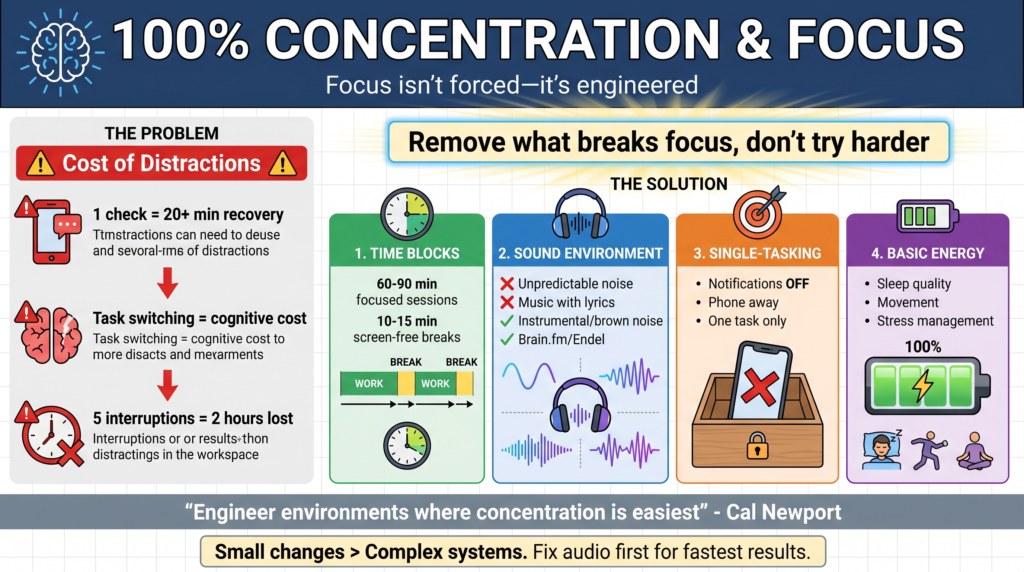
A quick check of your phone doesn’t feel like much. But research on cognitive load suggests that after an interruption, it can take more than twenty minutes to fully re-engage with complex work. Not because the distraction was significant, but because rebuilding the mental context you had before takes time and effort.
For developers working through a difficult bug, PhD students deep in a literature review, or writers in the middle of a complicated argument, that reset cost is real and compounding. Five small interruptions across a morning can effectively eliminate two hours of deep work.
Your Sound Environment Matters More Than You Think
One of the most underestimated factors in concentration is the sound environment you’re working in.
In a genuinely quiet room, your brain has little to filter. In a space with unpredictable noise — background conversations, the hum of an open office, traffic, notifications from across the room — part of your attention runs continuously in the background, checking whether anything demands a response. That’s energy spent not on your work.
This is why so many remote workers, students, and freelancers use background audio while they work. The point isn’t entertainment — it’s creating a stable, predictable acoustic environment that gives your attention less to react to.
What works varies by person and task:
- Music with lyrics tends to disrupt reading, writing, and any work involving language — the brain tries to process both at once.
- Instrumental music, brown noise, or ambient soundscapes are more neutral and less likely to pull attention.
- Functional music — designed specifically to support focus rather than be enjoyed — is a different category entirely.
Brain.fm sits in that last category. It generates audio that’s engineered to keep your brain in a focused state without becoming something you start listening to instead of working. It’s particularly popular among developers and ADHD users who need extended concentration sessions. Worth trying if standard playlists have stopped working for you. They offer a 30-day free trail, try it out here.
Key Points
Structure Your Time in Blocks
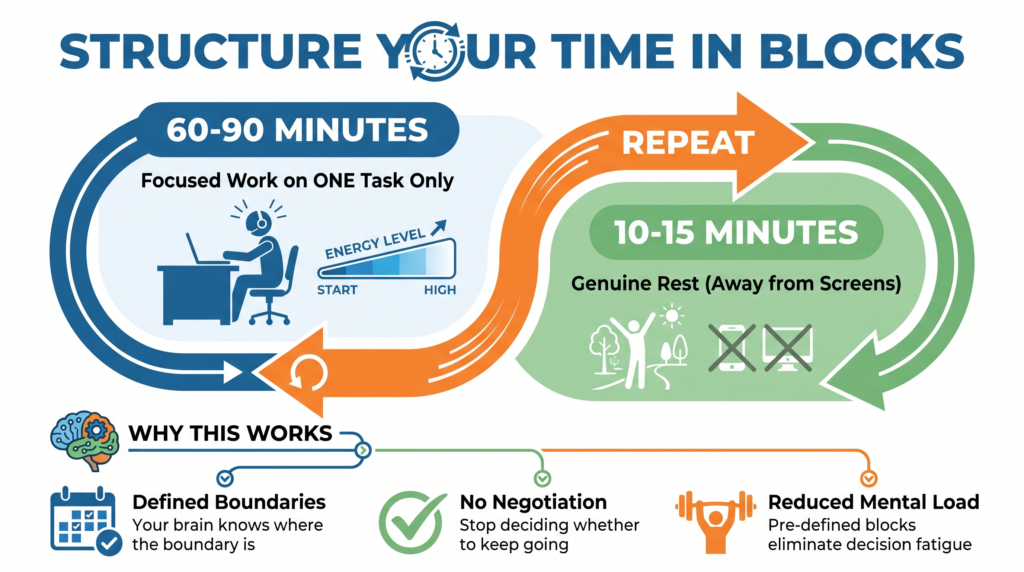
Working in unstructured stretches — “I’ll focus until I’m done” — tends to produce diminishing returns faster than most people expect. Anyone seriously asking how do you get 100% concentration and focus will eventually land on this: structure matters more than motivation. A more reliable approach:
- 60–90 minutes of focused work on one task only
- 10–15 minutes of genuine rest (away from screens, not just switching to social media)
- Repeat
The reason this works is that your brain knows where the boundary is. You’re not constantly negotiating with yourself about whether to keep going. The block is defined in advance, which reduces the mental overhead of deciding when to stop.
Cut Multitasking Entirely During Deep Work
Your brain doesn’t actually run two cognitive tasks in parallel — it switches rapidly between them, paying a small cost each time. For simple tasks, the cost barely matters. For complex work, it’s the difference between making real progress and spinning your wheels.
During focused work sessions: one task, notifications off, phone out of reach. That’s it. It feels uncomfortable at first because modern work habits wire you to expect constant input. Give it a few sessions before judging whether it works.
Use Audio to Stabilize Your Environment
If you work in an open office, a café, or a shared apartment, you probably can’t control your sound environment directly. What you can do is cover unpredictable noise with something stable.
Endel generates adaptive soundscapes that shift based on time of day and activity. Unlike a static playlist that becomes mentally stale, it stays fresh without becoming distracting — useful for long writing or research sessions.
For simpler needs, brown noise or rain sounds work well and are freely available. The key is consistency: using the same audio regularly helps your brain associate it with focused work over time.
Protect Your Energy
No focus method works well when your underlying energy is depleted. Sleep deprivation has measurable effects on working memory and attention — even one bad night. Chronic stress, too little movement, and excessive screen time without breaks all chip away at the same cognitive resources you need for deep work.
If concentration is consistently difficult, it’s worth checking those basics before adding another productivity tool to the stack.
Examples and Case Studies
Software Developers
Deep programming work — debugging, architecture decisions, working through unfamiliar codebases — requires holding a lot of context in mind at once. Interruptions don’t just break the flow; they wipe the mental state you’d built up.
Many developers use noise-isolating headphones as a signal to colleagues and a barrier to ambient noise simultaneously. Pairing that with structured work blocks and functional audio has become a common setup for sustained coding sessions.
PhD and Masters Students
Research and academic writing involve a particular kind of cognitive endurance — long reading sessions, slow-building arguments, sustained attention to detail over hours. Standard music playlists often become a distraction in their own right as your brain starts tracking the songs.
Many graduate students find that ambient or brown noise keeps them in a reading or writing state longer than music does, simply because it’s less interesting to their brains.
Freelance Writers and Creators
Creative work needs enough stimulation to stay engaged without tipping into distraction. That balance is different for everyone, but most writers find that audio without lyrics — especially something slightly melodic but not demanding — hits the right level.
The ritual aspect also matters here. Starting the same audio before each session is a reliable way to signal to your brain that concentrated work is about to begin.
Adults with ADHD
For people with ADHD, concentration works differently. A very quiet, unstimulating environment can actually make focus harder because the brain becomes under-stimulated and starts seeking novelty elsewhere.
Structured stimulation — audio with some rhythm or variation, a busier-than-average workspace, movement breaks built into work sessions — often works better than the conventional advice to eliminate all distractions.
If you want to know more, we have a special article about whether people with ADHD focus better with music.
Expert Insights
Cal Newport, who coined the term “deep work,” argues that the ability to concentrate without distraction is becoming increasingly rare and increasingly valuable at the same time. His core point is that most knowledge workers have unknowingly trained themselves out of deep focus through years of fragmented attention — and that retraining is possible but takes deliberate effort.
What research on attention and cognitive load consistently shows is that environment shapes behavior more reliably than willpower does. People who focus well typically don’t fight harder to concentrate — they’ve set up conditions where concentration is the path of least resistance.
The conditioning effect is also worth taking seriously. When you repeatedly start focused work in the same environment, with the same audio, at the same time, your brain gradually enters focus mode more quickly. The environment becomes a trigger. That’s not productivity mysticism — it’s straightforward associative learning.
Additional Resources
Brain.fm — Functional audio engineered for concentration. Particularly effective for extended sessions and popular with developers and ADHD users. Want to know more? Read our Brain.fm review article.
Endel — Adaptive soundscapes that shift based on your activity and time of day. Good for long research or writing sessions where a static playlist would become stale.
Cal Newport’s Deep Work — The most thorough argument for why distraction-free concentration matters and how to build it as a practice. Worth reading if you want the full framework rather than just tactics.
Noise-isolating headphones — In shared or open environments, good over-ear headphones are often the single most effective environmental change you can make. They block unpredictable sounds and signal to others that you’re not available. Read our blog about do noise cancelling headphones work?
Conclusion
So, how do you get 100% concentration and focus? Mostly by getting out of your own way.
The people who concentrate well aren’t fighting harder than everyone else. They’ve reduced the number of things competing for their attention, built routines their brains recognize as signals to focus, and accepted that the first ten minutes of any deep work session are often a bit rough before the mind settles in.
Small, consistent changes — a stable sound environment, proper work blocks, notifications genuinely switched off — tend to produce more reliable results than complicated systems. And for many people, sorting out the audio environment alone is enough to noticeably extend how long and how deeply they can concentrate.
Start there. See what changes.
Frequently Asked Questions
Can anyone learn to concentrate better?
People ask this in a lot of different ways — how do you get 100% concentration and focus, how do I stop getting distracted, why can’t I stay on task? The answer in most cases is yes — though the starting point and the path look different for everyone. Factors like ADHD, chronic sleep problems, or high baseline stress make it harder. But even then, the approach is the same: adjust conditions rather than try harder. It’s rarely all-or-nothing.
Does focus music actually work?
For many people, yes. The key is what kind. Music with lyrics tends to disrupt any work involving language — your brain is trying to process both streams at once. Instrumental music, ambient sound, or purpose-built functional audio (like Brain.fm) tends to be more effective because it creates a stable sound environment without demanding attention. Whether it helps you specifically is something you’ll find out quickly — the effect, when it’s there, is usually noticeable within a session or two.
How long can the average person stay focused?
It depends heavily on the task, your current energy level, how much you’ve been interrupted, and how consistently you’ve been practicing focused work. Under good conditions, most people can sustain genuine deep concentration for 60–90 minutes before quality begins to decline. That recovers with a real break — not scrolling, but actually stepping away.
What’s the difference between regular concentration and deep work?
Regular concentration is the everyday attention you bring to a task. Deep work — Cal Newport’s term — is the state of being fully immersed in a cognitively demanding task at the maximum level of your ability, without distraction. It’s the state where genuinely difficult problems get solved, and complex writing comes together. Most people reach it less often than they’d like, largely because modern work environments make it structurally difficult.
Does a dedicated workspace actually help?
For most people, yes. Your brain builds associations between places and states. If you consistently do focused work in one spot, that spot starts to function as a trigger — sitting down there nudges your brain toward work mode. Working in the same place you relax (a couch, your bed) blurs that association and makes it harder to switch into deep concentration.
Is it worth paying for a focus audio app?
It depends on how much distraction is costing you. If you’re losing an hour or two of productive work every day to noise and broken concentration, a subscription to something like Brain.fm or Endel is trivial in comparison. Both offer free trials, so there’s no real risk in testing whether it makes a difference for you before committing.
Some of the links on Best Focus Music are affiliate links. This means that if you click a link and buy something, we may earn a small commission — at no extra cost to you. We only recommend products we genuinely think are worth your time.
We are a participant in the Amazon Associates Program, an affiliate advertising program designed to provide a means for sites to earn advertising fees by linking to Amazon.com and affiliated sites. We may also work with other affiliate networks and individual brands from time to time.