This article is purely informational and does not constitute medical advice. If you’re experiencing tinnitus, please consult a doctor
Quick Answer
Can noise cancellation help with tinnitus? For a lot of people — yes, it can help. But probably not in the way you’re imagining.
Noise-cancelling headphones won’t make tinnitus go away. They can’t. What they can do is reduce the amount of environmental noise competing for your attention, which sometimes takes the edge off in loud, exhausting environments. The catch? For some people, all that quiet actually makes the ringing worse, because there’s nothing else to listen to. The sweet spot most people find is using noise cancellation together with some low-level background sound. Like soft rain, brown noise, or ambient music playing. That combination tends to work a lot better than pure silence.
Understanding the Question
Tinnitus is incredibly common. Estimates suggest somewhere around 15–20% of the global population experiences it to some degree, though the severity varies enormously. Some people notice it only when they’re going to sleep in a very quiet room. Others deal with it throughout the day, every day, regardless of what’s happening around them.
The sounds people describe are all over the place: ringing, buzzing, hissing, humming, clicking, and even what some call a high-pitched tone that never stops. It’s one of those conditions that’s difficult to explain to people who don’t have it, because there’s no external source you can point to.
As noise-canceling headphones have become more mainstream — and honestly, pretty impressive in terms of quality — it’s natural that tinnitus sufferers started wondering whether they might help. And the question makes sense. If outside noise makes it worse, blocking it should help, right?
It’s a bit more complicated than that.
What Tinnitus Actually Is (and Isn’t)
One thing worth understanding before going further: tinnitus isn’t a disease in itself. It’s a symptom — usually of something else going on in the auditory system. The most common causes include noise-induced hearing loss, age-related hearing changes, ear infections, earwax buildup, and sometimes stress or certain medications.
In many cases, the brain loses some of the sound signals it normally receives — often due to hearing loss — and essentially starts “filling in the gaps” with phantom sounds. It’s a bit like how your eyes can create visual patterns in the dark when there’s nothing actually there to see.
This is why tinnitus doesn’t go away when you put on headphones. The sound isn’t coming in through your ears from outside — it’s being generated internally, somewhere in the auditory pathway or brain. Blocking external noise can’t touch that.
How Active Noise Cancellation Actually Works
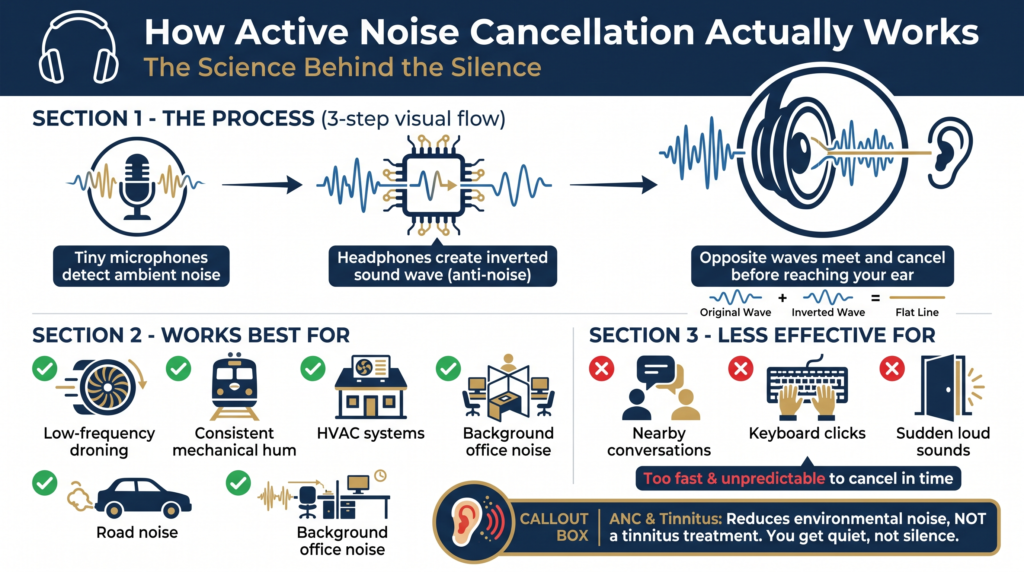
Active Noise Cancellation (ANC) uses tiny microphones built into the headphones to pick up ambient sounds around you. The headphones then produce an inverted sound wave — basically the exact opposite — that cancels out the incoming noise before it reaches your ears.
It’s clever technology, and it works really well for certain types of sound:
Consistent background hum in offices or open-plan environments
Road noise in cars
It’s less effective for sudden or unpredictable sounds — voices nearby, keyboard clicks, a door slamming. Those kinds of sounds are too fast and variable for the ANC system to cancel in time.
So when people ask whether noise cancellation can help with tinnitus, it’s worth knowing that what you’re really getting is relief from low-frequency environmental noise — not silence, and definitely not any kind of treatment for the tinnitus itself.
Where Noise-Cancelling Headphones Actually Help
Even if ANC doesn’t treat tinnitus, that doesn’t mean it’s useless. Far from it — for a lot of people, the indirect benefits are genuinely significant.
Open-plan offices are probably the biggest ones. If you’re sitting in a busy workspace with constant background chatter, phone calls, and general office noise, your brain is working overtime just to function. That listening effort is exhausting — especially when you’re also dealing with tinnitus on top of it. Reducing that ambient noise load can make a real difference to how fatigued you feel by the end of the day.
Long-haul flights are another area where ANC tends to perform well. Airplane cabin noise sits right in that low-frequency range that the technology handles best. For anyone managing tinnitus on top of regular travel, reducing that constant drone can make the experience feel less draining — even if the tinnitus itself doesn’t change.
Working from home in a shared space is a newer one, but it is relevant for a lot of people. If you’re trying to concentrate while a partner is on calls or kids are doing their thing nearby, noise cancellation can help create a more controlled listening environment, which is easier on a brain that’s already managing tinnitus.
The common thread here is that ANC reduces listening effort. And when you’re spending less mental energy processing unwanted background noise, there’s more left over for everything else — focus, calm, patience.
Why Complete Silence Can Make Things Worse
This is the part that surprises many people, and it’s worth spending a moment on.
When you put on noise-cancelling headphones and turn the ANC on full without playing anything, you’re creating a very quiet environment. For people without tinnitus, that’s pleasant. For people with tinnitus, it can go the other way — because with fewer external sounds competing for attention, the internal ringing or buzzing can suddenly seem much louder and more intrusive.
It’s a bit like trying not to think about something: the less there is to distract you, the more prominent the thing you’re trying to ignore becomes.
This is one of the core principles of sound enrichment, a strategy commonly recommended by audiologists. The idea is to keep a gentle level of background sound in your environment — not to drown out the tinnitus, but to give your brain something else to process. When the auditory system is occupied with a soft, neutral sound, tinnitus tends to recede into the background more.
What to Play Through Your Headphones
If you’re using noise-cancelling headphones and want to make tinnitus more manageable, the audio you play underneath matters.
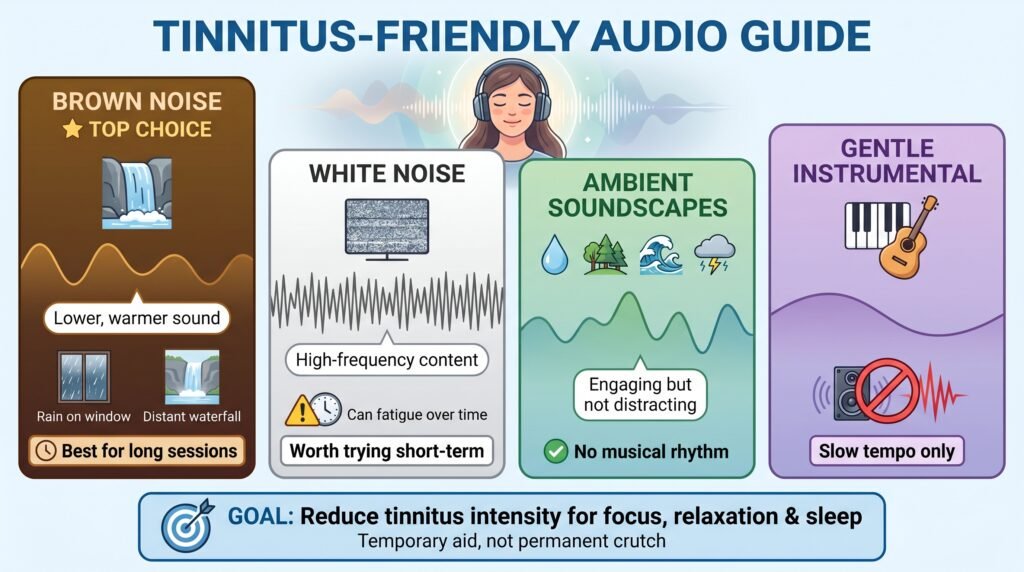
Brown noise is a popular choice. It’s a lower, warmer sound than white noise — less harsh and generally easier to tolerate during long work or study sessions. It’s often described as similar to standing near a waterfall or being inside during heavy rain.
White noise works well for some people, though the high-frequency content can feel fatiguing over time. Worth trying, but not necessarily the best long-term option.
Ambient soundscapes — rain, forest sounds, ocean waves, distant thunder — give the brain something slightly more interesting to latch onto without being distracting. For focused work, something continuous without an obvious musical rhythm tends to work better than something with a melody.
Gentle instrumental music can work if the tempo is slow and there aren’t too many dynamic changes. Anything with sudden loud sections or dramatic drops is probably not ideal.
The goal isn’t to use sound as a crutch indefinitely — it’s to reduce the perceived intensity of tinnitus enough that you can focus, relax, or sleep.
Things You Should Know
ANC helps with external noise, not internal noise. The technology works on sound coming from your environment. Tinnitus originates within the auditory system, so noise cancellation can’t reach it.
The relationship between quiet and tinnitus isn’t simple. More noise reduction doesn’t always mean less tinnitus awareness — sometimes the opposite is true.
Background sound often helps more than silence. This is well-established enough to be used in formal tinnitus therapy approaches, not just as anecdotal advice.
How you use your headphones matters. Volume levels, listening duration, and the type of audio you play all affect how your ears and auditory system respond over time.
Comfort counts for a lot. If you’re wearing headphones for four or five hours a day, physical comfort matters just as much as audio quality. Ear fatigue from tight-fitting headphones is a real issue, especially if you already have heightened sensitivity.
Real Situations Where This Plays Out
These aren’t specific individuals, but they’re realistic scenarios that reflect how noise-cancelling headphones tend to play out for people dealing with tinnitus day-to-day.
Working in an open-plan office: Imagine a developer whose noisy office makes it hard to get into deep work. Using ANC headphones with brown noise playing quietly underneath wouldn’t make the tinnitus disappear — but it could reduce the overall mental load of the environment enough to make sustained focus possible again.
Frequent flying: For someone who travels regularly and deals with tinnitus, long-haul flights can be genuinely exhausting. Cabin noise on top of tinnitus is a lot to manage. Noise-cancelling headphones could realistically make that experience less draining — not a cure, but a meaningful improvement in comfort.
Studying in shared housing: A student living with several housemates who struggles to concentrate during revision could find that combining ANC with soft ambient sound creates a consistent enough environment to make long study sessions more manageable.
None of these scenarios involves tinnitus being cured. But day-to-day functioning is improving — which, in practical terms, is often what matters most.
What Hearing Professionals Generally Recommend
The consensus among audiologists is fairly consistent: sound enrichment over silence. Most tinnitus therapy approaches — whether that’s Tinnitus Retraining Therapy, sound therapy, or broader management strategies — involve maintaining some level of background noise in the environment rather than seeking complete quiet.
Noise-cancelling headphones fit into this naturally, as long as you’re using them with sound rather than for silence. They’re a tool for managing your acoustic environment, not a replacement for proper audiological assessment.
If your tinnitus is significantly affecting your quality of life, it’s worth speaking to a specialist. There are proper therapeutic approaches that go well beyond what headphones can offer.
Additional Resources Worth Exploring
If you’re trying to find the right combination for focus and tinnitus management, a few things are genuinely worth experimenting with:
Brown noise generators — several free web-based tools let you generate brown or white noise without needing to play music. Good for long, focused sessions.
Ambient soundscapes — YouTube and various apps have hours-long recordings of rain, forest sounds, and similar. Worth trying a few to see what your brain finds calming.
Tinnitus support resources — organizations like the British Tinnitus Association (UK) and the American Tinnitus Association (US) have solid, evidence-based information that goes deeper than what any article can cover.
Audiologist consultation — if you haven’t had a proper hearing assessment alongside your tinnitus evaluation, it’s genuinely worth doing. In some cases, there are underlying causes that can be addressed, and that’s something only a professional can determine.
Conclusion
So, can noise cancellation help with tinnitus? Noise-cancelling headphones aren’t a fix for tinnitus, and it’s worth being upfront about that. But making noisy environments easier to deal with, taking some of the mental load off, and helping you actually concentrate are real benefits, even if they’re not the ones you were hoping for.
But they don’t treat tinnitus, and they won’t make it go away. In some situations — particularly when used without any background audio — they can even make it feel more prominent by removing the environmental sounds that were partially masking it.
The approach that tends to work best is to use ANC headphones as part of a complete plan: pairing them with gentle background sound, paying attention to the volumes, and making sure you’re being assessed by someone who properly understands tinnitus.
There’s no single solution that works for everyone, because tinnitus itself varies so much from person to person. But for a lot of people, thoughtful use of noise-cancelling headphones is a genuinely useful tool in managing it day-to-day.
Can noise cancellation help with tinnitus? It can help reduce environmental noise and the listening fatigue that often accompanies it. But it doesn’t treat or eliminate the tinnitus itself — that comes from inside the auditory system, beyond the reach of any headphone technology.
Can noise-cancelling headphones make tinnitus worse? For some people, yes — particularly if they’re used without any background audio. When external sounds are removed entirely, tinnitus can become more noticeable because there’s less else to pay attention to. Using quiet background sound alongside ANC usually works better than pure silence.
Is it safe to use noise-cancelling headphones if you have tinnitus? For most people, yes — just keep the volume sensible and don’t wear them for hours on end without a break. If something doesn’t feel right, get it checked by an audiologist rather than guessing.
What sounds are best for managing tinnitus? Brown noise and white noise are common choices. Many people also find relief with rain sounds, ocean waves, or other natural ambient soundscapes. You want to find something your brain finds neutral enough to process, without it becoming a distraction.
Do you need to spend a lot on noise-cancelling headphones to get the benefit? Not necessarily. While premium models from established brands often have better noise cancellation and comfort, the most important factors are how well they fit, how comfortable they are over long periods, and whether the ANC is effective enough for your typical environment.
This article is for informational purposes only and does not constitute medical advice. If you are experiencing tinnitus, please consult a qualified audiologist or healthcare professional.
Some of the links on Best Focus Music are affiliate links. This means that if you click a link and buy something, we may earn a small commission — at no extra cost to you. We only recommend products we genuinely think are worth your time.
We are a participant in the Amazon Associates Program, an affiliate advertising program designed to provide a means for sites to earn advertising fees by linking to Amazon.com and affiliated sites. We may also work with other affiliate networks and individual brands from time to time.