
Introduction
Sony has been making audio equipment for decades, and at this point, their noise-cancelling headphones are some of the most recognized in the world. You’ll find them on developers, remote workers, students, and frequent flyers — people who need to concentrate for long stretches and can’t always control what’s happening around them.
On Best Focus Music, we mostly talk about sound: what to listen to, why certain audio helps your brain stay on task, and how to build a focus environment that actually works. But there’s a piece of that puzzle we can’t ignore — the headphones themselves. Focus music works better when your environment isn’t fighting it. That’s why we put together this Sony guide: not to sell you something, but to give you a clear picture of what Sony offers and where it fits into a serious focus setup.
Why Sony Specifically
There are plenty of headphone brands out there. Sony keeps coming up in focus and productivity conversations for a few reasons.
Their noise cancelling is consistently strong across multiple price points, not just at the top of the range. And their headphones tend to be comfortable over long sessions, which matters a lot when you’re wearing them for six or eight hours a day. For focus audio to do its job, the headphones beneath it need to disappear. In this Sony guide, we tell you how this can help you to improve your focus.
Product Categories Overview
The WH-1000XM Series
This is Sony’s flagship over-ear line, and it’s the one most people are referring to when they say “Sony headphones.” The noise cancelling is excellent — particularly on low-frequency ambient sound like office HVAC, airplane engines, and street traffic.
The ear cups are spacious, and the clamping force is light enough that most people can wear them for a full workday without discomfort. Battery life on recent models sits around 30 hours with ANC on, which covers most use cases without anxiety.
These are best suited for people who work in genuinely noisy environments every day — open offices, busy home setups, frequent travel. If that’s your situation, they hold up.
If you’re considering the WH-1000XM5 but aren’t sure how it compares to competing models from Bose and Apple take a look at our Sony WH-1000XM5 vs Alternatives comparison before making a decision.
The ULT Wear
The ULT Wear sits below the flagship in price but holds its own on the features that matter most for focus work. ANC performance is solid, battery life is comparable, and the sound profile is well-balanced for ambient and instrumental audio.
For people who don’t want to spend flagship money but still need reliable noise cancelling for daily work or study sessions, this is the model that comes up most often as a sensible middle ground. It’s not a budget headphone — it’s a mid-range one that doesn’t feel like a compromise.
Earbuds (WF-1000X Series)
Sony’s in-ear options are genuinely good, especially for commuting or lighter work sessions. They’re compact and wireless, and the ANC does a reasonable job given the form factor.
That said, earbuds have a ceiling on long-session comfort. After a few hours, most people find over-ear headphones noticeably more forgiving. For deep work blocks of two hours or more, the full-sized headphones tend to win.
Speakers and Home Audio
Sony also makes portable speakers and home audio systems. These are less relevant for individual focus work, but they’re worth knowing about for people who prefer not to wear headphones — or who work alone in a private space and want ambient sound filling the room instead.
Brown noise or a slow ambient playlist through a good speaker can work well in a quiet home office. It’s a different experience from headphones, but for some people, it’s more sustainable.
How to Choose the Right Model
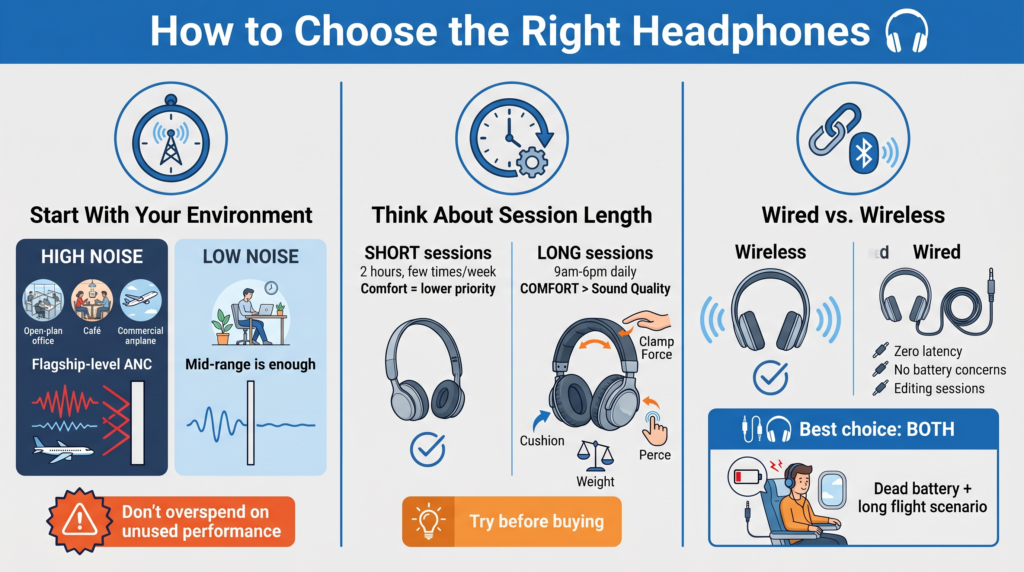
Start With Your Environment
The noisier your typical workspace, the more you’ll benefit from strong ANC. If you’re in an open-plan office, a busy café, or you travel regularly, flagship-level noise cancelling makes a real difference. If you work from a quiet home office and mainly want to take the edge off occasional distractions, mid-range is probably enough.
Don’t buy better headphones than your environment actually requires. It’s a common mistake that leads to spending money on performance you won’t notice.
Think About Session Length
If you wear headphones for two hours a few times a week, comfort is less of a priority. If they’re on your head from 9am to 6pm every workday, it becomes one of the most important specs on the page — more than sound quality, more than features.
Sony’s over-ear models generally perform well here, but there’s still variation. Heavier clamp force and smaller ear cups become problems faster than people expect. If possible, try before committing.
Wired vs. Wireless
Wireless is the practical default for most people today. But wired listening still has a place — especially for longer editing sessions, when battery management is annoying, or for anyone who prefers zero-latency audio.
Most Sony premium headphones support both. That flexibility is useful more often than people anticipate, particularly during travel when a dead battery and a transatlantic flight overlap.
Setup and Getting Started
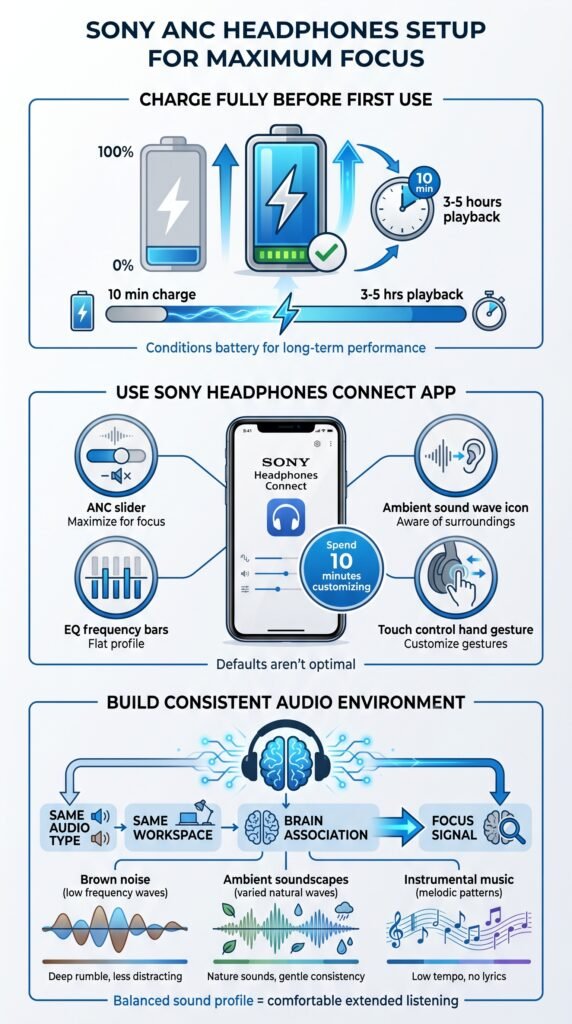
Charge Fully Before First Use
This is basic, but worth doing properly. Conditioning the battery from the start helps long-term performance. Most Sony ANC headphones support fast charging — even 10 minutes can give you a few hours of playback if you’re in a hurry.
Use the Sony Headphones Connect App
The companion app unlocks a meaningful amount of customization. You can adjust ANC intensity, set up ambient sound modes, tweak EQ, and configure touch controls to match how you actually use the headphones.
For focus work, most people end up maximizing ANC and leaving EQ relatively flat. But it’s worth spending 10 minutes in the app when you first set up — the defaults aren’t always optimal.
Build a Consistent Audio Environment
This is where Best Focus Music comes back in. Headphones reduce environmental noise; what you play through them shapes the rest of the experience. A consistent pairing — same headphones, same type of audio, same workspace — builds an association in your brain over time. Eventually, putting on the headphones becomes a signal to focus, not just a step toward it.
Brown noise, ambient soundscapes, and instrumental music all work well through Sony headphones. The balanced sound profile doesn’t overhype any particular frequency range, which matters for audio you’re listening to for hours rather than minutes.
Advanced Tips
Try ANC Without Any Audio
A lot of people discover this by accident — ANC alone, with nothing playing, can be surprisingly effective for reading or analytical work. The low-frequency noise disappears, leaving a quieter version of the room rather than silence.
It’s worth trying, especially in offices. Some people find it less fatiguing than music during tasks that require a lot of active thinking.
Fix Your ANC Settings Manually
Sony’s adaptive sound modes are smart, but they’re designed for movement — switching automatically when you go from sitting to walking. For a static desk setup, that behavior can occasionally feel disruptive. Setting ANC manually and leaving it there tends to work better for long focus sessions.
Build an Audio Ritual
The psychological side of focus setups is underrated. If you consistently start work by putting on headphones and starting a specific playlist or noise track, that sequence starts to function as a trigger. It becomes easier to shift into focused work because your brain has learned to associate those actions with concentration.
It sounds simple. It also actually works if you do it consistently.
Troubleshooting Common Issues
ANC Isn’t Blocking as Much as Expected
ANC works best on low-frequency, continuous sound. If voices or keyboard clicks are still coming through clearly, that’s normal — those frequencies are harder to cancel. A proper fit is also essential. If the ear cups don’t seal well against your head, performance drops significantly.
Ear Fatigue After Long Sessions
Usually, this comes down to volume. Most people listen louder than they realize, especially in noisy environments. ANC should mean you can turn the volume down — if you’re still cranking it, the noise cancelling isn’t doing its job or the fit isn’t right. Taking a break every 90 minutes also helps more than people expect.
Battery Draining Faster Than Advertised
ANC is the biggest battery draw. Advertised battery life is often measured with ANC off or at reduced intensity. In real daily use with ANC running constantly, expect something closer to 20–25 hours on most models rather than the headline number. Still plenty for a workday, but useful to know.
Bluetooth Drops or Interruptions
Firmware updates fix a surprising number of Bluetooth issues. Check the Sony app for pending updates before assuming the hardware is the problem. Interference from other wireless devices, particularly in dense office environments, can also cause instability — moving slightly or reducing the number of nearby devices usually helps.
Conclusion
Sony makes some of the most capable headphones available for people who need to concentrate in noisy environments. The noise cancelling is strong, the comfort holds up over long sessions, and the sound profile works well with the kind of audio — ambient, instrumental, structured noise — that helps people focus.
On Best Focus Music, we think about the full picture: not just what you listen to, but how you listen to it and where. That’s why we wrote this Sony guide in the first place. The headphones are part of that picture. A good pair doesn’t replace good audio habits, but it creates the conditions where those habits actually pay off.
This Sony guide is a starting point. The right model depends on your environment, session length, and what you’re trying to accomplish. But if you’re serious about focus work and you’re still listening to mediocre headphones in a noisy environment — that’s one of the easier problems to solve.
Frequently Asked Questions
Are Sony headphones good for focus work specifically? Yes, particularly the over-ear ANC models. They reduce environmental distractions, pair well with focus audio, and hold up comfortably over long sessions — exactly what focus work requires.
Which Sony headphone is best for daily office use? The WH-1000XM series is the most capable for all-day office use. The ULT Wear is a strong alternative if the flagship price is a barrier. Read back a bit in this Sony guide for more information.
If you’re deciding between Sony and other popular brands, see our Sony WH-1000XM5 vs Alternatives comparison for a detailed breakdown of the main differences.
Can I use Sony headphones without music for focus? Absolutely. An ANC without audio playing is a legitimate and effective setup for tasks that require active thinking. Many people prefer it over music during analytical or writing-heavy work.
Do Sony earbuds work for long study sessions? For sessions under two hours, yes. For longer blocks, most people find over-ear headphones significantly more comfortable. Ear fatigue from in-ear tips adds up faster than people expect.
Is the Sony app necessary? Not strictly necessary, but worth using. It unlocks customization options — especially ANC intensity and EQ — that can meaningfully improve the experience for focus work specifically.
Some of the links on Best Focus Music are affiliate links. This means that if you click a link and buy something, we may earn a small commission — at no extra cost to you. We only recommend products we genuinely think are worth your time.
We are a participant in the Amazon Associates Program, an affiliate advertising program designed to provide a means for sites to earn advertising fees by linking to Amazon.com and affiliated sites. We may also work with other affiliate networks and individual brands from time to time.