
Music is everywhere. We listen while working, cooking, commuting, or exercising. It’s the constant soundtrack to everything we do.
And yet most of us barely hear it. In this blog, you learn how to fully focus on music.
Quick Answer
Remove distractions, use good headphones, and make music the main thing you’re doing, not just something playing in the background while you do other things.
That’s really all there is to it. The rest of this article is about making that easier in practice.
Why Most People Never Really Listen
When was the last time you listened to a song and did nothing else?
No phone. No scrolling. No half-watching something on a second screen. Just you and the music.
For most people, that’s a genuinely hard question to answer. We’ve gotten so used to music as background noise that we’ve forgotten it can be a foreground experience — something you actually engage with rather than something that fills the silence while you engage with everything else.
The cost of that habit is real. We miss most of what’s actually in the music. The guitar part is buried deep in the mix. The way the vocalist trails off on a specific word. The moment when everything drops out for one beat, then crashes back in. Those things are there. We just stop noticing them somewhere along the way.
What Active Listening Actually Means
If you want to know how to fully focus on music, it really comes down to one shift: making the music the main event instead of the supporting act.
This is what people mean when they talk about active listening. It’s less about effort and more about direction. You’re not trying harder — you’re just pointing your attention somewhere specific instead of letting it float wherever it wants to go.
Passive listening is what most of us do by default. The music plays; we’re vaguely aware of it, and it gradually fades into the background. Active listening flips that. You’re following something — a melody, a rhythm, a lyric — and when your mind drifts (which it will), you notice and come back.
The hard part is that we’re out of practice.
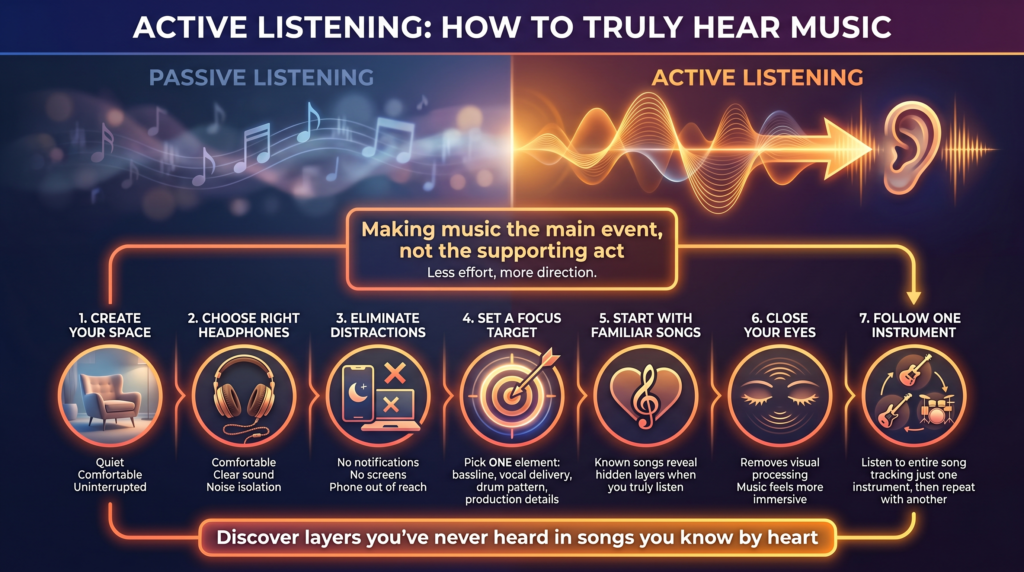
Step 1: Set Up an Environment That Isn’t Fighting You
Your surroundings do a lot of the work before you even press play. A noisy, busy room splits your attention before the first note arrives.
This doesn’t mean you need a special setup. It just means picking a space where you’re unlikely to be interrupted — a quiet room, a comfortable chair, somewhere you can actually settle. A lot of people underestimate how much physical comfort matters here. If something is nagging at you physically, part of your brain is always tracking it. Get comfortable first.
Step 2: Use Headphones That Don’t Get in the Way
You don’t need to spend a fortune on audio equipment. But you do need something comfortable enough to forget you’re wearing it and clear enough to actually hear what’s in the recording.
Earbuds that start hurting after twenty minutes are going to pull you out of the experience every twenty minutes — guaranteed. Muddy-sounding headphones hide details in the music, and those details are often exactly what you’re trying to find. Noise isolation helps too. If you can still hear the street outside or your housemate’s TV, your brain is still processing all of that in the background. If you wanna see different options, read our guide about Sony headphones for focus and deep work.
Step 3: Put the Phone Somewhere Inconvenient
This one is obvious and consistently ignored, including by people who know better.
Every notification is a small interruption. Even when you don’t act on it, your brain clocks it and spends a moment deciding whether it matters. Put your phone on Do Not Disturb and leave it somewhere you’d have to physically get up to reach. The extra friction makes a bigger difference than you’d expect.
Close any other tabs or screens, too. Visual information competes with audio more than most people realize. A blank wall is a better backdrop for active listening than an open laptop.
Step 4: Give Your Listening a Direction
Passive listening has no destination. Active listening has a set of steps it follows.
Before you press play, pick one thing to focus on. The bassline. The way a particular vocal phrase is delivered. The drum pattern in the verses versus the chorus. How the production opens up or closes down at different moments. Having a target gives your attention somewhere to land — and it gives you something to come back to when your mind wanders off, which it will.
“Focus on the music” is too vague to be useful. “Follow the bass guitar for this whole song” is something your brain can actually do.
Step 5: Start With Music You Already Know
This seems backward — shouldn’t unfamiliar music be more engaging? — but familiar songs are often the better starting point.
When you already know how a track goes, you’re not spending mental energy orienting yourself to the structure. That frees you up to notice everything underneath it. Background harmonies you never consciously registered. A percussion detail that’s been sitting there the whole time. A chord change that lands differently when you’re actually paying attention to it.
Songs you’ve heard a hundred times can feel genuinely new when you listen to them properly. That’s not an exaggeration — it’s something that happens, and it’s one of the better surprises active listening has to offer.
While familiar music works well for many people, others prefer dedicated focus music apps that remove many of the distractions found in traditional playlists.
Step 6: Try Closing Your Eyes
Your eyes are open, and your brain is processing whatever is in front of them — constantly, automatically, without asking permission.
Closing your eyes removes all of that at once. Most people find that music immediately feels more present when they do this. More detailed. More immersive. It’s one of those tricks that sounds too simple to work and then works immediately.
It’s especially useful with instrumental music — classical, jazz, ambient — where there’s no lyrical content to anchor your attention. Without something to read or look at, your ears take over.
Step 7: Follow One Instrument at a Time
This is probably the most effective active listening exercise, and it costs nothing.
Pick one instrument and follow it for the entire song. Just the guitar. Just the bass. Just the hi-hat. Then play the song again and follow something different. What you’ll notice — quickly — is that songs you thought you knew completely have entire layers you’ve never consciously heard before.
It changes how you experience music. Tracks you’ve heard dozens of times start feeling genuinely new again.
Genres That Reward This Kind of Attention
Any music works for active listening, but some styles are particularly rewarding.
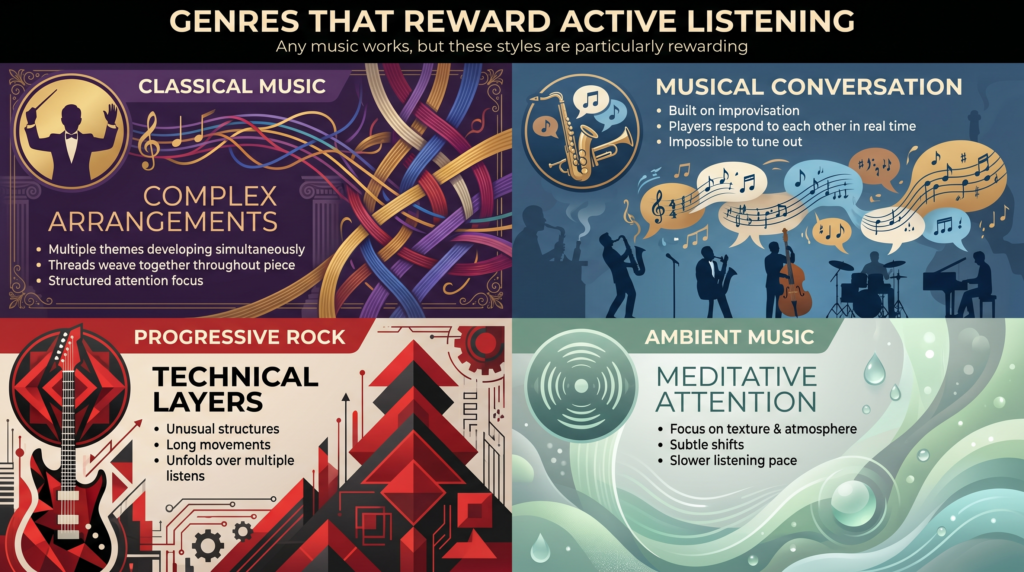
Classical music features complex arrangements with multiple themes developing simultaneously. Following how those threads weave together over the course of a piece gives your attention real structure to work with.
Jazz is built on improvisation and musical conversation. Once you start hearing how players respond to each other in real time, it becomes almost impossible to tune out.
Progressive rock tends to feature unusual structures, long movements, and technical layers that unfold slowly over multiple listens.
Ambient music rewards a slower, more meditative kind of attention. You’re not tracking melody or rhythm so much as texture and atmosphere — subtle shifts that you’d completely miss if you weren’t listening for them.
Mistakes That Kill Focus Before You Start
Trying to do anything else at the same time. Even light multitasking, like one quick email or a glance at your phone. Fractures attention in a way that’s hard to recover from mid-song. Active listening and multitasking don’t work together.
Going too long without a break. Focused listening takes mental energy. After about 45 minutes, your attention naturally starts to slip. Short breaks beat pushing through every time. We have created a special timer for our readers. If you have a hard time keeping track of time, we recommend using our timer.
Starting with something too unfamiliar. If you’re new to a genre or tackling a complex piece, your brain spends most of its energy just orienting itself. Build up to the challenging stuff.
Expecting to catch everything on the first listen. Good recordings reveal things over time. Noticing something on your fifth listen that you completely missed the first four times isn’t a failure — it’s actually the point.
How Long Should a Session Be?
Shorter and genuinely focused always beats longer and half-distracted.
Twenty minutes of real active listening will do more for your understanding of a piece than two hours of having it on in the background. Start with one or two songs and build from there. Most people find their capacity for focused listening grows fairly quickly once they start doing it consistently — it’s a muscle that responds to use.
Does It Make Music Better?
For most people, noticeably so.
Songs you’ve always liked become songs you actually understand. Artists you respected become artists whose thinking you can hear. Genres you’d written off become more interesting once you know what to listen for.
None of this requires musical training or technical knowledge. It just requires paying attention. The music does the rest — it always has.
Conclusion
Knowing how to fully focus on music isn’t about developing some rare skill or buying better gear. It’s about showing up for the experience instead of treating it as background noise.
Remove the distractions. Get comfortable. Pick something to follow. And then actually listen.
If you’re curious about alternatives to traditional playlists, we’ve compared the best focus music apps to help you find the right option for your workflow.
Frequently Asked Questions
How can I focus on music without getting distracted? Pick a quiet environment, leave your phone out of reach, and give yourself one specific thing to listen for before you start.
Headphones or speakers — which is better? Both work. Headphones tend to create greater immersion and block out surrounding noise, making focused listening easier in most environments. Knowing which works the best for you will help you learn how to fully focus on music.
Does closing your eyes actually help? Yes, and more than you’d expect. Removing visual input lets your brain allocate more of its processing power to what you’re hearing. Just try it once.
Why does my mind keep wandering? Because that’s what minds do — there’s nothing wrong with you. Giving your attention something concrete to track, like one specific instrument, makes it much easier to notice when you’ve drifted and come back.
Will active listening make me enjoy music more? Almost certainly. Most people find that paying closer attention makes music richer and more interesting, not just technically, but emotionally too. It’s worth trying even with music you already love.
Some of the links on Best Focus Music are affiliate links. This means that if you click a link and buy something, we may earn a small commission — at no extra cost to you. We only recommend products we genuinely think are worth your time.
We are a participant in the Amazon Associates Program, an affiliate advertising program designed to provide a means for sites to earn advertising fees by linking to Amazon.com and affiliated sites. We may also work with other affiliate networks and individual brands from time to time.