
Quick Answer
For most people who regularly work, study, or travel in noisy places — yes, it’s worth it. But how much it’s worth depends entirely on how you use headphones and what’s bothering you in the first place.
If you spend hours a day trying to concentrate while the world around you does its thing, noise-cancelling changes the experience in a way that’s hard to describe until you’ve tried it. It’s less about audio quality and more about mental space.
Why We’re Talking About This on a Focus Music Site
On Best Focus Music, we spend a lot of time thinking about what actually helps people concentrate — and what gets in the way.
Focus music works. Brown noise works. Binaural beats work. But none of it works as well as it should if your environment is fighting you the whole time. A good ambient track can’t do much when your neighbor is drilling a wall or your open-plan office sounds like a train station.
That’s why noise-cancelling headphones matter to us. They’re not just an audio product. They’re the foundation that makes everything else — the playlists, the soundscapes, the focus sessions — actually land.
So, is a noise-cancelling headphone worth it? Let’s get into it properly.
How Noise Cancelling Actually Works
There are two mechanisms at play, and understanding both helps you figure out what you’re actually buying.
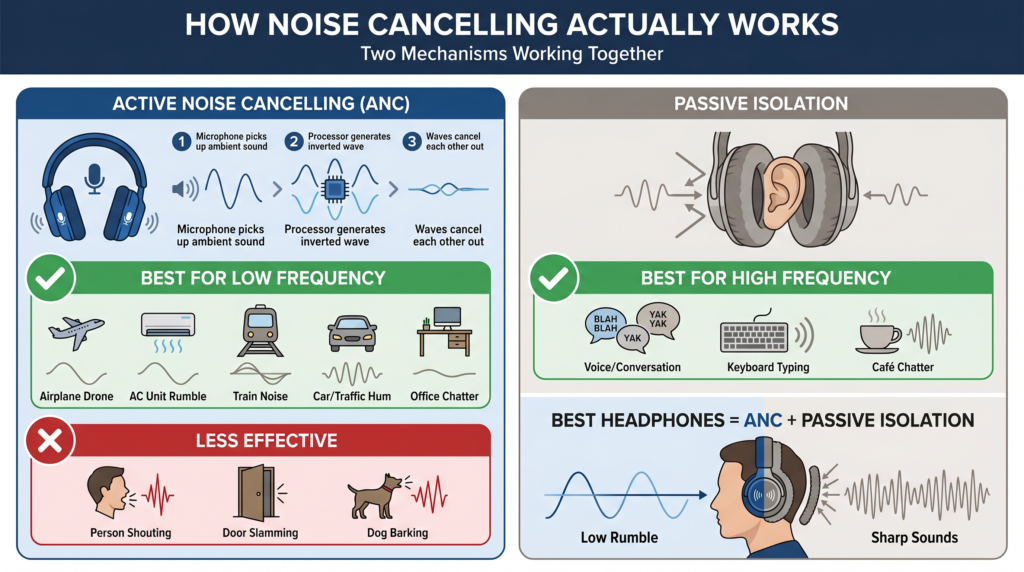
Active Noise Cancelling (ANC)
ANC uses tiny microphones on the outside of the headphones to pick up ambient sound. The headphones then generate an opposing sound wave that cancels out the original wave before it reaches your ears.
It works best on low-frequency, constant sounds:
- Airplane engine hum
- Air conditioning
- Train or bus noise
- Traffic rumble
- Office background buzz
It’s less effective on sudden, sharp sounds — someone shouting your name, a door slamming, a dog barking. Those still get through.
Passive Isolation
This is just physics — the ear cups physically block sound by sitting around your ears. Good padding and a solid seal make a real difference for higher-frequency noise like voices, keyboard clicks, and café chatter.
The best headphones combine both. ANC handles the low rumble; passive isolation handles the sharper stuff.
Why Background Noise Hits Harder Than You Think
Here’s something most people don’t realize: your brain never fully ignores background noise. Even when you think you’re tuned out, your auditory system is still monitoring it, scanning for anything relevant.
Every voice nearby, every notification sound, every random bang — your brain registers it. Most of the time, you don’t consciously react, but attention is still drawn. Over a full workday, that adds up to something that feels like exhaustion but is really just accumulated distraction.
This is especially obvious during deep work. A developer loses their thread mid-function. A writer reads the same sentence four times. A student looks up from their notes and realizes they haven’t actually absorbed anything in the last ten minutes.
Noise-cancelling headphones reduce those micro-interruptions before your brain has to deal with them. That’s the real value — not music quality, not bass response, not any spec on a product page. It’s cognitive load reduction.
Who Gets the Most Out of Them
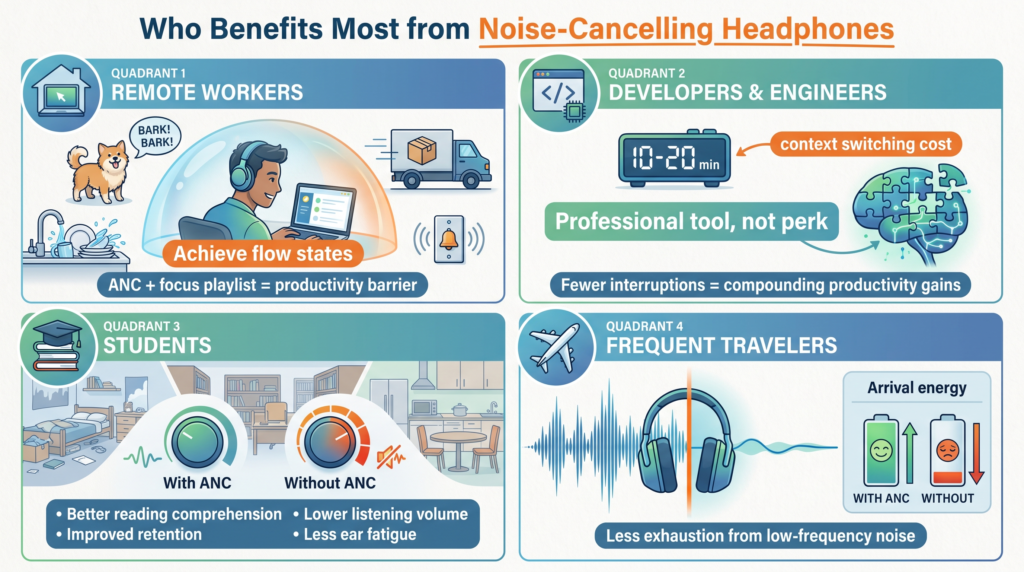
Remote Workers
Working from home sounds peaceful until you actually try to do it. Dogs, neighbors, deliveries, someone doing dishes at 11am — home environments are unpredictable in a way that offices at least try not to be.
ANC creates a kind of invisible wall between you and whatever’s happening around you. Combined with a consistent focus playlist or brown noise, many remote workers find they can reach flow states they couldn’t without it.
Developers and Engineers
If there’s one group that has fully adopted noise-cancelling headphones as a professional tool rather than a perk, it’s developers.
Context switching in deep coding is expensive. Rebuilding your mental model after an interruption can take 10–20 minutes. Anything that reduces the number of times that happens in a day compounds into real productivity gains.
Students
Dorms, shared flats, university libraries — none of these are quiet. And studying is exactly the kind of work that suffers most from interrupted attention: reading comprehension drops, retention suffers, and sessions run longer than they need to because concentration keeps breaking.
One underrated benefit for students: you can listen at a lower volume. Without ANC, a lot of people crank up their music to drown out the environment. That causes listening fatigue to set in faster and isn’t great in the long term. ANC handles the background noise first, so you don’t have to compensate with volume.
Frequent Travelers
Anyone who flies regularly knows the specific exhaustion of a long-haul flight — and a big part of that is the constant low-frequency engine noise that you barely notice, but your brain is registering the entire time.
ANC cuts that dramatically. A lot of people report arriving noticeably less tired after switching to noise-cancelling headphones on flights, even without sleeping better.
The Real Benefits (Without the Marketing Fluff)
Longer focus sessions. The main one. Less cognitive friction means you can stay in a task longer before needing to reset. Want to improve your focus even more? Check out our complete guide on how to get 100% concentration and focus.
Lower mental fatigue by the end of the day. Many ANC users notice this after a few weeks — they’re not as drained by the time they finish work. It’s subtle but consistent.
More effective focus audio. This matters specifically for the Best Focus Music audience. Soundscapes, ambient music, and binaural audio all work better in a quieter baseline environment. They’re not fighting background noise; they’re filling a clean space.
Listening at safer volumes. Healthier for your ears over time and reduces ear fatigue from listening to loud music for hours.
Routine anchoring. Putting on headphones and starting a focus playlist becomes a ritual. Over time, your brain starts associating that sequence with concentration — it’s easier to shift into work mode.
The Honest Downsides
Cost. Premium ANC headphones are expensive. Sony and Bose flagship models can run €300–€400. That’s a real barrier.
The good news: mid-range options have improved a lot. You don’t need the best model on the market for solid performance anymore. But genuinely cheap ANC headphones often disappoint in comfort, battery life, or actual noise cancellation — so there’s still a meaningful price floor.
Battery dependency. Wireless ANC headphones need charging. Most modern models last 25–40 hours, which is plenty for most use cases, but a dead headphone at the wrong moment is frustrating. Fast-charge features help here.
The pressure sensation. Some people notice a mild pressure feeling when ANC is active — like the slight feeling of altitude in a plane. Most people adapt to it quickly and stop noticing it. But if you’re sensitive, try before you buy.
Premium vs. Budget: Does It Actually Matter?
For casual or occasional use — commuting a few times a week, occasional study sessions — a mid-range model is probably fine.
For daily use over 6+ hours, the gap between premium and budget shows up in:
- Comfort — cheaper ear pads flatten out, the clamp gets uncomfortable, and the weight adds up
- ANC quality — cheaper models often let through more mid-frequency noise (voices, keyboards) where it matters most
- Microphone quality — if you’re on calls, cheaper headphones often sound noticeably worse to the other person
- Build durability — premium models are built to survive years of daily use; budget options often aren’t
If headphones are a daily tool for you, the premium price usually pays for itself in longevity and comfort alone. And if you’re still on the fence about whether a noise-cancelling headphone is worth it at all, daily use is exactly the scenario where the answer tips firmly to yes.
How Noise Cancelling Makes Focus Music Work Better
This is worth spelling out explicitly.
When we recommend ambient music, brown noise, or focus soundscapes on this site, those tools assume you have some level of acoustic control. They’re designed to occupy your auditory attention in a way that supports focus — not to fight your environment.
A café-level background noise floor makes focus audio significantly less effective. Your brain is still tracking the ambient conversation; the music becomes just another layer on top of the noise.
Noise-cancelling headphones change that equation. They create a quieter baseline, making the audio you choose to listen to more immersive and effective.
Expert Perspective
Researchers who study attention and deep work have documented something called “attention residue” — the lingering cognitive trace left by an interruption, even after you’ve returned to the original task. You’re back at your desk, but part of your brain is still processing what just pulled it away.
Noise-cancelling headphones reduce the frequency of those interruptions at the source, before attention residue has a chance to build up. That’s why people who use them consistently often describe the experience less as “better sound” and more as “I can actually think.”
Additional Resources
If you’re building a proper focus setup, headphones are one piece of it. Some things worth combining:
- Brown noise or pink noise — a steady, non-distracting audio layer that works well for sustained concentration
- Focus music platforms — purpose-built tools that go beyond generic playlists
- Pomodoro timer — structured work intervals that pair well with longer, uninterrupted sessions
- Website blockers — handles the digital version of distraction that ANC can’t touch
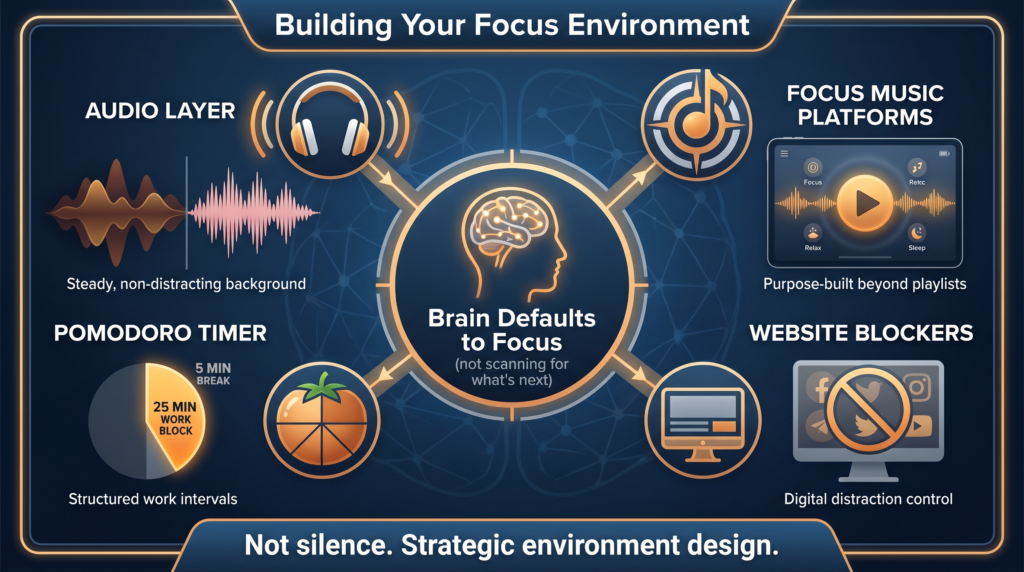
The goal isn’t silence for its own sake. It’s building an environment where your brain defaults to staying on task rather than scanning for what’s next.
Conclusion
So, is a noise-cancelling headphone worth it?
If you work, study, or travel in environments with consistent background noise — almost certainly yes. The value isn’t really about audio quality. It’s about reducing the cognitive friction that makes deep focus harder than it needs to be.
For anyone using focus music seriously, ANC headphones aren’t a luxury add-on. They’re what make the music actually work.
You don’t need the most expensive model. But if you’re spending hours a day trying to concentrate in a noisy world, a decent pair of noise-cancelling headphones is probably the highest-ROI upgrade you haven’t made yet.
Frequently Asked Questions
Do noise-cancelling headphones completely block all sound? No. They significantly reduce low-frequency, constant sounds, such as engine noise and air conditioning. Sudden sharp sounds — voices, slams, barks — still come through, though passive isolation softens those too.
Are noise-cancelling headphones good for ADHD? Many people with ADHD find them genuinely helpful. Reducing environmental unpredictability makes it easier to stay on one thing without the environment constantly pulling attention away.
Is ANC safe for everyday use? Yes. Modern ANC technology has no known health risks from normal daily use.
Do they help with studying specifically? Yes, especially for a reading-heavy study that requires sustained comprehension. Fewer interruptions, less re-reading, longer sessions before mental fatigue sets in.
Is the price jump to premium models worth it? For occasional use, probably not. For daily use over several hours — especially if comfort, call quality, and durability matter — premium models tend to pay for themselves over time.
Some of the links on Best Focus Music are affiliate links. This means that if you click a link and buy something, we may earn a small commission — at no extra cost to you. We only recommend products we genuinely think are worth your time.
We are a participant in the Amazon Associates Program, an affiliate advertising program designed to provide a means for sites to earn advertising fees by linking to Amazon.com and affiliated sites. We may also work with other affiliate networks and individual brands from time to time.