
If you’ve ever opened a neuroscience-based music app and found yourself stuck on the sleep vs relax question, you’re not alone. On the surface, they sound almost identical — both calm things down, both reduce mental noise. But they work differently, they target different brain states, and using the wrong one at the wrong time can leave you either too drowsy to function or too wired to wind down.
This article breaks down exactly what each mode does, when to use it, and which one actually fits your needs — whether you’re a developer decompressing after a brutal sprint, a PhD student trying to get to sleep before a 7am lab session, or someone with ADHD who just needs their nervous system to cooperate.
Overview
What Is Sleep Mode?
Sleep mode is built for one thing: helping your brain cross the threshold into sleep. The audio is slower, softer, and deliberately low-stimulation. There’s no rhythmic hook to latch onto, no melodic layer that keeps part of your brain engaged. The goal is progressive mental disengagement.
Most functional music platforms — including Brain.fm — structure their sleep mode sessions to gradually reduce cognitive activity, making it easier to fall asleep and stay asleep. It’s particularly useful for people who struggle to “turn off” after long screen sessions, deep work, or emotionally heavy days.
Sleep mode works well for:
- People who lie awake with racing thoughts
- Anyone recovering from sensory or cognitive overload
- Shift workers whose schedules fight against natural sleep rhythms
- Overthinkers who can’t stop processing the day
If poor sleep is affecting your focus and memory, Brain.fm’s Sleep sessions are worth trying. They offer a 30-day free trial.
What Is Relax Mode?
Relax mode keeps you conscious — just less tense. When comparing sleep vs relax at a basic level, the key distinction is this: relax mode is designed for a calm but alert mental state, not the drifting toward unconsciousness that sleep mode aims for.
The audio typically has a gentle ambient layering and light rhythmic consistency. It’s engaging enough to hold your attention loosely, but not stimulating enough to spike your stress or distract you from what you’re doing (or not doing).
Relax mode fits well into:
- Post-work decompression
- Reading or light creative tasks
- Managing anxiety without sedating yourself
- Meditation or breathwork sessions
- Daytime recovery between focused work blocks
Think of it as a mental gear shift — from fifth gear down to second, without stalling the engine entirely.
Feature Comparison
Audio Design
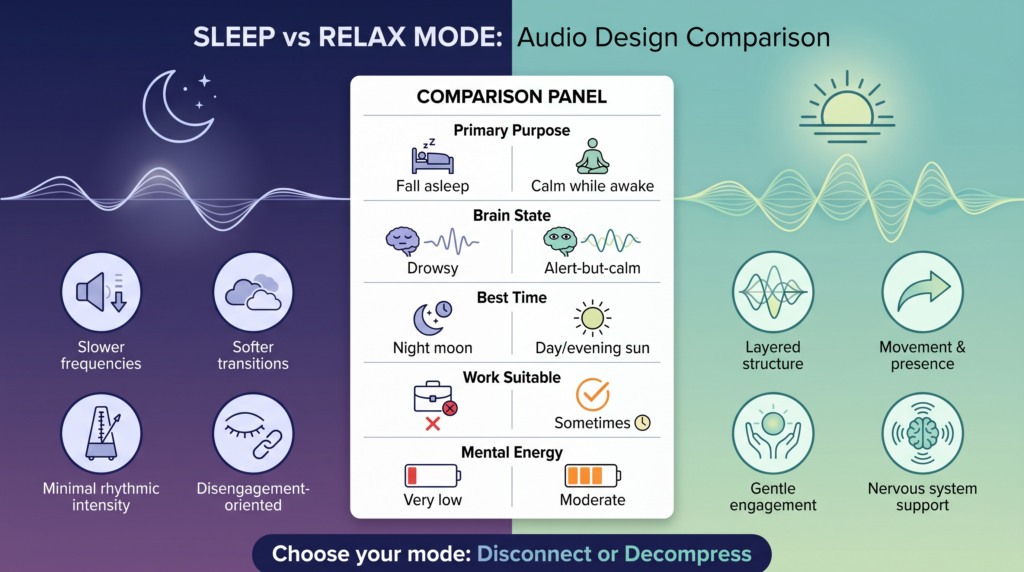
The audio design is where the sleep vs relax difference becomes most obvious.
Sleep mode uses slower frequencies, softer transitions, and minimal rhythmic intensity. There’s nothing in the sound design meant to keep you mentally present — it’s all oriented toward disengagement.
Relax mode is more layered. There’s still structure to the audio, still a sense of movement and gentle presence, but it doesn’t push you toward unconsciousness. It gives your nervous system something calm to rest against without pulling you under.
Mental State Effects
Sleep mode is effective at reducing nighttime mental chatter and shortening the time it takes to fall asleep. The downside is that it’s genuinely sedating — if you try to use sleep mode while doing something that requires brain activity, you’ll likely feel foggy and slow.
Relax mode, on the other hand, can improve emotional regulation and calm attention without making you sleepy. That’s useful for situations where you need to be present but not activated — a meeting you’re anxious about, a creative session that keeps stalling, or just a Tuesday afternoon where your stress response is running hot for no particular reason.
The sleep vs relax distinction here matters more than most people realize: reaching for sleep mode during the day when you actually need relax mode is a common mistake that leaves people groggy mid-afternoon.
Performance Analysis
Focus Recovery After Deep Work
After a long coding session, a research block, or any sustained mental effort, the brain tends to stay in a kind of elevated state — alert, slightly wired, not quite able to settle. Jumping straight from that into passive scrolling or socializing often extends the recovery time rather than shortening it.
In the sleep vs relax comparison for post-work recovery, relax mode wins clearly. It gives the brain a softer off-ramp: still conscious, still gently occupied, but with the cognitive load reduced. Twenty or thirty minutes of relax mode after deep work can meaningfully cut the time it takes to feel like yourself again.
Sleep mode in this scenario tends to overshoot — you end up drowsy when you didn’t want to sleep, then groggy when you snap out of it.
Brain.fm’s Relax sessions are specifically designed for this kind of recovery. It is worth your time reading our brain.fm review.
Sleep Quality
When it comes to actual sleep, sleep mode has the clearer edge. In the sleep vs relax debate at night, there’s not much contest: relax mode can help you feel calmer before bed, but it doesn’t guide the brain toward sleep states the way sleep mode does.
For anyone dealing with insomnia, racing thoughts, or the specific kind of over-stimulation that comes from too much screen time close to bedtime, sleep mode is the right tool.
Creativity
Relax mode tends to support creative work better. Creativity needs a certain openness — a mental state that’s low-pressure but not shut down. Sleep mode is too sedating for most creative tasks; relax mode hits closer to the right register.
Writers, designers, and researchers working through problems often find that relax sessions give them that slightly detached, associative quality of thinking that’s useful when you’re trying to generate ideas rather than execute them. If you’re choosing between sleep vs relax for a creative afternoon, relax is the one to pick.
Which Is Better for ADHD Users?
For people with ADHD, the sleep vs relax choice depends entirely on the time of day.
During the day, relax mode can help with emotional regulation, reduce the sensory overload that often comes with open-plan offices or busy environments, and make it easier to sustain calm attention on tasks that don’t naturally hold interest.
At night, sleep mode handles what relax mode can’t: shutting down the hyperactive thought patterns that tend to spike just when it’s time to sleep.
Many ADHD adults use both as part of a daily rhythm, and that combination tends to work better than relying on one mode exclusively.
Price Comparison
Most neuroscience-based audio platforms bundle sleep and relax under the same subscription — there’s no separate pricing tier for either.
Brain.fm, for example, includes Focus, Relax, Sleep, and Meditation sessions under a single membership. The real sleep vs relax value question isn’t about cost — it’s whether functional audio improves your mental performance enough to justify the subscription at all.
For remote workers, students in demanding programs, or anyone who’s already spending money on productivity tools, the answer is usually yes. Concentration, stress management, and sleep quality compound in ways that are hard to separate — improving one tends to improve the others.
Try Brain.fm here— there’s a free trial, so you can test it before committing.
Best for Different Users
Remote Software Developers
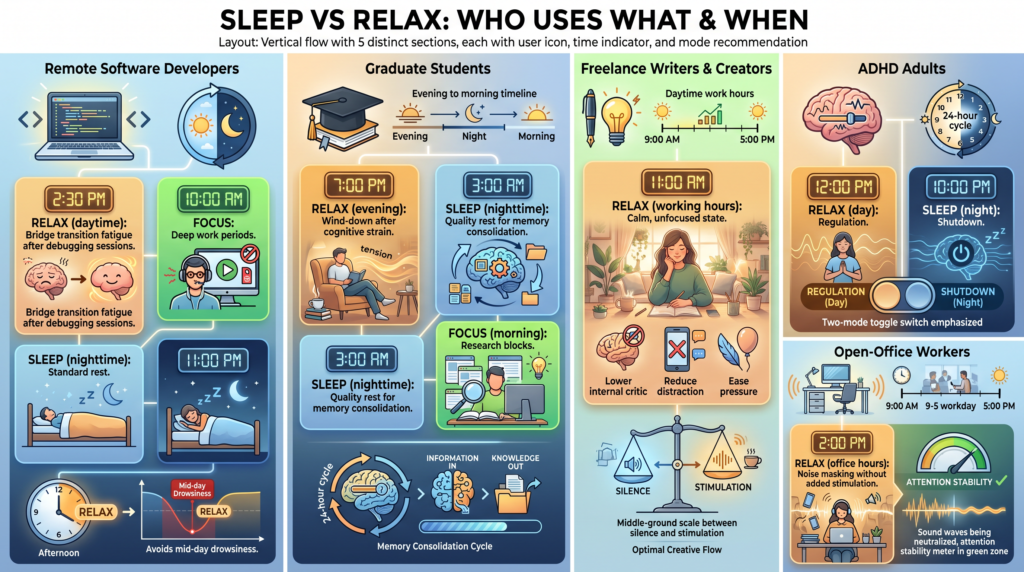
For developers, the sleep vs relax choice usually maps to time of day: relax during recovery periods and focus during actual work sessions. Cognitive overload and transition fatigue are common problems in deep technical work — you finish a complex debugging session and can’t quite step away from it mentally. Relax mode helps bridge that gap without putting you to sleep mid-afternoon.
Graduate Students
PhD and Master’s students often experience long, grinding cognitive strain followed by poor sleep, which in turn degrades the memory consolidation and problem-solving capacity on which their work depends.
For grad students, the sleep vs relax split is straightforward: relax mode for evening wind-down, sleep mode for actual quality rest before early-morning commitments. Pair both with a dedicated Focus session during research blocks, and you have a full daily system.
Freelance Writers and Creators
For writers, the sleep vs relax question is easy: relax wins during working hours. It produces a calm, slightly unfocused mental state that’s actually useful when you’re trying to write — lowering the internal critic, reducing distraction, and keeping the creative process from feeling pressured.
ADHD Adults
As covered above, relax during the day for regulation, sleep at night for shutdown. The two-mode approach works better than using a single setting for everything. When ADHD adults stop agonizing over the sleep vs relax decision and just apply each at the right time, the results tend to speak for themselves.
Open-Office Workers
Relax mode is the practical answer to the sleep vs relax question for anyone in a busy office environment. It’s effective at masking ambient noise and interruptions without adding stimulation, which matters in environments where the background noise is already mentally taxing. It keeps attention reasonably stable without tipping into either the hyperalert or drowsy end of the spectrum.
Final Recommendation
When people ask about sleep vs relax, the honest answer is that these modes aren’t competing — they’re complementary. Treating it as an either/or misses the point.
Choose sleep mode if:
- You struggle to fall asleep or stay asleep
- Nighttime overthinking is a recurring problem
- You need to wind down after high-stimulation evenings
- You want deeper, more restorative rest
Choose relax mode if:
- You need to decompress without getting drowsy
- You’re recovering from mental fatigue during the day
- You’re doing light creative work or reading
- Stress or anxiety is interfering with your thinking
For most people who care about mental performance, the most effective pattern looks like this:
- Focus during work sessions
- Relax for recovery and transitions
- Sleep at night
That’s a complete cognitive workflow — not just an audio preference.
Brain.fm includes all three modes under one subscription. Start a free trial here and test the full workflow yourself.
Final Verdict
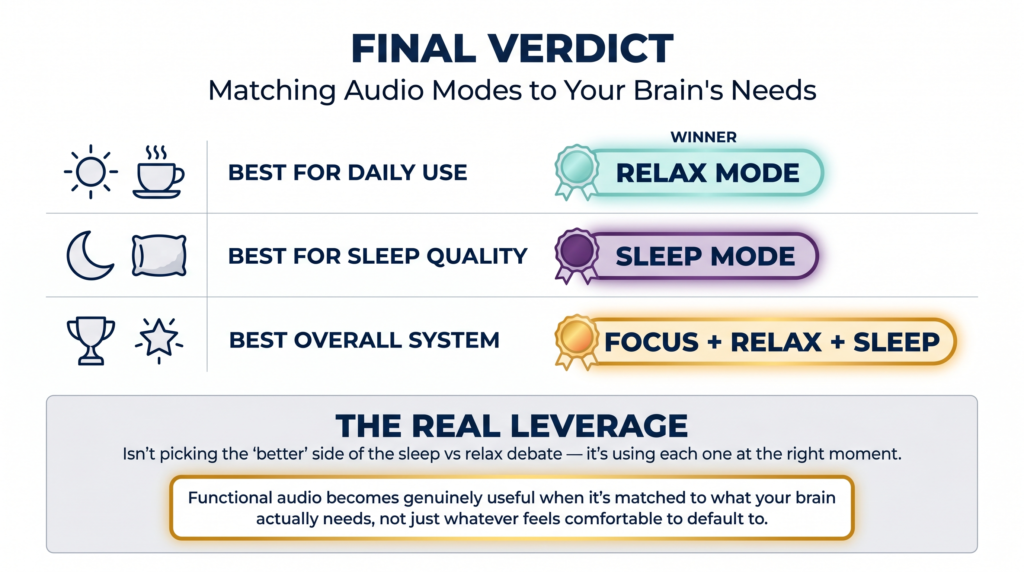
The real leverage isn’t picking the “better” side of the sleep vs relax debate — it’s using each one at the right moment. Functional audio becomes genuinely useful when it’s matched to what your brain actually needs, not just whatever feels comfortable to default to.
Some of the links on Best Focus Music are affiliate links. This means that if you click a link and buy something, we may earn a small commission — at no extra cost to you. We only recommend products we genuinely think are worth your time.
We are a participant in the Amazon Associates Program, an affiliate advertising program designed to provide a means for sites to earn advertising fees by linking to Amazon.com and affiliated sites. We may also work with other affiliate networks and individual brands from time to time.