Sony is everywhere. On planes, in offices, libraries, and home workspaces. If someone is wearing headphones and you can’t see the brand, there’s a good chance it’s Sony.
But name recognition doesn’t tell you whether a product is actually worth your money.
For Best Focus Music, Sony is interesting for one reason: their audio products keep coming up in conversations about concentration, deep work sessions, and blocking out distractions.
This isn’t a hands-on test of specific models. For anyone looking for an honest Sony review focused on audio and productivity: this is a brand-level overview — what Sony does well, where they fall short, and whether they’re the right choice for your situation.
Brand Overview and History
Sony was founded in Japan in 1946, shortly after World War II. Co-founders Masaru Ibuka and Akio Morita started small but grew the company into one of the world’s most influential electronics manufacturers.
Throughout the eighties and nineties, Sony led in innovation. The Walkman changed how people listened to music. The Trinitron television set a new standard for picture quality. And the original PlayStation laid the groundwork for what is now one of the most successful gaming platforms globally.
In 2026, Sony remains a strong performer. Not necessarily because they’re the most innovative player in the room, but because they’ve spent years investing in quality across different product categories.
That broad range is both a strength and a weakness — more on that shortly.
Product Range Analysis
Sony makes a lot of products. Possibly too many, if you don’t know where to start.
For the Best Focus Music audience, the audio products are most relevant. The main categories worth knowing about:
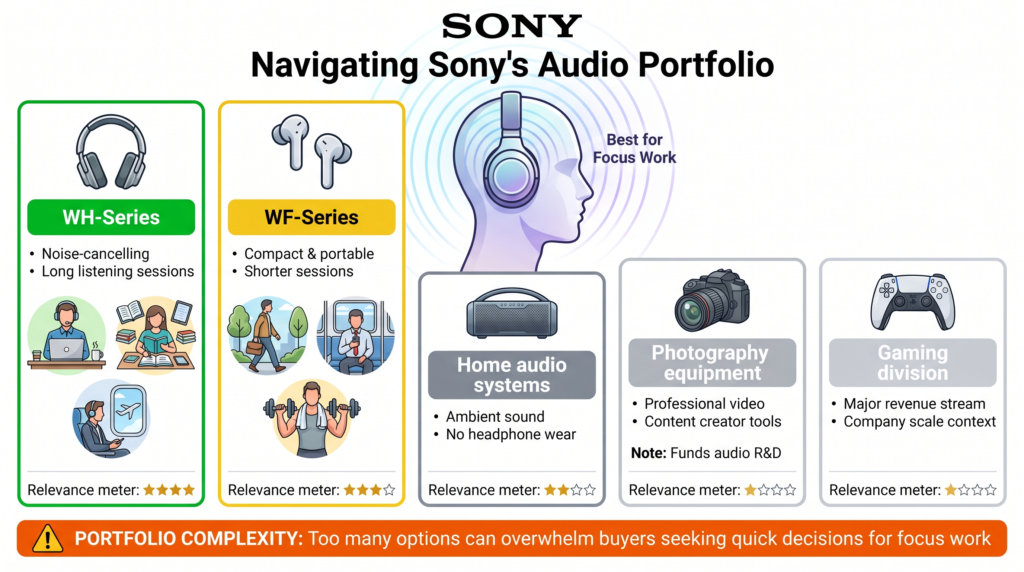
Over-ear noise-cancelling headphones: This is where Sony gets the most attention. Their WH-series is designed for users who want to listen for longer periods without distractions from their surroundings. Popular with remote workers, students, and frequent travelers.
In-ear earbuds: The WF-series can be a perfect fit for people on the move. More compact and convenient for shorter sessions, but less ideal for long desk-based workdays.
Speakers and home audio: Less relevant for focus-specific use, but a significant part of Sony’s portfolio for people who prefer ambient sound without wearing headphones.
Cameras and professional audio: Sony is a leading brand in photography and video, especially among content creators and filmmakers. Outside the scope of Best Focus Music, but it explains why Sony has the resources to keep investing in audio quality.
Gaming (PlayStation): The PlayStation division is one of Sony’s biggest revenue streams. Less relevant to this review, but worth mentioning as context for Sony’s overall scale.
The breadth of the portfolio can be confusing. If you’re looking for a headphone for focus work, it’s easy to get lost in the lineup. That’s a real drawback for people who just want to make a quick, confident decision.
Looking for a specific Sony headphone?
If you’re considering Sony mainly for work, studying, or noise cancellation, the WH-1000XM5 is one of the models worth looking at first. We take a closer look at its noise cancellation, comfort, battery life, features, and suitability for focused work in our full Sony WH-1000XM5 review.
Quality and Performance
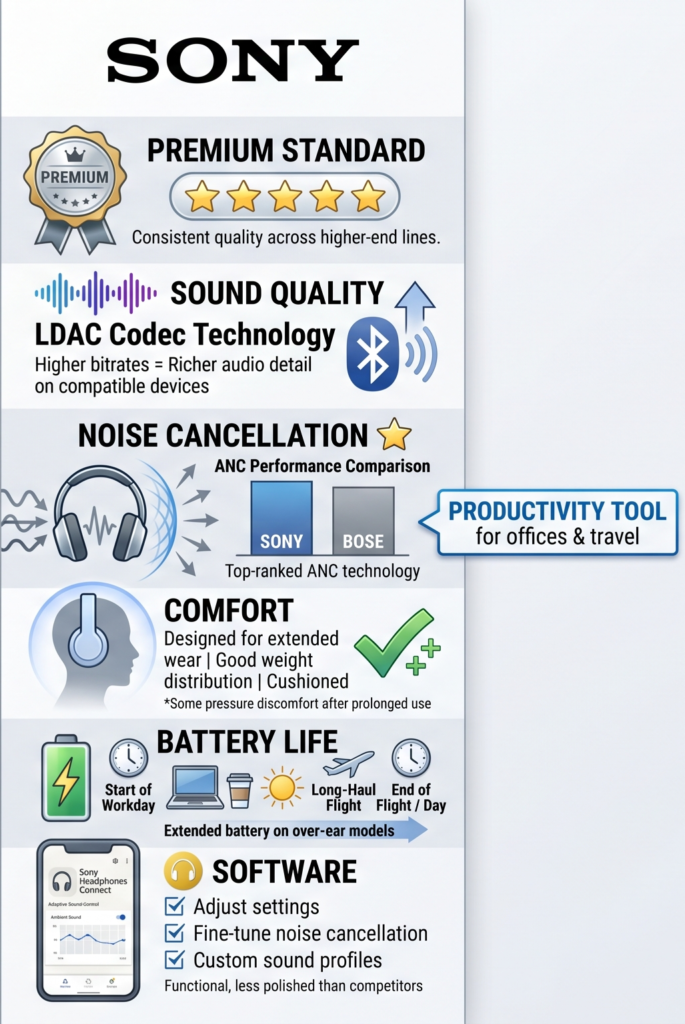
Sony is known for consistent quality in their premium segment. That doesn’t mean every product is perfect, but there’s a recognizable standard across their higher-end lines.
Sound quality: Sony’s audio technology has advanced significantly over the past several years. Their LDAC codec, which allows higher bitrates over Bluetooth, is a technical advantage that audio enthusiasts appreciate. In practice, it means richer detail on compatible devices.
Noise cancellation: This is the area where Sony receives the most praise. Their active noise cancellation technology is consistently ranked highly by independent reviewers. Whether it’s the best on the market depends on who you ask — Bose and Sony regularly trade positions in comparison tests — but Sony is always part of that conversation.
For people working in busy open-plan offices or flying regularly for work, effective noise cancellation isn’t a luxury. It’s a productivity tool.
Comfort: Comfort is subjective, but Sony generally scores well among users who wear headphones for several hours a day. The cushioning and weight distribution are designed for extended use. That said, some users report pressure discomfort after a few hours — worth keeping in mind if you’re sensitive to that.
Battery life: Sony’s over-ear models typically offer long battery life. For a full workday or a long-haul flight, that’s a practical advantage. Charging speed varies by model.
App and software: Sony has its own companion app — Sony Headphones Connect — which lets you adjust settings, fine-tune noise cancellation, and set sound profiles. It’s functional, though some users find the interface less polished than competitors.
Customer Service Experience
This is an area where Sony performs less consistently.
As a large international company, Sony offers support through online help centers, authorized service centers, and warranty programs. In most cases, this works adequately. But compared to smaller, more focused audio brands, some users miss a more personal touch.
Warranty terms and return policies vary by country. It’s worth checking local purchase conditions before committing to a higher-priced model.
It is something to think about when making a significant investment.
Pricing and Value Assessment
Sony is not a cheap brand — at least not in the segment that interests people who are seriously looking for quality.
Their flagship models fall within a price range that requires careful consideration for most buyers. In that space, they compete directly with Bose and Apple.
Is the price justified?
That depends on how you use the product.
If you’re buying headphones for occasional listening on the couch, probably not. If you work in an open office daily, travel frequently for work, or have long study sessions where noise cancellation makes the difference between focusing and not focusing, the calculation changes.
A pair of headphones used daily for two to three years spreads the cost across hundreds of sessions. Looked at that way, the upfront price feels less extreme.
Sony also offers mid-range options at a lower price with fewer features. For anyone who doesn’t need flagship performance, those are a more logical starting point.
Pros and Cons Summary
What Sony does well:
Consistent quality in their higher-end segment. Sony rarely delivers a product that falls significantly below expectations.
Strong noise cancellation. In the category most relevant to Best Focus Music readers, Sony is consistently among the top performers.
Broad platform support. Sony products work well with both Android and iOS, unlike brands that are more tightly integrated into a single ecosystem.
Long battery life on over-ear models. Relevant for anyone who doesn’t want to think about charging mid-session.
Where Sony falls short:
Sony has models with overlapping features. The wide lineup makes choosing harder than it needs to be.
Inconsistent customer service. Not bad, but not a standout either.
High entry price for premium models. Not accessible for every budget.
The companion app could be better. It is functional, but it’s less refined than some other brands.
Final Recommendation
Sony has earned its reputation. Not through marketing alone, but by consistently producing products that people actually use every day.
For the Best Focus Music audience — people who use audio as a tool for concentration, productivity, and deep work — Sony is a serious option. Their noise-cancellation technology is robust, their over-ear headphones are built for extended use, and their sound quality is consistent across their premium range.
But “Sony is a good brand” isn’t a sufficient answer to the question of whether you should buy a specific Sony product. The next step is figuring out which model fits your actual situation.
Do you use headphones mainly at a home desk? Or do you commute daily to an open office? Do you deal with tinnitus? Do you wear headphones for more than four hours at a time? Those factors determine which model makes sense — regardless of brand.
If you’re considering buying Sony headphones
If you’ve reached this point because you’re seriously considering Sony, the next step is to look at a specific model rather than the brand as a whole. For most people interested in Sony for work, studying, commuting, or focus, the WH-1000XM5 is one of the most relevant models to investigate.
Some of the links on Best Focus Music are affiliate links. This means that if you click a link and buy something, we may earn a small commission — at no extra cost to you. We only recommend products we genuinely think are worth your time.
We are a participant in the Amazon Associates Program, an affiliate advertising program designed to provide a means for sites to earn advertising fees by linking to Amazon.com and affiliated sites. We may also work with other affiliate networks and individual brands from time to time.