
Staying focused in 2026 is harder than ever. Between Slack notifications, open-office noise, endless tabs, and algorithm-driven distractions, maintaining deep concentration has become a real challenge—especially for developers, students, writers, and ADHD professionals.
That’s why focus music has exploded in popularity.
But here’s the problem: most “study playlists” aren’t actually designed for concentration. Many become repetitive, emotionally distracting, or mentally exhausting after an hour or two. Instead of helping you work, they slowly drain your cognitive energy.
There is good news! A new generation of focus music platforms is changing that.
From AI-generated soundscapes to neuroscience-backed functional music, today’s tools are designed specifically to improve concentration, reduce distractions, and help users enter flow states faster.
In this guide, we’ll explore the best focus music options in 2026, how they work, and which tools are best for coding, studying, creative work, and ADHD productivity.
Understanding the Basics
What Is Focus Music?
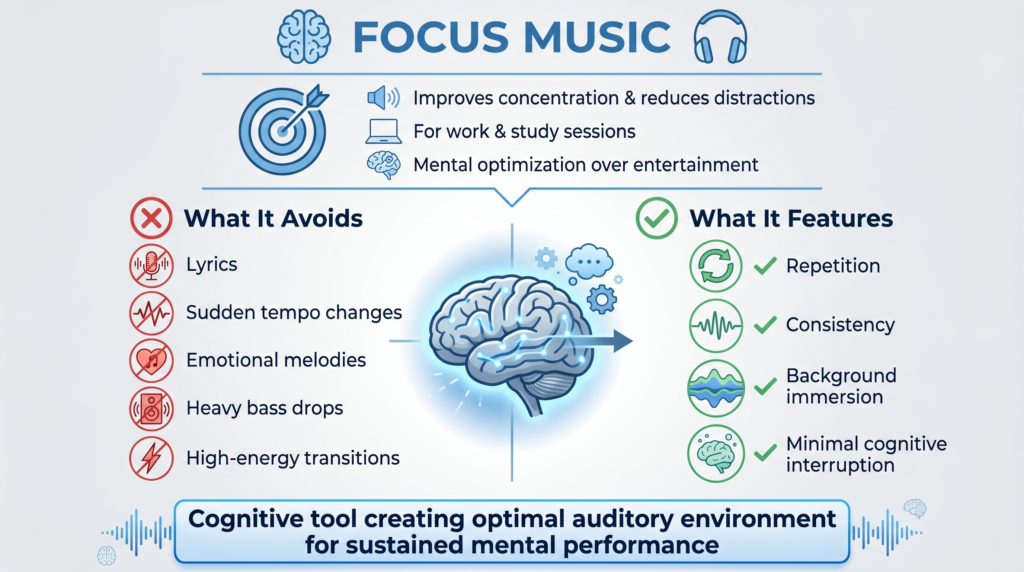
Focus music is audio specifically designed to improve concentration and reduce distractions, for example, while working or studying.
Unlike traditional music, focus-oriented audio often avoids:
- Lyrics
- Sudden tempo changes
- Emotional melodies
- Heavy bass drops
- High-energy transitions
Instead, this music is more aimed at:
- Repetition
- Consistency
- Background immersion
- Minimal cognitive interruption
Focus music isn’t for entertainment; it’s intended for mental optimization.
Why Regular Music can hurt your focus
Many people use Spotify or YouTube playlists while working, but standard music isn’t suitable for focus. It gives several problems:
1. Lyrics Compete for Attention
Your brain processes language subconsciously, which interferes with reading, coding, and writing.
2. Constant Song Changes Make It Hard To Stay Concentrated.
Unexpected transitions force your attention to shift constantly.
3. Your Brain Gets Tired Of The Same Music
Even good playlists become mentally tiring after repeated exposure.
4. Music Triggers Emotional Thinking
Songs tied to memories or emotions can pull you out of work mode.
This is why purpose-built focus audio tools have become so popular.
How Music Affects Your Brain
Your brain is constantly processing sound, whether you notice it or not. The prefrontal cortex, which handles focus, decision-making, and working memory, is especially sensitive to what you hear.
When music changes too often or contains vocals, your attention keeps getting pulled away from your task. Even if it’s subtle, it still creates mental interruptions.
Good focus music does the opposite. It fades into the background instead of competing for attention.
It’s not there to entertain you. It’s there to keep your brain in a steady, focused state for longer periods of time.
That’s why ambient sounds, brown noise, and structured soundscapes tend to work better than traditional playlists for deep work.
Before You Choose Your Focus Music
Your Work Type Matters
Not every type of focus music works for every kind of task. What helps a developer debug code might not work for someone writing a research paper.
For developers and engineers, simple and consistent audio usually works best. Brown noise, ambient electronic music, or AI-generated focus tracks are popular because they stay in the background.
Students and researchers usually perform better with softer, calmer background sounds. Ambient music, piano, or nature sounds can make long reading or writing sessions feel less tiring.
Writers, designers, and other creators often work better with music that has a bit more melody, as long as it doesn’t become too distracting.
For people with ADHD, very calm music doesn’t always help. Many find it easier to concentrate with music that has a bit more rhythm and stimulation instead of slow ambient sounds.
Your Environment Changes Everything
Your ideal focus music depends heavily on where you work.
In a quiet home office, subtle ambient audio may be enough. But in open offices, cafés, libraries, or noisy apartments, music also functions as acoustic masking.
This is where brown noise and dense ambient soundscapes really help. They smooth out background noise like conversations, traffic, or typing without becoming distracting.
Many remote workers underestimate how mentally exhausting unpredictable background noise can be until they experience a properly controlled audio environment.
The Rise of AI-Generated Focus Music
In the last few years, focus music has shifted from playlists to AI-generated sound environments.
Instead of choosing songs, these tools generate audio designed specifically for concentration. Platforms like Brain.fm and Endel are leading this shift.
They focus on things like:
- Rhythmic consistency
- Controlled stimulation
- Neural engagement
- Cognitive endurance
The biggest benefit is simple: you don’t waste time searching for the “right playlist” anymore.
You just started a session and are beginning to work.
Step-by-Step Guide
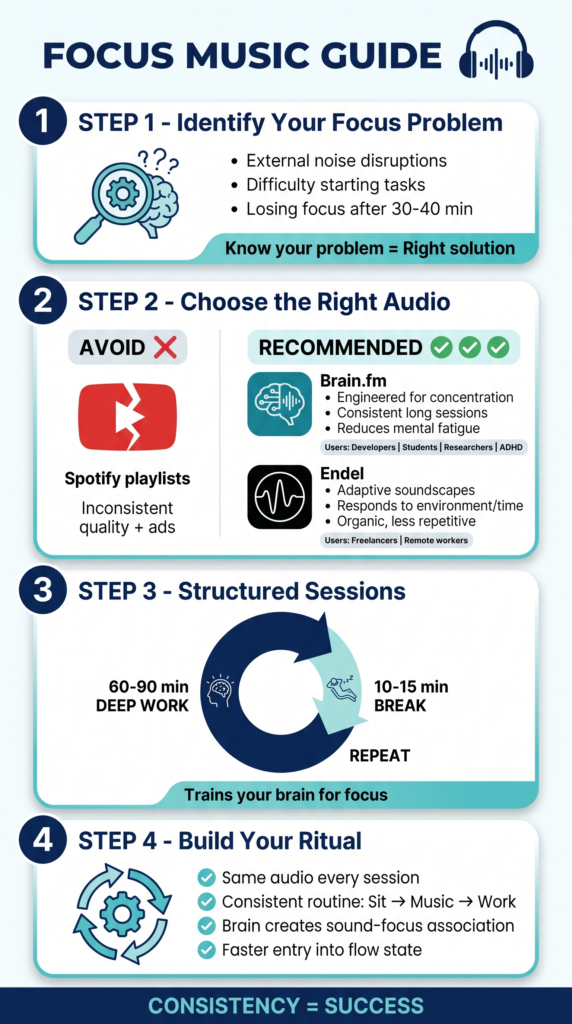
Step 1: Identify Your Biggest Focus Problem
Before choosing anything, it helps to understand what actually breaks your focus.
Maybe it’s the noise around you. Maybe you struggle to start tasks. Or maybe you lose focus after 30–40 minutes.
Once you know the problem, it becomes much easier to choose the right type of audio.
Step 2: Choose the Right Audio Style
Most people start with Spotify playlists because they’re convenient. The problem is that playlist quality varies wildly, and free versions introduce ads that instantly break the flow.
Dedicated focus tools are usually more reliable. Here are two options for you.
Brain.fm
Brain.fm is one of the most well-known focus tools in 2026. Instead of normal music, it uses engineered audio designed to support concentration.
It’s especially popular with developers, students, researchers, and ADHD users because it stays consistent during long sessions.
The main advantage is that it reduces mental fatigue compared to regular playlists.
We made a Brain.fm review so you get a good idea of how Brain.fm can help you focus and how the app works. Read it here.
If you want to go beyond a basic app comparison, check out our Focus Music Buyer’s Guide for a closer look at why Brain.fm stands out for deep work and focused sessions.
Endel
Endel takes a different approach. It generates adaptive soundscapes that change based on your environment, time of day, and activity.
It feels more organic and less repetitive than traditional playlists, which makes it popular among freelancers and remote workers.
Step 3: Use Structured Work Sessions
Focus music works best with intentional work blocks.
A good structure can look like this:
- 60–90 minutes of deep work
- 10–15 minute break
- Do it on repeat!
This combination helps train your brain to get into a state of focus and concentration.
Step 4: Build a Repeatable Ritual
One underrated productivity technique is using the same audio as a psychological trigger for deep work. Your brain loves it when it knows what is coming.
When you repeatedly:
- Sit down to work
- Start the same focus music
- Immediately begin concentrating
Your brain starts to connect those habits and that sound environment with focus.
Over time, it becomes easier to focus faster.
Expert Tips
Use Headphones Whenever Possible
Noise isolation dramatically improves the effectiveness of focus music.
Over-ear headphones are usually best for:
- Open offices
- Coffee shops
- Shared living spaces
See our article where we compare different brand headphones for the best focus.
Avoid emotional music
Songs that trigger memories or strong emotions trigger mind-wandering much more aggressively than neutral ambient audio.
Common Mistakes People Make
One of the biggest mistakes is starting work while still distracted. If you’re checking messages or scrolling before you begin, your brain associates the music with distraction instead of focus.
Another mistake is constantly switching playlists. Looking for the “perfect track” often ends up being procrastination in disguise.
Focus music can’t replace basic habits either. If you’re tired, stressed, or constantly interrupted, no audio will fully fix that.
Finally, people often give up too quickly. Focus music usually works better after repeated use, once your brain starts linking it to deep work.
Conclusion
In 2026, staying focused is just harder than it used to be. Notifications, open tabs, and constant distractions make it difficult to really get into deep work, especially for developers, students, and writers. That’s why focus music has become less of a trend and more of a practical tool.
The main thing to take away from this guide is pretty simple: most regular playlists aren’t actually built for focus. They change too much, pull your attention away, or just get mentally tiring over time. Focus music works better because it stays in the background, helping you concentrate rather than distracting you.
What works best really depends on what you’re doing. Developers usually need something steady and minimal, while students tend to prefer softer, calmer sounds. Creative work can handle a bit more variation, and people with ADHD often do better with more rhythm and structure.
Tools like Brain.fm and Endel make this easier because you don’t have to search for the right playlist every time. You just start a session and get into work without thinking too much about it. Give it a try and start your 30-day free trail.
In the end, it’s not about finding the perfect music. It’s about setting up something simple that helps you get into focus faster and stay there longer.
Some of the links on Best Focus Music are affiliate links. This means that if you click a link and buy something, we may earn a small commission — at no extra cost to you. We only recommend products we genuinely think are worth your time.
We are a participant in the Amazon Associates Program, an affiliate advertising program designed to provide a means for sites to earn advertising fees by linking to Amazon.com and affiliated sites. We may also work with other affiliate networks and individual brands from time to time.