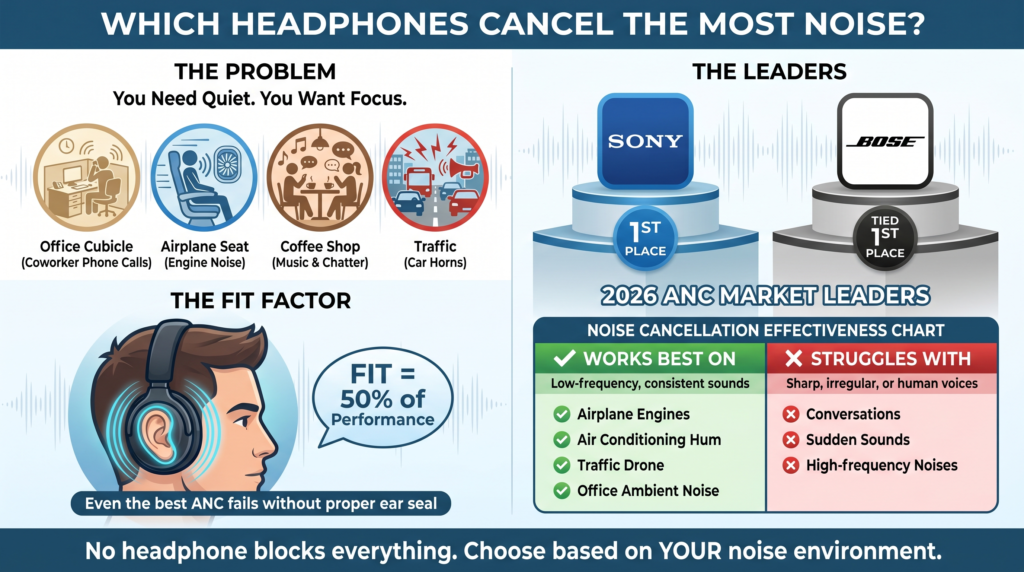
You like quiet. You want to focus. You’re tired of hearing your coworker’s phone calls, the person next to you on the plane, or the coffee shop playlist bleeding through whatever you’re trying to listen to.
So, which headphone cancels the most noise?
Short answer
Sony and Bose are the names that keep coming up, and for good reason. But the longer answer is more useful, because the “best” headphone for noise cancellation depends entirely on what kind of noise you’re dealing with.
Quick Answer
As of 2026, Sony and Bose lead the consumer market for active noise cancellation. Both perform best against low-frequency, consistent noise — airplane engines, air conditioning, traffic, the general hum of an open office.
No headphone blocks everything. Conversations, sudden sounds, and anything high-frequency are much harder to cancel. And for most people in most environments, how well the headphones fit matters just as much as the ANC hardware itself. In this article we will look at Sony, Bose, Apple and Sennheiser.
How Noise Cancellation Actually Works
ANC headphones use small microphones on the outside of the ear cups to pick up ambient sound. The headphones then generate an opposing sound wave — essentially a counter-signal — that reduces the signal reaching your ears.
That process works well against predictable, low-frequency noise. Engines, HVAC, road, and rumble. The system can “read” those sounds reliably enough to counter them. A barking dog or a door slamming? Too sudden, too unpredictable. ANC barely touches those.
So when people ask which headphone cancels the most noise, they’re often imagining a different problem than what ANC is actually solving. The best headphone for a flight is not necessarily the best one for a noisy shared office.
Fit Matters More Than Most People Realize
Most buyers go straight to ANC specs. Understandable — that’s what the marketing emphasizes. But the physical seal between the ear cup and your head has a significant effect on how much noise is actually blocked.
A well-fitting over-ear headphone provides passive isolation in addition to active noise cancellation. Both layers are working together. Break that seal — wrong head shape, glasses frames getting in the way, a headband that doesn’t sit right — and you’re losing a meaningful chunk of performance regardless of what the spec sheet says.
It explains why two people can buy identical headphones and walk away with completely different impressions. It’s not always the technology. Often it’s just a fit.
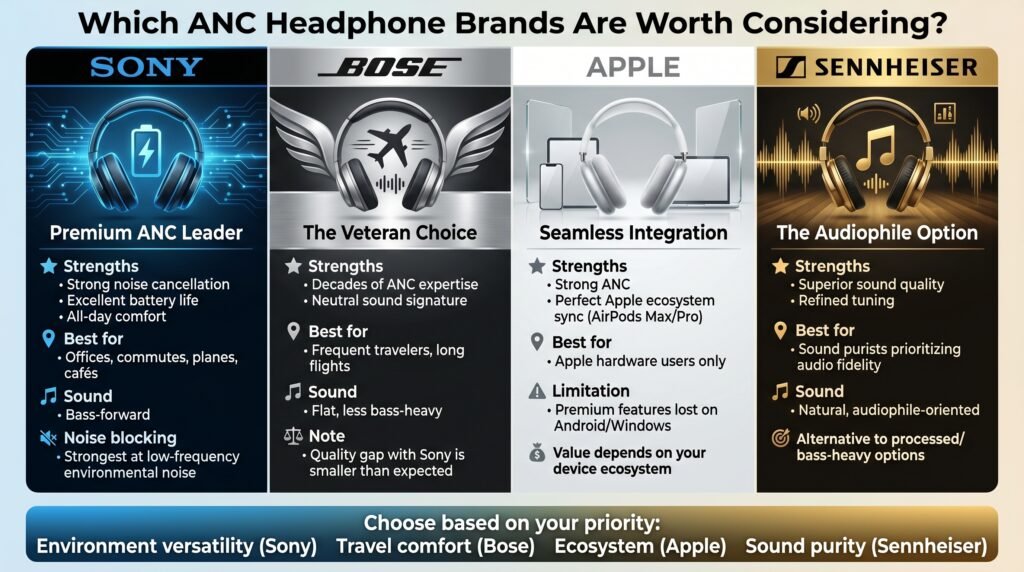
Which Brands Are Worth Considering?
Sony
Sony’s premium lineup has been among the strongest for ANC for several years now. Good battery life, comfortable for long sessions, and noise cancellation that holds up well in the environments most people actually use them.
We’ve looked at Sony’s headphones in more detail in our Complete Guide to Sony Headphones for Focus, if you want a closer breakdown. We also have a Sony WH1000XM5 overview here. Or you can check out the headphones on Amazon using the button below.
If you’re specifically considering Sony, see our full Sony brand overview for a broader look at the brand and its headphones.
Bose
Bose has been building noise-cancelling headphones longer than almost anyone else, and the experience shows. The sound signature is a bit more neutral than Sony’s, less bass-heavy, flatter.
Many frequent travelers appreciate Bose for long flights. They are also know for the great comfort their headphones offer.
If you’re already looking for a Bose headphone, you may be interested in our Bose Quietcomfort Ultra overview.
Apple
The AirPods Max and AirPods Pro are real contenders now, particularly if you’re already using Apple hardware. The integration is seamless, and the ANC is strong. The Max, in particular, performs well.
But if you’re mixing platforms like an Android phone and a Windows laptop, then the Apple-specific features mostly disappear. At that point, you’re paying a premium for advantages you won’t fully use.
Sennheiser
A different kind of choice. Sennheiser attracts people who care about sound quality as much as they do about noise isolation. More audiophile-oriented tuning. If Sony and Bose feel a bit processed or bass-heavy to you, Sennheiser is worth a look.
What Actually Matters for Focus
The strongest ANC doesn’t automatically mean the best focus.
Uncomfortable headphones get taken off. A pair that causes ear pressure after two hours isn’t useful during a six-hour work session, no matter what its specs claim. Long-term wearability is consistently underrated in headphone buying decisions.
Consistency matters too. Steady background noise — even moderate volume — is far less disruptive to concentration than unpredictable noise. A headphone that reliably flattens the ambient hum of a room often does more for focus than one that occasionally reaches higher cancellation peaks but lets through random spikes.
A lot of people here at Best Focus Music combine ANC with background audio — brown noise, lo-fi, ambient soundscapes. The headphones reduce the room; the audio fills the remaining space. That combination tends to outperform either approach alone, which is worth keeping in mind when deciding how much to spend on ANC specifically.
Different Noise, Different Solutions
Not all noise behaves the same way, and knowing the difference helps a lot.
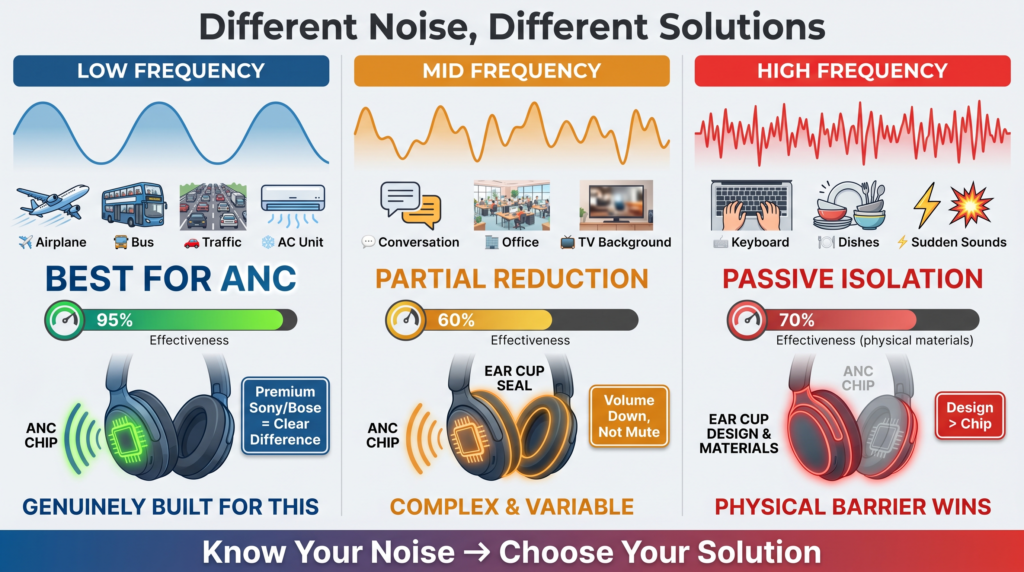
Low-frequency noise — airplane engines, traffic, buses, air conditioning — is what ANC is genuinely built for. A premium Sony or Bose headphone makes a clear, obvious difference here.
Mid-frequency noise — conversations, office chatter, background television — is harder to hear. ANC reduces it, but voices are complex and variable. You’ll turn down the volume, not hit mute. A good ear cup seal helps as much as the active cancellation does for this range.
High-frequency noise —keyboards, dishes, sharp, sudden sounds—is mostly addressed with passive isolation. The physical materials and design of the ear cup matter more than the ANC chip for these.
Knowing which of these is your main problem narrows down what you actually need.
A Few Real Situations
Working from home: The noise is mostly mid- to low-frequency — a partner on calls, traffic, and the occasional vacuum. A decent ANC headphone handles this well. You don’t need flagship hardware for a home office.
Open-plan office: Probably the hardest environment. Conversations are close, keyboards are constant, and the noise is both variable and mid-frequency. ANC helps, but fit matters enormously here. Over-ear designs generally work better than earbuds in this setting because they provide a more complete seal.
Long flights: This is where ANC earns its keep. Airplane engine noise is exactly the kind of consistent, low-frequency hum the technology is designed for. The difference between a premium and mid-range headphone becomes genuinely noticeable on a 10-hour flight.
Students in shared housing: Student houses have variable noise and unpredictable hours. Usually, students live on a tighter budget. A mid-range option with decent ANC and a good fit often makes more practical sense than spending €350 on a flagship.
What the Packaging Doesn’t Mention
Headphone companies test noise cancellation in controlled lab conditions. Your commute is not a controlled lab condition.
Spec sheet numbers don’t always account for your specific environment, your specific head shape, or the specific way glasses frames break the ear cup seal. User reviews from people describing your exact use case tend to be more informative than manufacturer data.
ANC has also improved significantly at lower price points over the last few years. The gap between a €100 pair and a €350 pair is real — but it’s narrower than it used to be. For casual or occasional use, mid-range is genuinely capable now. For daily use in demanding environments, the premium models still justify themselves. But it’s a smaller gap than the price difference implies.
The Conclusion
Sony and Bose lead the field in most real-world comparisons, particularly for low-frequency environments where ANC performs best. But the right choice depends on where you’ll use them, how long you’ll wear them, and whether the fit works for your head.
Noise cancellation is one variable. Comfort, fit, sound quality, and battery life all shape whether a headphone actually improves your day or ends up sitting unused.
For focus specifically — work, study, deep thinking — pairing solid ANC with suitable background audio almost always beats relying on noise cancellation alone. Worth factoring into the decision.
For a closer look at how the leading models compare, see our Sony WH-1000XM5 Wireless Noise Cancelling Headphones vs Alternatives guide. If you’re interested in specific models, you can also read our Sony WH-1000XM5 product overview and Bose QuietComfort Ultra overview.
Frequently Asked Questions
Which headphone cancels the most noise? Sony and Bose are consistently the strongest performers, particularly for low-frequency noise. The gap between the two brands is small — fit and personal preference often matter more than which logo is on the ear cup.
Can noise-cancelling headphones block conversations? They reduce them, but nearby voices typically remain partially audible. A well-fitting ear cup seal helps here as much as the ANC itself does.
Are noise-cancelling headphones worth it for studying? Noise-cancelling headphones can really help you study. Especially in shared housing or libraries, where noise levels are variable. The reduction in ambient distraction tends to be meaningful for longer sessions.
Does a higher price always mean better noise cancellation? Not automatically. Fit, ear cup design, and passive isolation all matter alongside the ANC hardware. A cheaper headphone with a better seal can outperform an expensive one that doesn’t fit your head well.
Is silence better for focus than background audio? Depends on the person. Some people focus best in near silence; others find a layer of ambient sound — brown noise, lo-fi, or nature sounds — more effective. The goal isn’t necessarily to eliminate every sound, just the unpredictable, distracting ones.
Based on publicly available information and general market research. Performance varies by fit, environment, and individual use.
Some of the links on Best Focus Music are affiliate links. This means that if you click a link and buy something, we may earn a small commission — at no extra cost to you. We only recommend products we genuinely think are worth your time.
We are a participant in the Amazon Associates Program, an affiliate advertising program designed to provide a means for sites to earn advertising fees by linking to Amazon.com and affiliated sites. We may also work with other affiliate networks and individual brands from time to time.