Quick Answer
If you’re trying to sleep — or just function the next day — next to someone who snores, the headphones that work best combine strong active noise cancellation (ANC) with deep low-frequency reduction, since snoring sits mostly in the low-to-mid frequency range.
- Bose QuietComfort Ultra — widely regarded as having some of the most effective ANC for low rumbling sounds like snoring.
- Sony WH-1000XM5 — excellent all-round noise cancellation with strong adaptive sound control
- Soft sleep earbuds (like Bose Sleepbuds or similar in-ear options) — better for side-sleepers, though these rely more on sound masking than pure cancellation
There isn’t one single “best” pair for everyone. It depends on whether you sleep on your back or side, how loud the snoring actually is, and how much you’re willing to spend.
What’s worth keeping in mind, though, is that this isn’t just a sleep problem. A bad night because of a snoring partner has a direct knock-on effect on the next day — and that’s really why this topic belongs here.
Understanding the Question
People searching for which noise-cancelling headphones are good for snoring usually face one of two situations. It can be a partner or roommate whose snoring disrupts sleep, or someone trying to nap or focus during the day in a noisy space.
Snoring is a tricky sound for noise cancellation technology because it’s not steady. It’s irregular, because it changes unexpectedly in volume and sound. That’s different from the kind of background noise ANC headphones were originally engineered for.
This is why some headphones marketed as “great for travel” don’t necessarily perform as well against snoring, even though both involve low-frequency sound.
There’s also a bigger reason this matters beyond just the night itself. Poor sleep doesn’t stay in bed — it follows you to your desk the next morning, and that’s where the real cost shows up.
Why This Affects More Than Just Your Sleep
This is worth pausing on, because it’s easy to treat snoring purely as a nighttime annoyance and miss the bigger picture.
Disrupted sleep — even partial disruption from a snoring partner — reduces the amount of deep sleep you get. Deep sleep is when your brain does most of its recovery work, including the processes tied to memory consolidation and attention the next day.
The result is a familiar pattern for a lot of people:
- Waking up groggy even after “enough” hours in bed
- Struggling to concentrate during the first few hours at work
- Relying more heavily on caffeine just to get through the morning
- Feeling mentally foggy by early afternoon
In other words, the headphones you choose for nighttime aren’t just about getting through the snoring itself — they’re about protecting the focus and energy you need the next day. That’s the same underlying problem we cover from the daytime side: noisy open offices, coffee shops, shared living spaces. Snoring is just the version of that problem that happens to you while you’re asleep.
Detailed Explanation
Why Snoring Is Hard to Cancel Out
Active noise cancellation works by generating an inverse sound wave to cancel out incoming noise. It’s most effective against consistent, low-frequency sounds — think engine drones, HVAC systems, or train rumble.
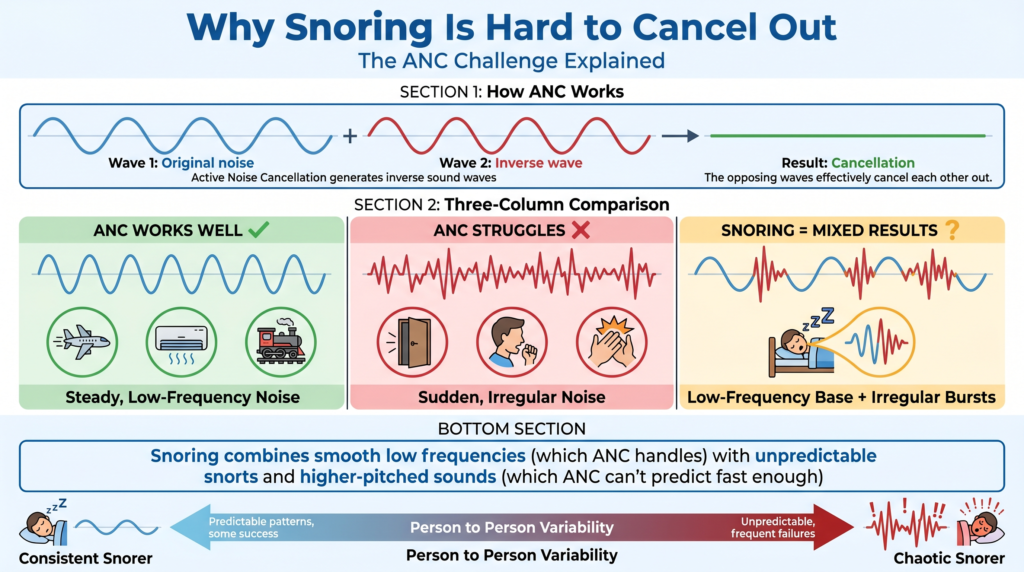
Snoring partially overlaps with this profile, since much of the snoring sound lies in the lower frequencies. But snoring also includes irregular bursts, snorts, and higher-pitched elements that ANC struggles to predict and neutralize in real time.
That’s the core challenge:
- Steady background noise → ANC handles this well.
- Sudden or irregular noise → ANC has a harder time keeping up.
- Snoring → a mix of both, which is why results vary from person to person
Two Different Approaches: Cancellation vs. Masking
There are really two strategies people use here, and they’re not the same thing.
Active noise cancellation physically reduces the sound reaching your ear using microphones and counter-waves. Over-ear headphones like the Bose QuietComfort Ultra or Sony WH-1000XM5 use this approach.
Sound masking doesn’t cancel anything — it covers unwanted noise with a more pleasant sound, such as white noise, rain, or ambient music. Sleep earbuds and some apps lean on this method instead.
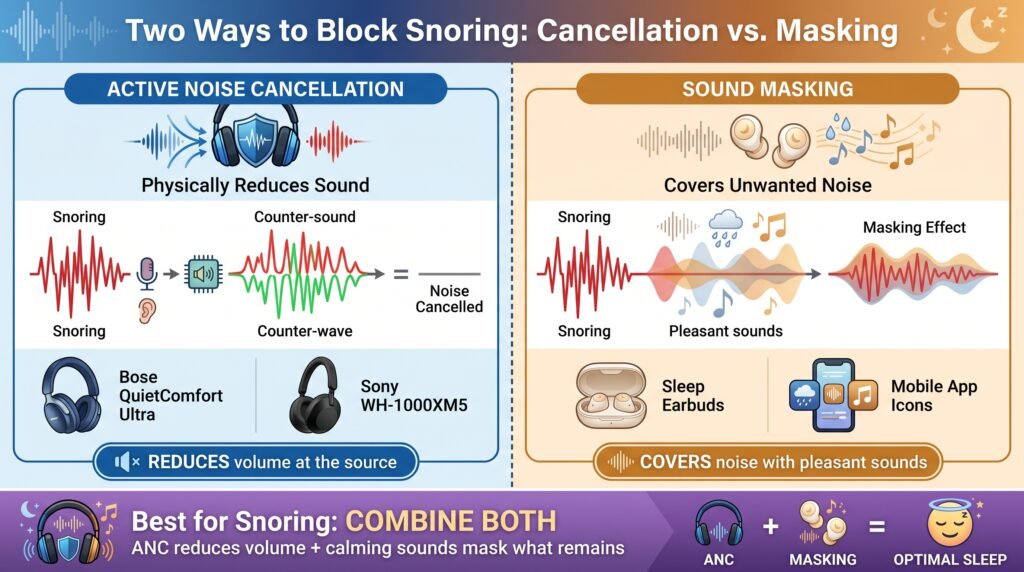
For many people dealing with snoring, a combination of both works best: ANC headphones to reduce the volume of the snoring itself, plus a calming background sound to mask whatever gets through.
Key Points
A few things matter more than brand name when you’re choosing headphones specifically for this purpose:
- Low-frequency ANC performance matters more than overall noise cancellation ratings, since snoring lives mostly in that range.
- Comfort for sleeping is essential — bulky over-ear headphones aren’t ideal if you sleep on your side.
- Battery life should comfortably cover a full night, ideally 20+ hours.
- Fit and seal affect passive isolation just as much as the active cancellation does
- Sound masking features (white noise, rain sounds, etc.) can fill the gaps that ANC alone doesn’t catch.
If you’re a side sleeper, traditional over-ear ANC headphones can be uncomfortable to lie on for hours. This is where in-ear sleep-specific options tend to win, even if their raw noise cancellation isn’t as strong on paper.
Examples and Case Studies
Case 1: The Back Sleeper Using Over-Ear ANC
Someone who sleeps mostly on their back can comfortably wear larger over-ear headphones, such as the Bose QuietComfort Ultra or Sony WH-1000XM5, through the night. The Sony model in particular is known for its adaptive sound control, which adjusts cancellation levels based on the surrounding noise rather than applying a single fixed setting. We’ve covered this model in more depth in our Sony WH-1000XM5 overview, including how its ANC performs across different noise types.
The tradeoff is that these headphones aren’t designed primarily for sleep, so overnight comfort varies depending on how the headband and ear cups sit against a pillow.
Case 2: The Side Sleeper Using Sleep Earbuds
For side sleepers, bulky headphones simply don’t work — they press uncomfortably into the ear and pillow. Sleep-specific earbuds, which are smaller and flatter, solve the comfort problem but rely more heavily on masking sounds than true active cancellation.
The result is less about silencing the snoring entirely and more about making it less noticeable underneath rain sounds or white noise.
Case 3: The Light Sleeper Combining Both
Some people use noise-masking apps alongside basic passive isolation, rather than investing in premium ANC headphones at all. This budget-conscious approach can work reasonably well for lighter snoring, though it’s less effective against louder or more irregular snoring patterns.
Expert Insights
Audio engineers generally agree that no current consumer ANC headphones are purpose-built specifically for snoring — they’re engineered for environmental noise like air travel, traffic, and office chatter. Snoring just happens to fall partly within the frequency range these headphones already target.
That means when people ask which noise-cancelling headphones are good for snoring, the honest answer is: the best general-purpose ANC headphones tend to also be the best at reducing snoring, simply because strong low-frequency cancellation transfers over reasonably well.
A few practical insights worth knowing:
- Adaptive ANC (which adjusts in real time to ambient sound) tends to respond better to the irregular nature of snoring than fixed-mode ANC.
- A proper ear seal matters as much as the ANC chip itself — leaky fit undermines even premium noise cancellation.
- Combining ANC with a low white noise track tends to outperform ANC alone for most people.
This connection between sleep quality and next-day performance is also why so much of our content on Best Focus Music circles back to the same core idea: the right headphones aren’t just a comfort item, they’re part of how well you function the next day, whether that’s at a desk, in a meeting, or trying to study.
Additional Resources
If snoring noise is part of a bigger picture — say, you’re also dealing with general focus issues, light sleep, or sensitivity to background noise during the day — it can help to look at this from a broader angle rather than just buying headphones and hoping for the best.
Things to look into to learn which noise-cancelling headphones are good for snoring:
- How focus music and ambient soundscapes can support sleep and daytime concentration.
- The difference between passive isolation (physical blocking) and active cancellation (electronic blocking), and why combining both gives the most reliable results
- How sleep quality directly affects concentration and energy levels during work or study
We go into these topics in more depth elsewhere on the site, particularly around noise cancellation fundamentals and how disrupted sleep shows up as a focus problem the next day.
Conclusion
So which noise-cancelling headphones are good for snoring? First, we want to make clear that there’s no single perfect pair of headphones that eliminates snoring entirely — the irregular, mixed-frequency nature of snoring makes that a genuinely hard problem for current ANC technology. But headphones with strong low-frequency noise cancellation, like the Bose QuietComfort Ultra and Sony WH-1000XM5, tend to perform noticeably better than average. You can read our Sony WH-1000XM5 comparison for a closer look at how it stacks up against Bose on noise cancellation specifically.
If comfort while sleeping matters more to you than maximum cancellation, then smaller sleep-focused earbuds that rely on sound masking are often a more practical choice, especially for side sleepers or people who turn a lot in their sleep.
Either way, it’s worth remembering that this isn’t only about getting through the night. A good night’s sleep is one of the simplest ways to protect your focus the next day — and for a lot of people, the headphones on their nightstand matter just as much as the ones on their desk.
Frequently Asked Questions
Can noise-cancelling headphones completely block out snoring? They can’t. ANC reduces the volume and intensity of low-frequency sound, but irregular bursts of snoring still often get through to some degree.
Are Bose or Sony better for blocking snoring sounds? Both are good options and are strong performers for low-frequency noise. Bose is often noted for handling steady, droning sounds particularly well, while Sony’s adaptive sound control can respond more dynamically to changing noise levels.
Is it better to use earbuds or over-ear headphones for snoring? It mostly comes down to sleep position. Back sleepers tend to do fine with over-ear headphones, while side sleepers usually find smaller in-ear options more comfortable for a full night. You can not sleep on your side while wearing headphones.
Do I need to spend a lot of money to reduce snoring noise? That depends on the result you prefer. Premium ANC headphones perform best, but pairing budget headphones with a white noise app can also reduce how disruptive snoring feels and sounds. That’s especially for lighter snoring.
Will noise-masking apps work as well as noise-cancelling headphones? They work just differently. Masking covers the sound rather than reducing it, which can be just as effective for some people, particularly when combined with even basic passive isolation.
Does bad sleep from snoring really affect work focus the next day? Yes — disrupted sleep reduces deep sleep time, which is when the brain handles memory and attention recovery. Even partial sleep disruption tends to show up the next day as grogginess and difficulty concentrating.
Some of the links on Best Focus Music are affiliate links. This means that if you click a link and buy something, we may earn a small commission — at no extra cost to you. We only recommend products we genuinely think are worth your time.
We are a participant in the Amazon Associates Program, an affiliate advertising program designed to provide a means for sites to earn advertising fees by linking to Amazon.com and affiliated sites. We may also work with other affiliate networks and individual brands from time to time.