Quick Answer
Why do people with ADHD like music so much? Honestly, the simplest answer is this: music gives the brain something to hold onto.
For a lot of people with ADHD, silence isn’t peaceful. It’s just empty space that the brain immediately starts filling with whatever it can find — stray thoughts, old memories, the mental to-do list that has nothing to do with the task in front of you. Music gets in the way of all that, in the best possible sense.
It also helps with mood and motivation, and with making genuinely boring work feel slightly less like torture. Though it’s worth saying upfront: it doesn’t work the same way for everyone, and the type of music matters more than most people expect.
Understanding the Question
Spend five minutes in any ADHD subreddit or forum, and music comes up almost immediately. People sharing playlists, debating whether lo-fi actually works, talking about the album they’ve had on repeat for three months straight. It’s a recurring theme.
And it makes sense that people notice this pattern and start wondering about it. If outside noise is supposed to be distracting, why are so many people with ADHD actively seeking it out? Why does putting headphones on feel like flipping a switch?
The answer isn’t one thing. It’s a few things stacked on top of each other.
What ADHD Actually Feels Like (From the Inside)
ADHD gets described as an attention disorder, but that framing misses something. It’s not that the attention isn’t there — it’s that it doesn’t respond well to direction. It goes where it wants, when it wants, regardless of what you actually need it to do.
Interesting task? Great, you’re locked in for four hours. Routine admin that needs doing? Suddenly, everything else in the room is fascinating.
This is why someone with ADHD can lose an entire afternoon to a video game but can’t get through a single email. It’s not a motivation problem in the traditional sense — the brain just has a much higher bar for what counts as worth paying attention to.
The Dopamine Connection
A lot of what’s going on with ADHD traces back to dopamine — a neurotransmitter tied to motivation, reward, and keeping your attention pointed in the right direction. The current thinking is that ADHD brains process dopamine differently, which helps explain why low-stimulation tasks feel so genuinely difficult rather than just mildly annoying.
The brain isn’t being lazy. It’s looking for stimulation because that’s what it needs to stay engaged. Music — especially music you actually like — is a pretty reliable way to provide it.
It offers novelty, some emotional pull, and just enough structure to keep things moving without demanding your full attention. That combination is harder to find than it sounds.
Detailed Explanation
Silence Isn’t Neutral for Everyone
Most productivity advice assumes quiet equals focus. And for plenty of people, that’s true — a silent room is ideal. For a lot of people with ADHD, though, silence is almost the worst option.
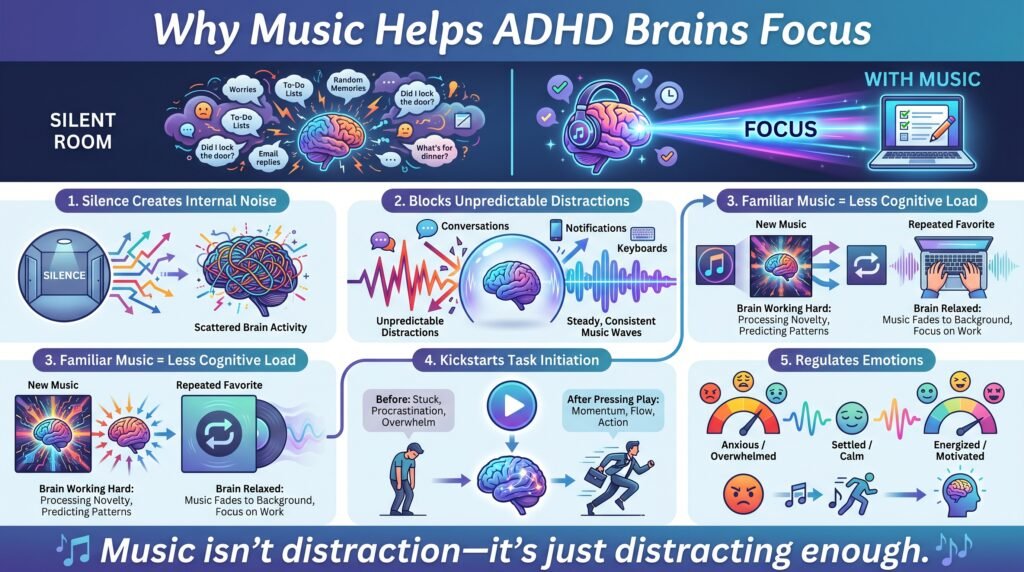
Take away external noise, and the brain doesn’t calm down. It just starts generating its own noise — thoughts, half-formed plans, memories, worries about things that aren’t relevant right now. The to-do list runs in the background. Focus drifts before you’ve even started.
Music interrupts that loop. It gives the brain a background process to run, which paradoxically leaves more room for actual work. Not because it’s distracting, but because it’s just distracting enough.
It Blocks Out Unpredictable Noise
One of the trickier aspects of ADHD is how hard it is to filter out irrelevant information. A conversation happening across the room, a notification sound, someone’s keyboard — these things can derail focus completely, even if they barely register for other people.
Music creates a consistent audio environment that makes unpredictable sounds less disruptive. Instead of the brain reacting to every new noise, it has something steady to rest against. It’s not silence, but it’s controlled — and for a lot of people, that’s actually more useful.
Familiar Music Reduces Cognitive Load
Here’s something that surprises people: a lot of individuals with ADHD listen to the exact same music on repeat, sometimes for months. Not because they can’t be bothered to find anything new, but because familiarity is actually the point.
When you already know a track inside out, it no longer demands your attention. Your brain isn’t waiting to hear what comes next. The music just runs in the background, doing its job without getting in the way. New music, or music with unpredictable shifts and sudden changes, can actually pull you out of focus rather than support it.
It Helps with Getting Started
Getting started is often harder than the actual work. That first moment of sitting down and beginning — for people with ADHD, that transition can feel genuinely stuck, even when you know exactly what needs doing.
Music can act as the thing that kicks it off. Play a specific playlist only during work sessions, and over time, the brain starts associating that sound with getting into it. Pressing play becomes the ritual. The task feels slightly less like dragging yourself through the mud at the start.
Emotional Regulation Plays a Role Too
Focus is only part of the picture. ADHD also affects how emotions are regulated — something that doesn’t get nearly as much airtime as the attention side. Frustration kicks in faster, boredom is more intense, and restlessness is harder to sit with.
Music moves emotional states around quickly. Something calm can take the edge off when anxiety is making it impossible to settle. Something with a bit more energy can pull you out of that flat. It’s not complicated, but it works — and for a lot of people with ADHD, getting the emotional state right is half the battle.
What Types of Music Actually Work
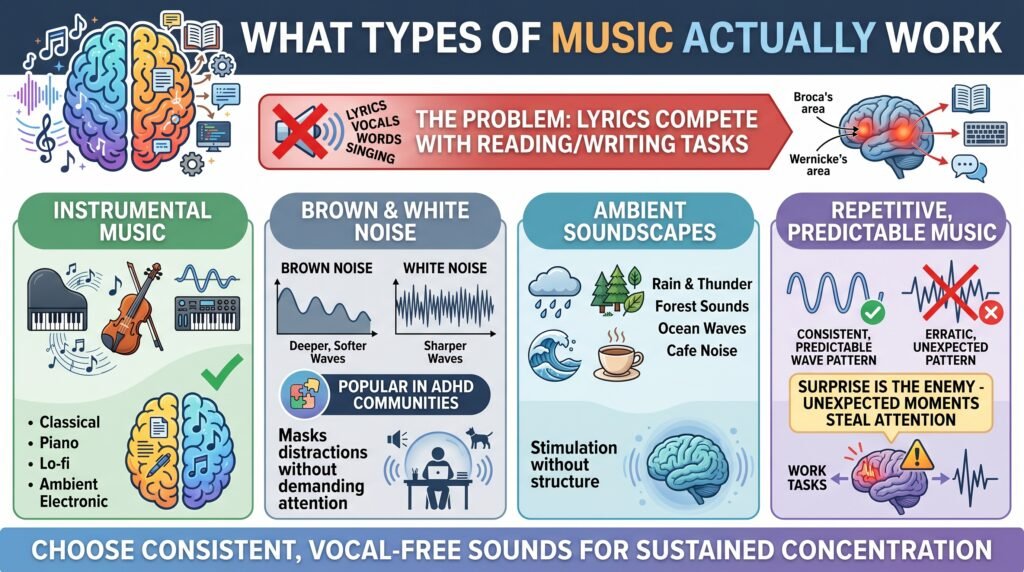
Not all music helps equally, and some music actively makes focus worse. Lyrics are a common culprit. If language-processing parts of the brain are engaged by lyrics, there’s less capacity left for reading, writing, or anything else that involves words.
Instrumental Music
Classical, piano, lo-fi, ambient electronic — anything without vocals tends to be easier to work alongside. The brain isn’t trying to process language at the same time as you’re trying to produce it.
Brown Noise and White Noise
Brown noise in particular has become popular in ADHD communities. It’s deeper and warmer than white noise — less harsh — and many people find it easier to sustain over long periods. It masks distracting sounds without adding anything that demands attention.
Ambient Soundscapes
Rain, forest sounds, ocean waves, café background noise — these sit in a similar space to brown noise but feel more natural to some people. They provide stimulation without structure, which works well for tasks that require sustained but not intense concentration.
Repetitive, Predictable Music
Whatever genre you prefer, tracks with a consistent structure tend to work better for focus than ones with lots of variation. Surprise is the enemy of background music — every unexpected moment pulls a small amount of attention away from what you’re doing.
Key Things to Remember
There’s no universal answer. What works brilliantly for one person with ADHD might be completely useless for another. This is an area where personal experimentation matters more than any general recommendation.
Volume matters. Music that’s too loud becomes the main event rather than the background. Most people find a lower volume more sustainable over longer sessions.
The task matters too. Music that helps during repetitive or administrative work might not be right for deep reading or complex problem-solving. It’s worth having different options for different kinds of tasks.
It’s not a cure. Music can create better conditions for focus, but it doesn’t address the underlying challenges of ADHD. Think of it as one tool among several, not a replacement for other strategies or professional support.
How This Plays Out in Practice
Take a software developer working from home, dealing with ADHD and a noisy environment. Silence makes the mind wander; background household noise is constantly interrupting. A consistent ambient playlist — something without lyrics, something familiar — creates a steady audio layer that makes it easier to stay in a flow state during long coding sessions.
Or consider a PhD student working through dense research papers. Without background audio, attention drifts every few minutes. With familiar instrumental music playing quietly, reading sessions last longer and mind-wandering occurs less.
Or a freelance writer who struggles with the blank page. Building a specific “work playlist” — one that only gets played during writing sessions — turns pressing play into a ritual that makes starting the work easier. The music becomes a cue, not just a soundtrack.
None of these is a magic solution. But they’re practical adjustments that make the day a bit more manageable.
What Research and Professionals Generally Say
The research on music and ADHD is still developing, and most experts are careful not to overclaim. The evidence suggests that background music or noise can support attention in some contexts — particularly for tasks that don’t require intensive language processing.
There’s also reasonable evidence that moderate levels of ambient noise (think: a quiet café) can improve creative performance for some people. That’s part of why lo-fi and café ambiance playlists have become so popular for focused work.
Most clinicians would frame music as a useful environmental tool — something worth experimenting with — rather than a treatment. It can support focus, but it works best as part of a broader approach that might include structure, routine, breaks, and, where appropriate, professional support.
Additional Resources
If you’re exploring ways to improve focus alongside managing ADHD, a few things are worth trying:
Brown noise generators — free, web-based tools that let you dial in exactly the sound you want without needing to find a playlist.
Lo-fi and ambient playlists — widely available on most streaming platforms, and a good starting point if you’re not sure what works for you yet.
Noise-cancelling headphones — if environmental noise is a major issue, getting the right headphones makes a significant difference. We’ve put together a detailed comparison of popular noise-cancelling models to help you figure out which ones are worth considering for focus and everyday use. Read our comparison here.
Professional support — if ADHD is significantly affecting your work or study, speaking to a specialist is worth doing. There are well-established approaches beyond music that can make a real difference.
Conclusion
So, why do people with ADHD like music so much? Brain chemistry is part of it. Practicality is part of it. And honestly, habit is part of it too — once you find something that actually helps, you stick with it.
Music isn’t a fix. It doesn’t make ADHD go away, and it won’t work identically for every person. But for a lot of people, it’s one of the more reliable things in the toolkit — something that makes the difference between a day that functions and one that doesn’t.
If you haven’t played around much with different types of audio yet, it’s genuinely worth the experiment. The gap between music that helps and music that quietly makes things worse is bigger than most people expect.
Frequently Asked Questions
Why do people with ADHD like music so much? Mostly because silence doesn’t really work for them. Music provides the brain with a steady source of stimulation that keeps it from wandering off — and it also helps with mood and motivation, which matter more than people realize.
Does music actually improve ADHD symptoms? It doesn’t treat ADHD, no. But it can make the conditions for focus a lot better. Think of it less as a solution and more as a way of setting up your environment so that getting things done is slightly less of a fight.
What type of music works best for ADHD focus? Anything without lyrics is usually a safer bet — classical, lo-fi, ambient electronic, brown noise. Familiar and repetitive tend to beat new and varied. But honestly, it varies from person to person, so it’s worth trying a few things.
Why do people with ADHD listen to the same songs on repeat? Because they already know what’s coming. Familiar music doesn’t demand attention the way new music does — it just sits in the background and does its job, which is exactly the point.
Is silence better than music for people with ADHD? For some people, yes. For many, not at all — a quiet room just gives the brain more room to wander. The only real way to know is to try both and see what actually happens to your focus.
Some of the links on Best Focus Music are affiliate links. This means that if you click a link and buy something, we may earn a small commission — at no extra cost to you. We only recommend products we genuinely think are worth your time.
We are a participant in the Amazon Associates Program, an affiliate advertising program designed to provide a means for sites to earn advertising fees by linking to Amazon.com and affiliated sites. We may also work with other affiliate networks and individual brands from time to time.