I spent the last few weeks researching focus music apps. In this guide, we’ll compare the best apps available today and explain which one is worth your money. If you’re looking for the best focus music, this comparison will help you find the right platform for your work style and budget.
Why can you benefit from focus music?
Whether you’re studying for exams, working from home, or trying to stay productive in a noisy office, the right audio can make a difference. Focus apps are becoming increasingly popular because they’re designed specifically to help reduce distractions and support concentration.
How We Evaluated These Apps
Not every app serves the same purpose, so we compared them using the following criteria:
- Audio quality
- Variety of music and soundscapes
- Scientific approach
- Personalization
- User friendliness
- Pricing
- Offline listening
- Free trial availability
Besides comparing features, we also looked at how practical each app is for everyday use, and we considered value for money. The right choice depends on how often you expect to use the app.
So now dive into it!
Our Top Apps
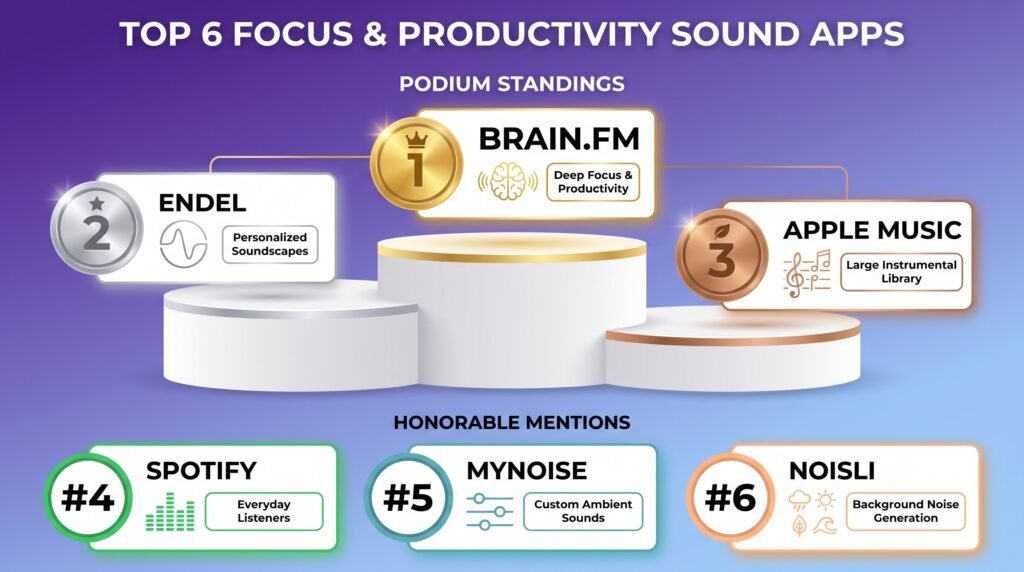
| 🥇 | Brain.fm | Deep focus and productivity |
| 🥈 | Endel | Personalized soundscapes |
| 🥉 | Apple Music | Large instrumental library |
| 4 | Spotify | Everyday listeners |
| 5 | myNoise | Custom ambient sounds |
| 6 | Noisli | Background noise generation |
Detailed Reviews
1. Brain.fm – Best Overall for Deep Work ⭐⭐⭐⭐⭐
Brain.fm isn’t just another streaming service. Instead of relying on existing songs or playlists, it creates music specifically designed to support concentration, relaxation, or sleep.
The platform shows its audio is engineered to encourage and keep attention. Everyone can use it, but their main target audience is workers, students, programmers, and writers who spend hours on mentally demanding tasks.
For users who struggle to concentrate in noisy environments, Brain.fm can also work well alongside a pair of noise-cancelling headphones. Together, they create a calmer workspace where external distractions become less noticeable.
One of the reasons Brain.fm stands out is that it removes many of the elements that typically distract listeners. Instead of dramatic changes in rhythm or recognizable melodies, the sessions remain consistent from beginning to end. This makes it easier to stay immersed in demanding tasks like writing, coding, or studying.
The interface is refreshingly simple. You choose your goal—Focus, Relax, or Sleep—and Brain.fm generates continuous sessions without lyrics or sudden changes that might interrupt your workflow.
Pros
- Designed specifically for concentration
- Minimal distractions
- Excellent session customization
- Mobile and desktop apps
- 30-day free trial
Cons
- Monthly subscription
- Smaller library than Spotify
Want to know whether it’s worth paying for? Read our complete Brain.fm review before making your decision.
2. Endel – Best Personalized Experience
Endel generates adaptive soundscapes based on factors like the time of day and your activity. Instead of playlists that already exist, the audio changes gradually to maintain a calm listening experience.
It’s particularly well suited to people who enjoy ambient sounds rather than traditional music.
If your workday varies from one task to another, Endel can be an option to consider. Because the soundscapes adapt over time, the listening experience feels less repetitive than looping the same playlist for hours.
Pros
- Adaptive audio
- Beautiful design
- Excellent relaxation modes
Cons
- Less suitable for people who prefer actual music
- Subscription required
3. Apple Music – Best for Apple Users
Apple Music includes thousands of instrumental albums, classical playlists, lo-fi beats, and ambient music.
Although it isn’t specifically designed for productivity, its recommendation engine makes it easy to discover new artists and playlists.
If you’re already paying for Apple Music, it may be all you need.
Pros
- Huge music library
- Excellent sound quality
- Offline listening
Cons
- No productivity-focused features
4. Spotify – Best Free Option
Spotify remains one of the easiest ways to discover productivity playlists.
Search for:
- Lo-fi beats
- Classical piano
- Ambient electronic
- White noise
- Study playlists
The downside is consistency. Since playlists are created for entertainment rather than concentration, songs can vary significantly in tempo and mood.
Pros
- Massive selection
- Free plan available
- Excellent recommendations
Cons
- Ads on free version
- Playlists can become repetitive
5. myNoise – Best Ambient Sound Generator
myNoise lets you build your own sound environment by combining rain, wind, café ambiance, waterfalls, fans, and dozens of other sounds.
It is especially useful for people who are easily distracted by conversations in open offices or, for example, household noise while working from home.
6. Noisli – Best for Simplicity
Noisli focuses on customizable background sounds instead of music. You can combine rain, thunder, or forest sounds to create a distraction-free workspace.
It’s especially useful if lyrics or melodies easily pull your attention away from work. You can combine Noisli with techniques such as the Pomodoro Method or time blocking. Having consistent background sounds during each work session can help create a routine that signals to your brain it’s time to focus.
This technique is something you can probably use in combination with all the apps we discussed before.
Still not sure which focus music service is right for you? Our Focus Music Buyer’s Guide explains what to look for when comparing focus audio, from task-specific soundscapes to traditional playlists, and why Brain.fm may be worth trying if you want audio designed specifically for focused work.
Comparison Table
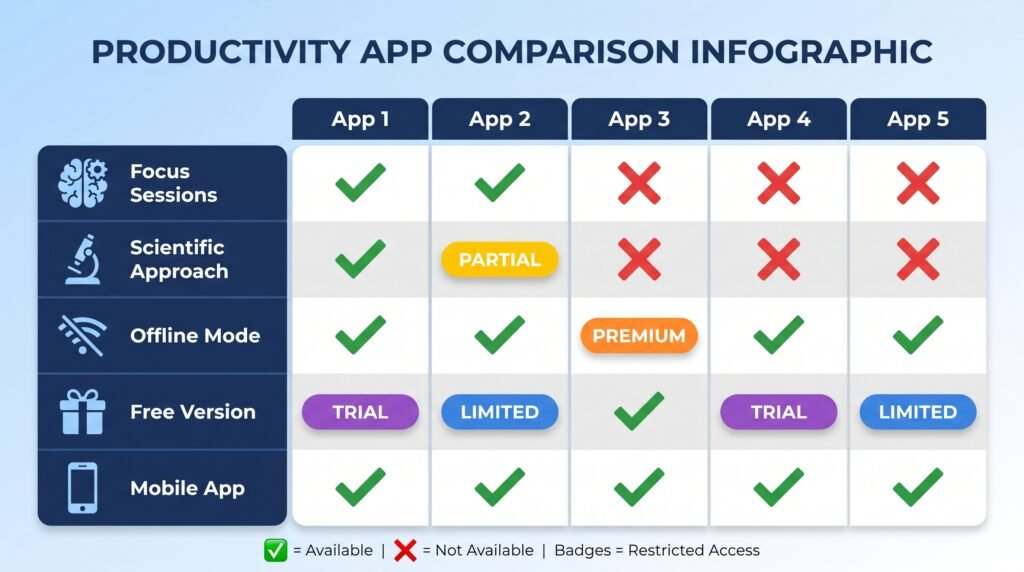
| Focus Sessions | ✅ | ✅ | ❌ | ❌ | ❌ |
| Scientific Approach | ✅ | Partial | ❌ | ❌ | ❌ |
| Offline Mode | ✅ | ✅ | Premium | ✅ | ✅ |
| Free Version | Trial | Limited | ✅ | Trial | Limited |
| Mobile App | ✅ | ✅ | ✅ | ✅ | ✅ |
Buying Guide
Choosing the right app depends on how you work.
Choose Brain.fm if:
- You spend hours doing deep work.
- You struggle with office distractions.
- You want music created specifically for concentration.
- You’re happy to pay for a specialized tool.
Still comparing options? See our in-depth Brain.fm review to learn how it performs in real-world use, including its strengths and weaknesses.
Choose Spotify if:
You already have Premium and want access to thousands of playlists without paying for another subscription.
Choose Apple Music if:
You have more Apple devices, have integrated the ecosystem, and enjoy discovering instrumental music.
Choose Endel if:
You prefer evolving soundscapes over traditional songs.
Is Focus Music Actually Worth It?
No app can magically make you productive. Good sleep, healthy habits, and a distraction-free workspace will always be more important than any playlist.
However, many people find that consistent background audio helps mask unpredictable noises such as conversations, keyboard clicks, or traffic. Specialized apps like Brain.fm and Endel take this one step further by removing many of the musical elements that typically grab your attention, allowing you to stay immersed in your work for longer.
Final Thoughts
As we discussed in this guide, there are plenty of excellent apps available in 2026, but each serves a different audience.
If you’re looking for music playlists and variety, Spotify and Apple Music remain fantastic choices. If you prefer adaptive ambient soundscapes, Endel is an excellent option.
However, if your primary goal is improving concentration during demanding work, Brain.fm stands out as the strongest overall choice. Its distraction-free sessions, simple interface, and focus on sustained attention make it different from traditional music streaming services.
Ready to experience it yourself? Start Brain.fm’s 30-day free trial and see whether dedicated focus audio helps you work with fewer distractions. There’s no better way to decide if it’s the right fit for your workflow than to try it out yourself.
Frequently Asked Questions
Does focus music really work?
It can be helpful while working or studying. The main benefit is that it can mask distracting background noises, such as conversations or keyboard clicks. Focus music makes it easier to maintain concentration.
Specialized apps like Brain.fm and Endel go a step further by creating audio designed to stay in the background rather than constantly grabbing your attention. While results vary from person to person, combining focus music with good work habits—such as taking breaks and minimizing distractions—can create a more productive environment.
Is Brain.fm better than Spotify?
That depends on what you’re looking for.
If your goal is simply to enjoy music while working, Spotify offers millions of playlists across every genre imaginable. However, Spotify is designed primarily for entertainment; playlists may include songs with lyrics, changing tempos, or advertisements that interrupt your focus.
Brain.fm takes a different approach. Instead of streaming existing songs, it generates sessions specifically designed for concentration, relaxation, or sleep. The audio remains consistent throughout each session, making it a better choice for deep work and mentally demanding tasks.
If you’re still unsure which platform suits your needs, be sure to read our complete Brain.fm review for a detailed comparison.
Can I use focus music while studying?
Absolutely. That’s one of the main things people use focus music for. You can use it while reading, writing essays, preparing for exams, or completing assignments.
It is important to choose an audio that doesn’t distract you. Instrumental music, ambient soundscapes, or specially designed focus sessions tend to work better than popular songs with vocals. Everyone studies differently, so it’s worth experimenting with different styles to discover what helps you stay focused for longer periods.
Should I listen with headphones?
Headphones aren’t essential, but they often provide the best listening experience—especially if you work in a noisy environment.
A good pair of noise-cancelling headphones can reduce distractions from coworkers, household noise, or public spaces, allowing the audio to do its job more effectively. If you’re working somewhere quiet, regular headphones or speakers can also work well, although speakers may be less practical if other people are nearby.
Is instrumental music better than music with lyrics?
For many people, yes.
Lyrics naturally attract your attention because your brain processes spoken language, even when you’re trying to ignore it. This can make reading, writing, or studying more difficult.
Instrumental music or classical pieces, for example, are better options for tasks that require sustained concentration. Since there are no vocals competing with your thoughts, they’re less likely to interrupt your workflow.
Personal preference still plays an important role. Maybe you like working while listening to songs with lyrics? Or you find complete silence or ambient sounds more effective. We recommend experimenting and choosing the listening style that helps you stay productive.
Some of the links on Best Focus Music are affiliate links. This means that if you click a link and buy something, we may earn a small commission — at no extra cost to you. We only recommend products we genuinely think are worth your time.
We are a participant in the Amazon Associates Program, an affiliate advertising program designed to provide a means for sites to earn advertising fees by linking to Amazon.com and affiliated sites. We may also work with other affiliate networks and individual brands from time to time.