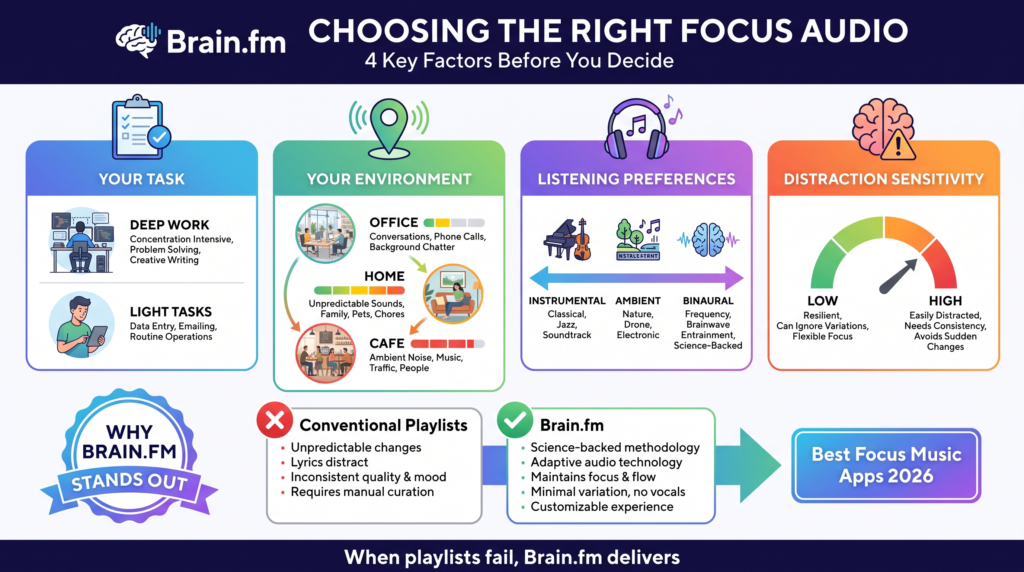
What should you actually look for when choosing audio for focused work?
The answer depends on your task, environment, listening preferences, and how easily you become distracted by changes in the audio.
This guide walks through the most important factors to consider before choosing a focus music-audio service. We’ll also look at where Brain.fm fits into the picture and why it is worth considering if conventional playlists haven’t worked well for you.
If you’re already comparing specific apps, you can also see our best focus music apps for 2026 for a broader look at the available options.
Understanding the Basics
What makes audio suitable for focused work?
Not all music serves the same purpose.
Music created primarily for entertainment is designed to hold your attention. It may include memorable melodies, lyrics, dramatic transitions, tempo changes, or emotional moments.
Those characteristics are not necessarily bad. They are part of what makes music enjoyable.
However, they can become inconvenient when your primary goal is to concentrate on something else.
For demanding tasks such as writing, programming, studying, reading, or analyzing information, you may prefer audio that stays relatively unobtrusive.
That is why many people gravitate toward:
- Instrumental music
- Ambient soundscapes
- Classical music
- Lo-fi
- Brown or white noise
- Nature sounds
- Purpose-built functional audio
Some people concentrate best in silence. Others need consistent background sound to prevent environmental distractions from becoming the focus of their attention.
Why ordinary playlists can become frustrating
A traditional playlist puts you in control of the music.
That sounds like an advantage, but it can introduce its own problems.
You may spend time searching for the right playlist, skipping songs, adjusting the volume, or looking for something new when the current playlist starts feeling repetitive.
Individual songs can also be unpredictable.
A track you normally enjoy might suddenly contain a memorable chorus, dramatic transition, or sound that makes you stop working and listen. It can create exactly the kind of interruption they were trying to avoid.
Key Considerations When Choosing Focus Audio
Before paying for an audio service, consider these five factors.
1. Your type of work
Start with the task, not the music.
Different activities place different demands on your attention.
We quickly go over the different types of work there are:
Deep work:
Writing, coding, research, analysis, and complex problem-solving generally benefit from a relatively stable auditory environment.
Light work:
Email, administration, filing, and repetitive tasks give you more freedom to listen to conventional music.
Creative work:
Design, brainstorming, photography, and other creative activities work better with music you personally enjoy.
Reading and studying:
Lyrics can be particularly distracting if you are simultaneously processing written language.
The best audio is the option that interferes least with the task you’re trying to complete.
2. How distracting your environment is
Your environment matters as much as your music.
Working from a quiet home office is very different from working in an open-plan office, coffee shop, university library, or shared workspace.
If people talking nearby constantly pull your attention away from your work, you may want audio that creates a more consistent sound environment.
This is also where headphones can make a significant practical difference.
If background noise is one of your biggest problems, take a look at our guide on which headphones cancel the most noise before choosing your audio setup.
3. Predictability vs. variety
More variety isn’t always better.
With entertainment music, variety is usually desirable. When you’re working, however, constant changes can become another source of stimulation.
Ask yourself:
- Do I want recognizable songs?
- Do I enjoy hearing lyrics while working?
- Do I constantly skip tracks?
- Do I get tired of repetitive playlists?
- Do sudden changes in sound pull my attention away?
If you frequently answer yes, a purpose-built audio platform may be worth testing.
4. Scientific approach
This is one area where buyers should be careful.
A service describing itself as “science-backed” does not automatically mean that every claim made about its effects has been independently established.
Look at what the company actually explains about its research.
Brain.fm, for example, publishes information about its approach to audio modulation, EEG and fMRI research, and performance testing. The company says its experiments include control conditions so that it can compare its technology with unmodulated versions of music.
That doesn’t mean you should assume the technology will produce the same experience for everyone.
Instead, scientific research can be one factor that separates purpose-built audio from a playlist labeled “deep focus.”
5. Ease of use
If you have to spend ten minutes finding the right playlist every time you sit down to work, the tool itself becomes a distraction.
Ideally, your audio routine should be simple:
- Choose your task.
- Start the audio.
- Put your phone away.
- Begin working.
This is one area where dedicated focus platforms can be convenient.
Why Brain.fm Stands Out
Brain.fm takes a different approach from conventional streaming services.
Instead of simply collecting existing songs into productivity playlists, the company describes its product as functional music designed around particular mental states and activities.
Its Focus section includes options such as Deep Work, Learning, Creativity, Light Work, and Motivation. The service also has separate Relax, Sleep, and Meditation experiences.
That task-based approach is useful because you don’t necessarily want the same type of audio for every activity.
Brain.fm also says that its music is created with reduced attention-grabbing elements, including no lyrics in its focus audio and longer tracks intended to minimize interruptions.
Another difference is its use of audio modulation.
According to Brain.fm, its technology uses rhythmic modulation and neural phase-locking principles rather than simply providing conventional ambient music. The company also explicitly distinguishes its approach from traditional binaural beats.
Whether that difference matters to you is something you can only determine by actually using the service.
I’ve used Brain.fm myself, and that is one reason a personal trial is more useful than simply reading another list of claims. The listening experience is different enough from a normal playlist that it makes sense to test it during your actual work rather than judging it from the concept alone.
Try it in your real workflow
If you’re curious about Brain.fm, the best approach isn’t to decide immediately that it will transform your productivity.
Instead, test it properly.
Use it during the type of work where you normally struggle to maintain concentration. Keep your work environment relatively consistent and compare how the sessions feel with your usual audio—or with silence.
Try Brain.fm for yourself and decide based on your own experience rather than someone else’s productivity routine.
Step-by-Step Guide to Choosing the Right Audio
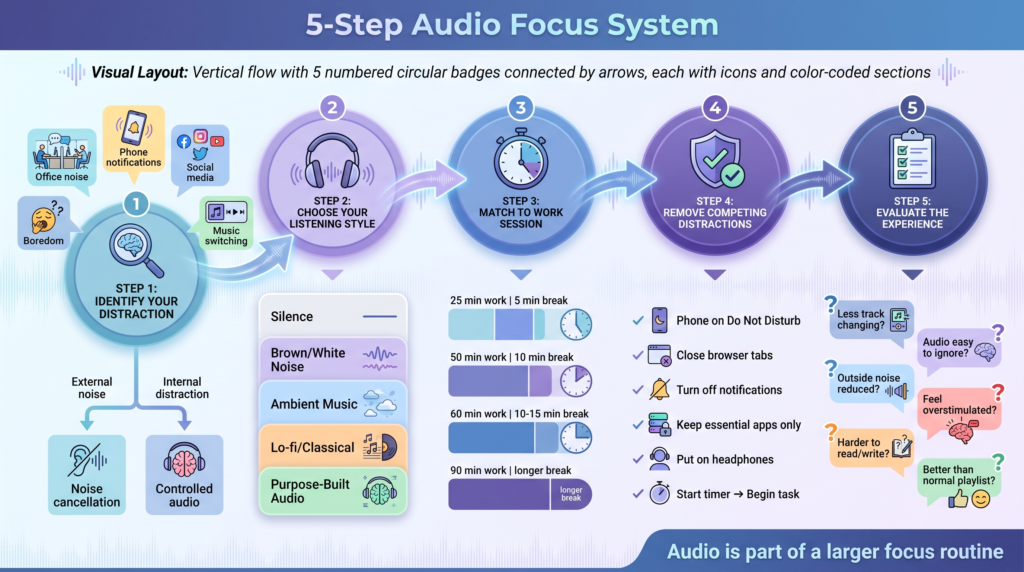
Step 1: Identify your biggest distraction
Before choosing an app, determine what’s actually causing the problem.
Is it:
- Office conversations?
- Household noise?
- Your phone?
- Social media?
- Boredom?
- Constantly changing music?
- Difficulty getting started?
If external noise is the issue, noise cancellation may be more important than the music itself.
If music constantly distracts you, a more controlled audio environment could be the better solution.
Step 2: Choose your listening style
Start with the simplest option that could solve your problem.
Try:
Silence if your environment is already quiet.
Brown or white noise if you primarily need sound masking.
Ambient music if you want something musical but unobtrusive.
Lo-fi or classical if you enjoy recognizable musical structures without prominent lyrics.
Purpose-built audio if you want something specifically designed around focused work rather than entertainment.
Step 3: Match the audio to a work session
Don’t play audio for eight hours immediately.
Instead, create a defined experiment.
For example:
- 25 minutes of work + 5 minutes break
- 50 minutes of work + 10 minutes break
- 60 minutes of work + 10–15 minutes break
- 90 minutes of work + longer break
The right duration depends on your task and personal working style.
You can also use our deep work session timer to structure the session without constantly checking the clock. The tool is free to use.
Step 4: Remove competing distractions
Audio cannot compensate for a workspace full of interruptions.
Before starting:
- Put your phone on Do Not Disturb.
- Close unnecessary browser tabs.
- Turn off non-essential notifications.
- Keep only the documents and applications you need.
- Put on your headphones.
- Start your timer.
- Begin the task immediately.
The goal is to make the audio part of a larger focus routine.
Step 5: Evaluate the experience
After several sessions, ask yourself:
Did I spend less time changing tracks?
Did the audio become easy to ignore?
Did outside noise bother me less?
Did I feel overstimulated?
Did the audio make reading or writing harder?
Would I choose this over my normal playlist?
These questions are more useful than simply asking whether the music “felt productive.”
Expert Tips for Getting More From Your Setup
Use headphones strategically
Headphones can make your audio environment much more predictable.
In noisy workplaces, active noise cancellation can reduce environmental sound competing with your chosen audio.
For Brain.fm specifically, stereo headphones can also be useful because the service’s audio processing is designed around stereo playback.
You don’t necessarily need the most expensive headphones available. Comfort matters because you’ll be wearing them for extended periods.
Don’t automatically increase stimulation
More intense audio isn’t automatically better.
If your music feels too noticeable, distracting, or tiring, try reducing the intensity rather than turning it up.
The ideal background sound is often the sound you stop consciously thinking about.
Create an audio ritual
Consistency can be useful.
For example:
Headphones on → Brain.fm starts → phone away → timer starts → work begins.
Over time, that sequence can become a familiar starting routine.
The purpose isn’t to convince yourself that the audio has magical properties. It simply reduces the number of decisions you have to make before beginning.
Test audio with difficult tasks
If you’re evaluating a focus tool, don’t only test it while answering easy emails.
Use it for something that genuinely requires concentration.
Try writing a difficult article, studying a challenging chapter, programming, analyzing data, or working through a complicated project.
That’s where you’ll learn whether the audio actually fits your workflow.
If you’re particularly interested in Brain.fm, our full Brain.fm review goes deeper into the platform, features, pricing, and practical experience.
Common Mistakes to Avoid
Assuming everyone needs music
Some people genuinely work better in silence.
If music makes you concentrate on the audio instead of your work, don’t force yourself to use it.
The goal is concentration—not listening to music for its own sake.
Using music to compensate for poor sleep
Audio can be one part of a focus environment, but it isn’t a substitute for rest.
If you’re exhausted, constantly interrupted, or trying to work without meaningful breaks, changing your playlist is unlikely to solve the underlying problem.
Listening too loudly
Your audio should be comfortable enough that you can largely ignore it.
Turning the volume up doesn’t automatically make the audio more effective.
Constantly changing your setup
Don’t test five different apps in one afternoon and try to determine which one is best.
Give one setup a fair test during several comparable work sessions.
If you want to compare several services first, our Best Focus Music Apps of 2026 guide compares Brain.fm with alternatives such as Endel, Spotify, Apple Music, myNoise, and Noisli.
Conclusion
The best audio for focused work isn’t necessarily the most exciting, popular, or technologically impressive.
It is the audio that fits your particular task and environment while creating as little additional distraction as possible.
For some people, that will be silence. For others, it might be brown noise, classical music, ambient soundscapes, or a carefully curated playlist.
If conventional playlists have become repetitive, distracting, or difficult to manage, purpose-built audio is another option worth exploring.
Brain.fm is particularly interesting because it approaches the problem differently from a conventional streaming service. It creates music around specific activities and uses proprietary audio techniques that the company has studied through behavioral testing and neuroscience research.
That doesn’t mean it is automatically the right choice for everyone.
The better question is whether it works for you.
Try it during a few genuinely demanding work sessions. Use the same type of task you normally struggle with, keep other distractions under control, and compare the experience with your usual audio.
Try Brain.fm and test it yourself
If you’re still unsure which platform fits your workflow, start with our comparison of the best focus music apps, or read our detailed Brain.fm review before making a decision.
The goal isn’t to find the most sophisticated audio technology.
It’s to build a listening environment that helps you sit down, start your work, and stay there.
Some of the links on Best Focus Music are affiliate links. This means that if you click a link and buy something, we may earn a small commission — at no extra cost to you. We only recommend products we genuinely think are worth your time.
We are a participant in the Amazon Associates Program, an affiliate advertising program designed to provide a means for sites to earn advertising fees by linking to Amazon.com and affiliated sites. We may also work with other affiliate networks and individual brands from time to time.