
Finding the right audio for studying can make a surprisingly big difference. Some students prefer complete silence, while others need something playing in the background to stay focused. White noise is a popular option, but another approach is worth considering: music designed specifically for focus and attention.
Brain.fm takes that approach. Instead of simply providing a constant background sound, the platform uses specially engineered instrumental audio designed around particular mental states. I have personally used Brain.fm while working and studying, which gave me a good opportunity to see how it fits into a real study routine rather than judging it based on marketing claims.
But does that make it a better choice than white noise?
The answer depends on what you want from your study audio. Let’s compare the two based on their approach, features, research, price, and different types of learners.
1. Overview
What is white noise?
White noise is essentially a consistent background sound containing a broad range of frequencies. For some people, the appeal is its simplicity: instead of listening to songs, melodies, or changing soundscapes, you get a relatively constant audio environment.
That can be useful when the main goal is to make your listening environment feel more consistent.
However, research doesn’t support a simple conclusion that white noise improves concentration for everyone. A 2024 systematic review and meta-analysis found a small positive effect from white and pink noise on laboratory attention tasks among children and young adults with ADHD or elevated ADHD symptoms. Interestingly, the same analysis found a negative effect among comparison groups without ADHD or elevated attention problems.
In other words, white noise isn’t automatically a universal concentration solution.
What is Brain.fm?
Brain.fm takes a fundamentally different approach.
Rather than providing a single type of noise, it offers instrumental audio designed for different activities, including Focus, Relax, Sleep, and Meditation. The company says its music incorporates specific acoustic patterns intended to influence brain activity and support particular mental states.
The platform also says its research includes EEG and fMRI measurements, as well as performance testing using control or placebo conditions.
This distinction is important.
White noise primarily gives you a consistent sound environment. Brain.fm is attempting to make the audio itself part of the focus experience.
My experience using Brain.fm
This is where my experience comes in.
I’ve used Brain.fm while working, and one thing I noticed was that it doesn’t feel like putting on a normal playlist. You aren’t necessarily waiting for a favorite song to come on, and there isn’t a constant temptation to interact with the music. I either like the song, let it play, or I don’t like it and hit the next one. Usually I find a number within a minute and feel more focused while working.
For longer periods of concentrated work, I found that particularly useful. I could start a session, choose the type of focus audio I wanted, and leave it running while working.
Your response to background audio is personal, and the best way to determine whether it works for you is actually to test it during your own study sessions.
2. Feature Comparison
Let’s look at the biggest differences between Brain.fm and white noise.
| Features | Brain.fm | White Noise |
| Primary purpose | Designed for specific mental states | Consistent background sound |
| Audio variety | Multiple focus sessions and soundscapes | Usually one continuous noise type |
| Instrumental music | Yes | No |
| Study-focused options | Yes | Not specifically designed around studying |
| Research program | EEG, fMRI and controlled performance testing | Research exists, but effects vary by population |
| Customization | Focus modes and intensity options | Usually volume and sound selection |
| Mobile access | Web, iOS, Android and desktop | Widely available through many apps/services |
| Subscription required | Yes after trial, depending on current offer | Often available free |
| Best suited to | People who enjoy structured background audio | People who prefer simple, consistent sound |
Audio variety
One of Brain.fm’s biggest advantages is variety.
Instead of having one sound that you use every time, you can select different focus experiences. That makes it easier to experiment with what works for different situations. Plus, there are lots of different songs to choose from.
For example, you might want something relatively subtle while reading a textbook and a more immersive session when working through a difficult assignment.
White noise is much simpler. That can be an advantage if you dislike music and want the least complicated background sound possible.
Distraction level
This is an area where personal preference matters.
Some students find music distracting because melodies or changes in the audio pull their attention away from their work. Others find complete silence uncomfortable, especially when studying in a busy environment.
Brain.fm’s focus audio is instrumental and designed to minimize the kind of attention-grabbing elements you might associate with conventional music.
In my experience, this is one reason I preferred using it for longer work sessions over simply putting on a normal music playlist.
3. Performance Analysis
The biggest question is whether either option can help you study more effectively.
The evidence needs to be treated carefully here.
What the research says about Brain.fm
Brain.fm has developed a research program around its audio technology. According to its science page, its experiments use control conditions and measure outcomes using methods including EEG and fMRI.
Brain.fm also points to peer-reviewed research examining how modulation in background music relates to sustained attention. Its current research page lists a 2024 paper investigating rapid modulation in music and attention among people with attentional difficulties.
A Brain.fm research paper comparing its music with silence, Spotify music, and noise-control conditions reported differences in neural oscillatory activity during a sustained-attention task.
More recent Brain.fm materials report a 119% increase in focus-related brainwave activity in certain experimental comparisons. However, it’s important to understand what this does and does not mean: a change in measured brain activity is not the same thing as guaranteeing that every student will study 119% better.
What about white noise?
White noise has also been studied, but the results aren’t straightforward.
The 2024 meta-analysis mentioned earlier found a small benefit for white/pink noise among participants with ADHD or elevated attention problems, while finding a small negative effect in non-ADHD comparison groups.
That finding is particularly relevant when comparing the two options.
It suggests that the question isn’t simply:
“Does white noise work?”
A better question is:
“Does this type of audio work for me, for this particular task?”
That is also why I wouldn’t recommend making a blanket statement that Brain.fm is scientifically superior to white noise for every student.
The two approaches are simply different.
Which one feels better for complex studying?
For tasks such as reading, writing, blogging, coding, research, or preparing an essay, I personally prefer Brain.fm because I can choose a dedicated focus session and let it run without having to manage a playlist.
If you’re spending two hours studying, even small interruptions can become annoying. Having an audio session ready to go removes one more decision from the process.
If you’re interested in trying that experience yourself, you can try Brain.fm for free before deciding whether the subscription is worthwhile.
4. Price Comparison
Price is one of the clearest differences between the two options.
White noise
White noise can be extremely inexpensive.
Numerous free recordings and applications are available, so you can experiment with white noise without committing to a subscription.
For someone who wants a constant background sound, paying for a dedicated service may therefore seem unnecessary.
Brain.fm
Brain.fm is a premium service.
At the time of writing, Brain.fm lists its monthly plan at $14.99 per month and its annual plan at $99.99 per year. It also offers a free trial and says subscriptions can be canceled.
That makes the annual plan considerably cheaper than paying the monthly price for twelve months.
But the real question isn’t whether Brain.fm costs more than free white noise. It obviously does.
The question is whether the additional features are valuable enough for you to justify the cost.
If you’re a student who only wants background sound occasionally, free white noise may be perfectly adequate.
If you’re regularly doing long study sessions and specifically want audio designed around focus, Brain.fm becomes a more interesting proposition.
Want to see whether the premium approach works for you? Try Brain.fm during several different study sessions before committing to a subscription. They offer a 30-day free trial.
5. Best For Different Users
There isn’t one universally best study sound. Here’s how I’d approach the decision.
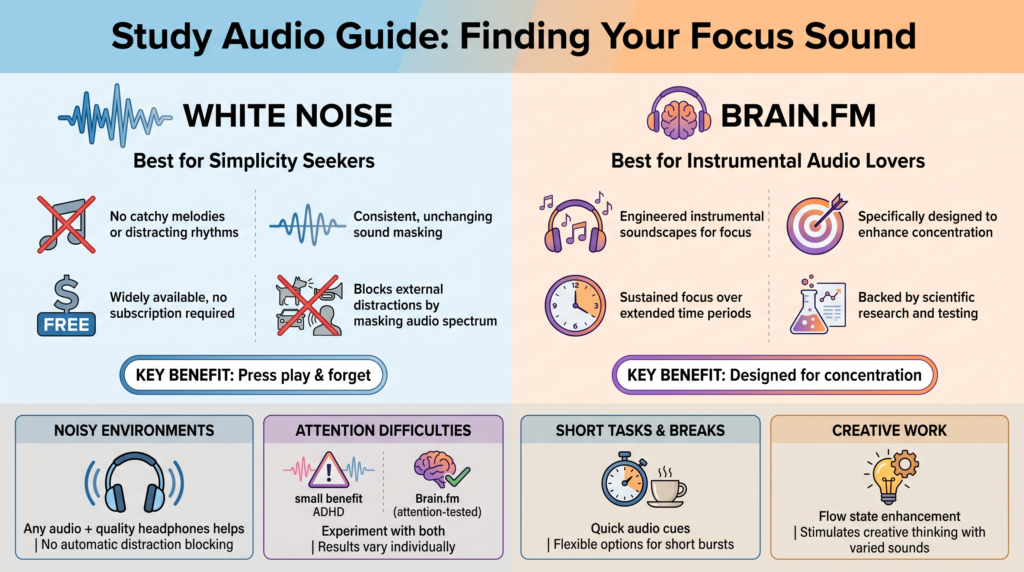
Best for students who want simplicity: White noise
White noise is worth considering if you:
- Don’t enjoy music while studying
- Want a constant background sound
- Prefer not to pay for another subscription
- Mainly want to cover up a variable sound environment
- Find musical elements distracting
Its biggest advantage is simplicity.
You press play and get a consistent background sound without needing to choose a particular musical session.
Best for students who enjoy instrumental audio: Brain.fm
Brain.fm makes more sense if you:
- Enjoy having audio while studying
- Want something specifically designed around focus
- Work on demanding tasks for extended periods
- Don’t want to constantly manage playlists
- Like experimenting with different focus settings
- Want to explore an audio service that has a research program behind its technology
This is where my own experience with Brain.fm matters most. I found it particularly convenient for extended periods of concentrated work because the audio could simply run in the background while I worked.
Best for students studying in noisy environments
This one is more complicated.
If you’re studying somewhere with conversations, movement, keyboards, or other unpredictable sounds, any background audio can potentially change the listening environment.
The important thing is not to assume that one type of audio will automatically block every distraction.
Good headphones can make a significant difference here, especially when paired with an audio track you find comfortable. If you want to know which headphones are best for your situation, read our blog on which headphones cancel the most noise.
For me, Brain.fm paired naturally with headphones during focused work sessions. The combination gave me a consistent audio environment without relying on a conventional music playlist.
Best for students with attention difficulties
This is another situation where the evidence needs nuance.
Research on white and pink noise suggests that these sounds may have small benefits for some people with ADHD or elevated attention problems, while the same analysis found negative effects in non-ADHD comparison groups.
Brain.fm also specifically researches attention and says its technology has been tested in people with attentional difficulties.
Neither finding means that a particular audio option will definitely work for you.
If you have attention difficulties, I’d treat both as experiments: use the same type of study task with each audio option and compare how you actually perform and feel.
6. Final Recommendation
So, does Brain.fm beat white noise?
For me, Brain.fm is the best option when the goal is sustained studying rather than simply creating background sound.
White noise has a legitimate research base, and some people may find it useful. But the research also suggests that its effects can differ substantially between individuals and populations.
Brain.fm takes a different approach. It combines instrumental audio with specific design principles intended to support focus, offers dedicated sessions rather than a single continuous noise, and has conducted controlled research using measures such as EEG and fMRI.
My own experience also makes Brain.fm the easier recommendation for me when I’m facing a long period of concentrated work. I like being able to start a session and get on with the task instead of searching through playlists.
But I wouldn’t tell every student to immediately pay for it.
If you already know that you prefer silence or simple noise, free white noise may be all you need. If you enjoy instrumental audio and regularly struggle to maintain concentration during longer study sessions, Brain.fm is worth testing.
The free trial makes that decision relatively straightforward: use it for several different study sessions, compare it with your normal setup, and judge the result based on your own experience.
If you’re curious, try Brain.fm for free here.
Ultimately, the best study audio is the one that helps you spend less time thinking about what you’re listening to—and more time actually learning.
Some of the links on Best Focus Music are affiliate links. This means that if you click a link and buy something, we may earn a small commission — at no extra cost to you. We only recommend products we genuinely think are worth your time.
We are a participant in the Amazon Associates Program, an affiliate advertising program designed to provide a means for sites to earn advertising fees by linking to Amazon.com and affiliated sites. We may also work with other affiliate networks and individual brands from time to time.