Introduction
Distractions are everywhere. Whether you’re debugging a complex system, reading dense research papers, or trying to get into a creative flow, staying focused for long stretches has become genuinely hard.
That’s why interest in focus music has grown so much. Instead of random playlists or background TV, more professionals are looking for audio specifically designed to reduce distraction and support sustained mental work.
But does it actually help? And how do you avoid music that ends up making things worse? This guide covers what works, what doesn’t, and how to build a sound environment that fits the way you actually work.
Understanding the Basics
What Is Focus Music?
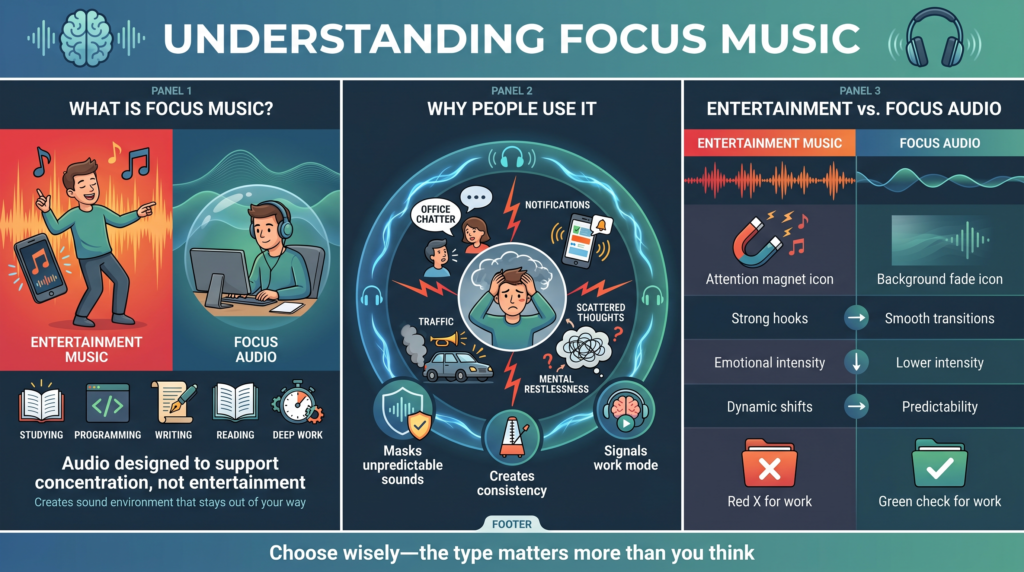
Focus music is audio designed — or intentionally selected — to support concentration during mentally demanding tasks. Unlike entertainment listening, it’s chosen for how it affects your working environment rather than how much you enjoy it.
People use it for studying, programming, writing, reading, and deep work sessions. The goal isn’t stimulation or enjoyment alone, but creating a sound environment that stays out of your way.
Why People Use It
Most people work in environments full of office chatter, notifications, traffic noise, or just their own mental restlessness. Audio can help by masking unpredictable sounds, creating consistency, and making it easier to transition into work mode.
That said, not all music affects concentration the same way. The type you choose matters a lot more than most people expect.
Entertainment Music vs. Focus Audio
Traditional music is designed to capture attention — that’s literally the point. Strong hooks, emotional intensity, dynamic shifts. All of that makes it engaging to listen to, and also makes it harder to ignore when you’re trying to think.
Focus-oriented audio aims for the opposite: fewer abrupt changes, smoother transitions, lower emotional intensity, and more predictability. The audio should fade into the background, not compete with your work.
Some users explore platforms like Brain.fm because the audio is designed to support concentration rather than for entertainment.
Key Considerations Before Choosing Focus Music
The Type of Task Matters
What you’re doing should drive what you listen to. For deep analytical work — coding, technical writing, research analysis — most people do better with instrumental or minimal audio. For creative work like brainstorming or content creation, something with a bit more texture or emotional warmth tends to work.
There’s no single right answer. The best approach is matching the audio to the cognitive demands of the task.
Lyrics Often Get in the Way
For anything involving reading or writing, lyrics compete directly with your language processing. You’re running two streams of verbal information at once, which chips away at comprehension and writing quality in ways that aren’t always obvious until you review your work.
Instrumental audio sidesteps this entirely. It’s one of the most consistently useful switches people make when trying to improve focus.
Familiarity Changes How You Process Sound
Your brain naturally analyses unfamiliar sounds — categorising them, evaluating them, waiting to see what comes next. New music pulls more cognitive attention than music you’ve heard dozens of times.
A playlist you’ve been using for months can become almost invisible. That’s actually useful. Familiar audio fades into the background in a way that brand-new tracks, however “relaxing,” often don’t.
Volume Is Underestimated
Loud audio increases fatigue and mental strain over long sessions, even if it doesn’t feel that way in the moment. Low-to-moderate volume — present but not demanding — tends to be far more sustainable across a full work day.
If you’d have to raise your voice to speak to someone nearby, it’s probably too loud.
Types of Focus Music
Ambient Music
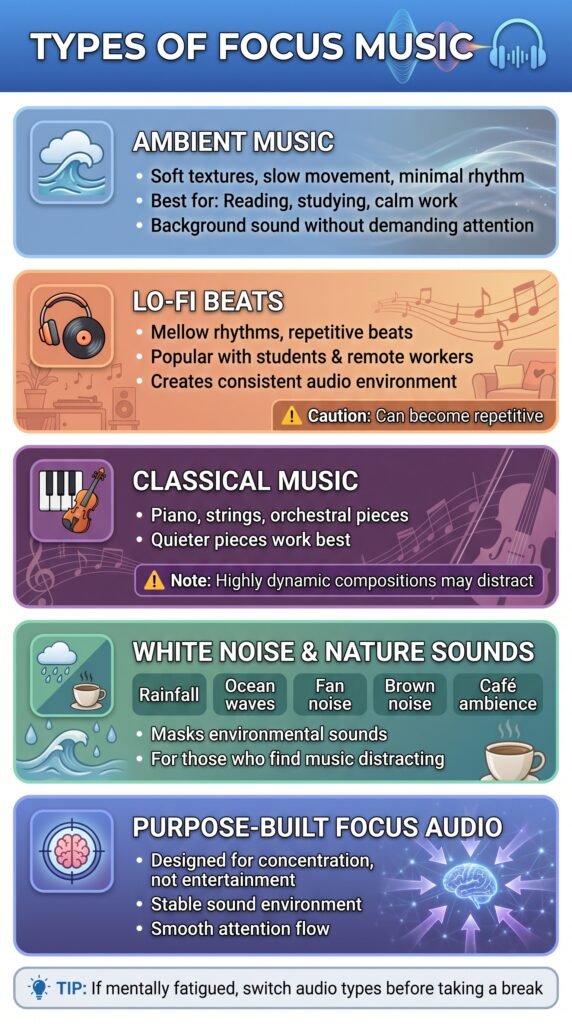
Ambient audio prioritises atmosphere over structure — soft textures, slow movement, minimal rhythm. It works well for reading, studying, and calm work sessions where you want sound present without it pulling any attention.
Lo-Fi Beats
Lo-fi remains popular with students and remote workers for a reason. Mellow rhythms, repetitive beats, and low-intensity soundscapes create a consistent audio environment without much variation to react to.
The downside is that long lo-fi sessions can start to feel repetitive, and some playlists introduce more variety than expected. If mental fatigue creeps in, switching audio type is worth trying before assuming you just need a break.
Classical Music
Piano, strings, and orchestral backgrounds have been associated with concentration for a long time. They work for many people — but heavily dynamic classical compositions can become distracting during complex analytical work. Quieter, more consistent pieces tend to perform better as background audio.
White Noise and Nature Sounds
Not everyone wants music at all. Rainfall, ocean waves, fan noise, brown noise, and café ambience all work well for masking unpredictable environmental sound without adding musical content that competes for attention.
These are worth trying if you find even low-key music pulls your focus.
Purpose-Built Focus Audio
A newer category involves audio designed specifically for concentration support — not entertainment. These systems aim for stable sound environments, reduced distraction cues, and smoother attention flow rather than engaging listening experiences.
Brain.fm is one example of a platform built around structured focus audio rather than curated playlists. If you’re interested, you can try it out with their 30-day free trial.
Step-by-Step Guide to Using Focus Music Effectively
Step 1: Match Audio to Your Task
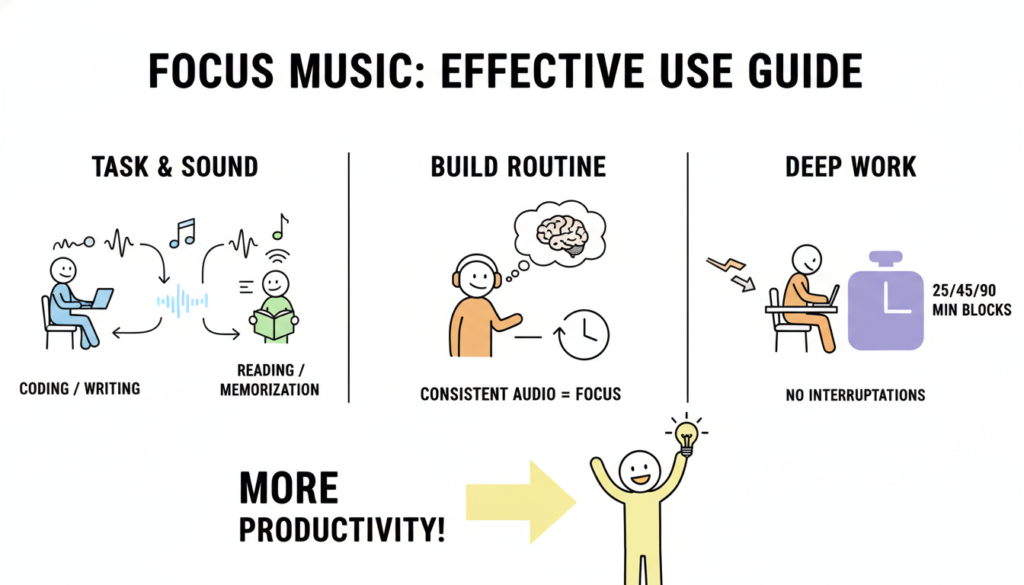
Don’t use the same audio for everything. Coding and technical work generally suit ambient or instrumental tracks. Writing and creative sessions often work better with something that has a bit more texture — lo-fi or cinematic music. Reading and memorisation benefit from simpler, quieter sound environments.
Step 2: Build Consistency
Using the same audio during work sessions creates a mental association over time. Certain sounds start to signal “focus time” to your brain. That routine effect is genuinely useful for remote workers who don’t have the natural environmental cues of an office.
Step 3: Avoid Constant Playlist Switching
Changing tracks every few minutes interrupts concentration more than most people realise. Long-form playlists or uninterrupted audio sessions work better for deep work. The less you interact with the audio, the less it pulls your attention.
Step 4: Pair Audio with Structured Work Intervals
Most professionals who use focus audio combine it with structured work blocks — 25-minute Pomodoro sessions, 45-minute focused intervals, or 90-minute deep work cycles. The audio works best when it’s part of a system, not just running in the background indefinitely.
Step 5: Reduce Other Competing Stimulation
Audio can’t compensate for constant notifications, multitasking, or a chaotic work environment. Focus-friendly audio works best alongside good attention habits — not as a substitute for them.
Expert Tips for Better Focus Sessions
Use audio as an environmental cue. Consistent work-session audio trains your brain to associate certain sounds with concentration. Over time this becomes a trigger that reduces transition resistance before starting work.
Avoid high-stimulation music during deep work. Fast BPM tracks, emotional vocals, and highly dynamic music increase mental fatigue over long sessions. Calmer consistency tends to be more sustainable than anything designed to energise.
Match audio intensity to your energy level. Morning work might benefit from something slightly more energetic. Late-night sessions often call for calmer, lower-stimulation audio. Paying attention to how you feel at different times of day is more useful than following a fixed rule.
Experiment rather than copying trends. The “best” focus audio is highly individual. What works for a software developer might feel wrong for a writer or a student with ADHD. Personal testing over real work sessions matters more than any recommendation.
Common Mistakes
Using emotionally distracting music. Songs with strong personal associations, catchy vocals, or dramatic changes are engaging by design — which is exactly the problem during cognitively demanding work.
Spending more time optimising playlists than working. Some people treat audio optimisation as productive procrastination. A simple, repeatable system beats endless searching for the perfect playlist.
Ignoring mental fatigue. Even well-chosen audio can become draining after many hours. Breaks still matter. Audio is not a substitute for rest.
Expecting music to fix productivity on its own. Sleep, stress levels, task clarity, physical environment, and energy management all play larger roles than audio. Focus-friendly music is one small piece of a larger picture.
Choosing audio based on what’s popular. Viral playlists are not automatically effective for sustained concentration. Your task type and personal attention style matter far more than download counts or YouTube views.
Focus Music and ADHD
Many adults with ADHD experiment with audio to manage boredom, create better stimulation balance, or reduce distracting environmental noise. Responses vary — some people find white noise or brown noise most helpful, others prefer instrumental music, and some find all background audio distracting.
What tends to be consistent: traditional playlists with a lot of variety often feel overstimulating, while more predictable, low-complexity audio is easier to work with. Structured focus audio platforms appeal to some ADHD users for exactly this reason.
Audio is not a replacement for professional ADHD support or treatment. It works best as one part of a broader strategy. See our article where we talk about if ADHD People Focus Better With Music and give some tips.
Focus Music for Remote Workers
Remote work removes many of the natural environmental cues that signal work time — commutes, office presence, social accountability. Consistent audio can partially replace those cues, creating psychological boundaries between work and non-work time.
For remote professionals, sound environment becomes part of workspace design. A consistent audio routine can reduce the friction of starting work and help maintain momentum during long solo sessions.
Focus Music for Students
Long study sessions generate cognitive fatigue, boredom, and mental drift — especially during repetitive tasks like literature reviews or problem sets. Audio environments that stay consistent and low-distraction can make those sessions more sustainable without adding to cognitive load.
Consistency matters more than perfection here. A simple ambient playlist used reliably will outperform an elaborate system that requires constant management.
Conclusion
Focus is no longer just about willpower. Modern environments are built to fragment attention, and fighting that with effort alone is exhausting.
Audio won’t solve everything — sleep, stress, task clarity, and environment all matter more. But a well-chosen sound environment removes friction, masks distraction, and can make sustained work feel noticeably easier.
The best focus music isn’t the most popular or the most intense. It’s whatever creates a consistent, low-distraction background that stays out of your way and lets you actually work.
If regular playlists feel distracting or repetitive, Brain.fm is worth trying — audio built for concentration rather than entertainment.
Experiment across real work sessions rather than judging audio after five minutes. Patterns take time to show up.
Long-term consistency beats finding the perfect playlist. Pick something reasonable and stick with it long enough to actually evaluate it.
Some of the links on Best Focus Music are affiliate links. This means that if you click a link and buy something, we may earn a small commission — at no extra cost to you. We only recommend products we genuinely think are worth your time.
We are a participant in the Amazon Associates Program, an affiliate advertising program designed to provide a means for sites to earn advertising fees by linking to Amazon.com and affiliated sites. We may also work with other affiliate networks and individual brands from time to time.