
Quick Answer
Do ADHD people focus better with music? For many, yes — but it depends heavily on the type of audio and the task. Instrumental tracks, ambient sound, and lo-fi beats tend to help. Lyrics, emotional songs, and chaotic playlists tend to hurt.
Effectiveness depends on your task and goal. This guide explains practical strategies without vague statements.
Understanding the Question
When people ask, “do ADHD people focus better with music?” they’re usually asking from a place of genuine frustration. They’ve tried silence. They’ve tried their usual playlist. Neither quite works the way it needs to.
ADHD doesn’t affect all attention equally. It’s not just an inability to focus; ADHD often means intense focus on novelty, urgency, emotion, or rewards. The issue is persistent work with distant rewards.
When tasks lack stimulation, ADHD brains may drift. Music adjusts the sensory environment, helping prevent attention loss. That’s why music is often discussed for ADHD productivity.
However, music is not a universal solution. Two people with the same ADHD diagnosis might react very differently to the same playlist. This is why trying different options yourself is more important than following someone else’s “best focus music” list online.
Detailed Explanation
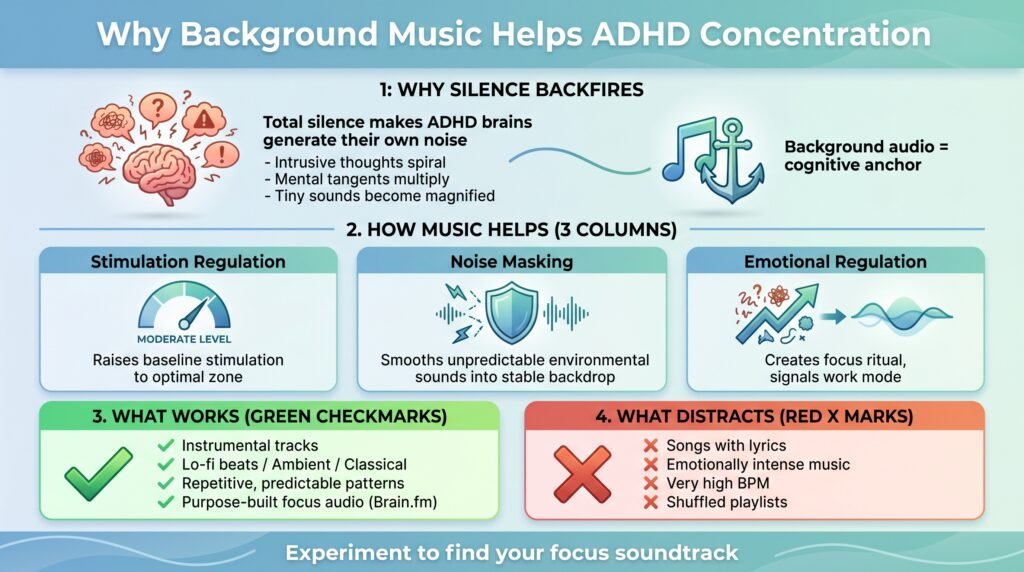
Why Silence Often Makes Things Worse
Here’s something counterintuitive: for many people with ADHD, complete silence isn’t helpful. It can actually increase distraction. Silence is supposed to be the gold standard for concentration, but that assumption often doesn’t hold for ADHD brains.
When the environment is completely quiet, the brain fills the silence with its own distractions — intrusive thoughts, mental tangents, or noticing small sounds you would usually ignore, such as a distant conversation, someone typing nearby, or a car outside.
Background audio can serve as an anchor. It gives the brain just enough stimulation to stay present without constantly scanning for something more interesting. In this sense, asking do ADHD people focus better with music is really asking whether a controlled sound environment outperforms an uncontrolled silent one — and for many, it does.
How Music Influences Attention
A few mechanisms are worth understanding here:
Stimulation regulation. Some research suggests that certain ADHD brains function better with moderate sensory input rather than very low stimulation. Music can raise that baseline, making it easier to stay engaged with a task that isn’t inherently exciting.
Environmental noise masking. Open offices, shared apartments, and coffee shops all generate unpredictable audio — conversations that cut in and out, sudden noises, background movement. Consistent background audio smooths that out. Instead of reacting to every unexpected sound, your brain settles into a stable acoustic environment.
Emotional state. ADHD is closely linked to emotional regulation as well as attention. Music can help you move from feeling scattered or anxious to feeling calmer and more focused. Starting a work session on the right track can become a helpful ritual, signaling to your brain that it’s time to concentrate.
What Type of Music Actually Helps?
This is where it gets specific. Not all music helps concentration, and for complex cognitive work, some music can actively worsen performance.
Instrumental tracks tend to work well because there are no lyrics competing for your language-processing bandwidth. When you’re writing or reading, lyrics pull you in two directions at once. Ambient music, lo-fi beats, classical, and cinematic soundscapes sidestep this problem entirely.
Repetitive or predictable audio tends to be easier to “tune out” in the productive sense. Highly varied music — sudden tempo changes, unexpected drops, emotionally intense sections — keeps pulling your attention back to the audio itself. More consistent patterns fade into the background more naturally.
Purpose-built focus audio goes even further. Platforms like Brain.fm create audio specifically for concentration, not entertainment. No jarring transitions, no lyrics, no emotional spikes — just structured sound designed to help you focus for longer periods.
What tends to be distracting:
- Songs with lyrics, especially ones you know and will mentally sing along to
- Emotionally intense music (anything that makes you feel a lot)
- Very high BPM tracks
- Constantly shuffled playlists where every new song demands a moment of attention
If you want to know more about focus music, see our best focus music in 2026 article.
Key Points to Keep in Mind
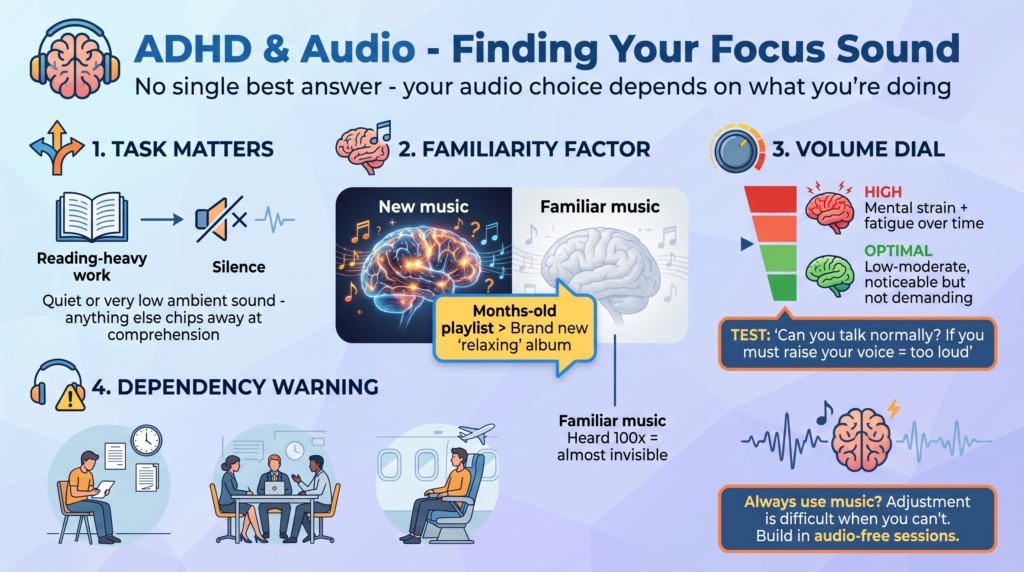
Your Task Determines Your Audio
There isn’t a single best answer to whether do ADHD people focus better with music, because the best audio choice depends entirely on the task you’re doing.
For creative work (drafting, brainstorming, ideation): ambient or cinematic music often helps sustain a loose, generative mental state without pushing too hard.
For analytical work (coding, research, data): something more minimal tends to work better. Even white noise or simple lo-fi beats. The goal is masking, not stimulation.
For reading-heavy work, the case for complete quiet or extremely low-volume ambient sound is stronger. Anything that draws even partial attention to itself will chip away at comprehension.
Familiarity Changes Everything
New music requires more mental attention than music you already know. Your brain naturally analyses unfamiliar sounds — categorizing them, evaluating them, and waiting to see what happens next.
Music you’ve heard dozens of times fades into the background much more readily. A playlist you’ve been using for months becomes almost invisible. A brand-new album, no matter how “relaxing” it’s supposed to be, carries more cognitive overhead.
Volume Is Often Overlooked
High volume can increase mental strain and fatigue over time. Most people find that a low-to-moderate background volume — noticeable but not demanding — works best for sustained focus.
If your audio is loud enough that you occasionally have to raise your voice to speak to someone, it’s probably too loud for sustained concentration.
Dependency Is Real
One downside that isn’t discussed enough: if you always work with music and then find yourself somewhere you can’t use it — an exam, a quiet meeting room, a plane without headphones — the adjustment can be genuinely difficult. Building in some sessions without audio is a reasonable habit, even if you usually prefer working with music.
Examples and Case Studies
Remote Software Developer
Debugging and long coding sessions require steady focus but offer little emotional reward. Many developers find that lo-fi or ambient music helps them stay productive during the less exciting parts — reading error logs, refactoring, or writing tests.
Lyrical music disrupts focus because coding already involves verbal processing. Two language streams cause errors.
PhD Student in STEM
Graduate research often means spending long periods reading, analyzing data, and writing — all tasks that require steady concentration with minimal immediate reward.
Many students report that ambient or repetitive audio helps them get into a working rhythm during literature reviews or analysis sessions, while near-silence works better for writing-heavy days when internal language processing is already maxed out.
Freelance Writer
For writing, the tension is real: music can help with emotional flow and reduce the perfectionism that slows down first drafts. However, lyrics can interfere with prose quality in ways that are hard to notice at first but become obvious on re-reading.
The common solution is instrumental music for drafting, and near-silence or white noise for editing and proofreading.
ADHD Adult in an Open Office
Office environments are particularly challenging because unpredictable background conversation is exactly what ADHD brains struggle to filter out. Consistent audio — even white noise — can significantly reduce the cognitive cost of working in a shared space.
Headphones, along with consistent audio, effectively create a private acoustic environment within a noisy environment.
Expert Insights
Most researchers and clinicians avoid making blanket claims about ADHD and music because individual variation is high. What’s generally accepted:
- There’s no universal “ADHD focus music” that works for everyone
- Predictable, low-complexity audio tends to be more consistently useful than high-stimulation audio
- Music should be understood as an environmental adjustment, not a treatment
- Individual experimentation is the only reliable way to find what works
Research and clinical practice show ADHD brains are differently calibrated—not underperforming. Environmental adjustments work better than forcing adaptation.
Music is one tool to help ADHD focus, but results depend on the individual and their task. The key takeaway: finding the right audio requires experimentation, and personalized solutions are most effective.
Additional Resources
If you want to start experimenting, here are the main categories worth trying:
Ambient music — Suitable for lighter cognitive tasks, reading, and calm work sessions. Available on most streaming platforms or via dedicated ambient playlists.
White or brown noise — Good for masking office or household noise without adding musical content that could pull attention. Free apps and websites are widely available.
Lo-fi beats — Popular with students and remote workers for a reason. Low-complexity, consistent, and widely available. Best for medium-intensity tasks.
Purpose-built focus audio — Platforms like Brain.fm design audio specifically for sustained cognitive work, avoiding the entertainment patterns that can undermine concentration.
Conclusion
So, do ADHD people focus better with music? Often, yes. But “music” as a category is too broad to be useful on its own.
What actually helps: audio that provides stable, moderate stimulation without demanding active attention. Instrumental tracks, ambient sound, consistent lo-fi beats, and purpose-designed focus audio tend to fit that description. What tends to hurt: lyrics, emotional intensity, unpredictability, and high volume.
The task matters too. Creative work and analytical work often call for different audio environments, and reading-heavy work is the most sensitive to distraction from any source, including music.
The practical takeaway: don’t take someone else’s focus playlist at face value. Build your own experiments, different audio types, different tasks, different volumes.
If you’ve found a type of music that works for you, the next step is learning how to use it effectively. Our guide on how to fully focus on music shares practical strategies for getting the most out of your listening sessions.
And if traditional playlists keep letting you down, it might be worth trying audio designed for concentration rather than entertainment. Then you can compare two of the most popular dedicated focus audio platforms in our Brain.fm vs Endel comparison.
Frequently Asked Questions
Is music scientifically proven to help ADHD focus?
Research in this area is ongoing, and results vary significantly between individuals. Some studies suggest certain audio environments may support attention for specific people and task types, but there’s no universal finding that music reliably improves ADHD focus across the board. Whether do ADHD people focus better with music is ultimately answered differently for each person, which is why individual experimentation matters more than any single study.
Is silence better than music for ADHD?
Not necessarily. For many people, the opposite is true. Complete silence can lead to more mind-wandering, internal distractions, and noticing small environmental sounds — all of which can be harder for ADHD brains to manage than steady background audio.
What type of music is usually least distracting?
Instrumental, ambient, and repetitive audio is usually the least disruptive for mental work. The key is low complexity and consistency — sound that creates a stable background without pulling your attention away.
Can music replace ADHD treatment?
No. Music can be a useful environmental tool, but it is not a substitute for medical or professional support. It works best as part of a broader strategy, not as a standalone solution.
Why do lyrics seem to hurt my focus so much?
Language processing competes directly with reading and writing. When you hear words, your brain tries to process their meaning even if you are not actively listening. During tasks that already need a lot of verbal processing, lyrics effectively split your mental resources.
Are focus music apps different from regular playlists?
Yes, they are different by design. Regular playlists are made for entertainment — they grab your attention, create emotional reactions, and are meant to be enjoyed. Focus audio platforms like Brain.fm are designed to do the opposite: background sound that supports sustained concentration without the peaks and shifts that pull attention away from work.
Some of the links on Best Focus Music are affiliate links. This means that if you click a link and buy something, we may earn a small commission — at no extra cost to you. We only recommend products we genuinely think are worth your time.
We are a participant in the Amazon Associates Program, an affiliate advertising program designed to provide a means for sites to earn advertising fees by linking to Amazon.com and affiliated sites. We may also work with other affiliate networks and individual brands from time to time.