
Introduction
Concentration has become genuinely hard to come by. Open-plan offices, coffee shop chatter, shared apartments, and the general chaos of modern life make it difficult to settle into the kind of deep focus that actually gets things done.
For a lot of people, Noise Cancelling Headphones have quietly become one of the most practical tools in their productivity setup — not just for listening to music, but for carving out a mental space where real work can happen. If you commute on planes regularly, spend your days in a busy office, or try to study in a dorm where someone is always blasting something down the hall, you already know what I mean.
This guide covers everything you need to know: why headphones help your brain focus, how to set up your environment properly, and how to troubleshoot the most common frustrations. Whether you’re just starting out or want to get more out of a setup you already have, there’s something here for you.
Why Headphones Help You Focus
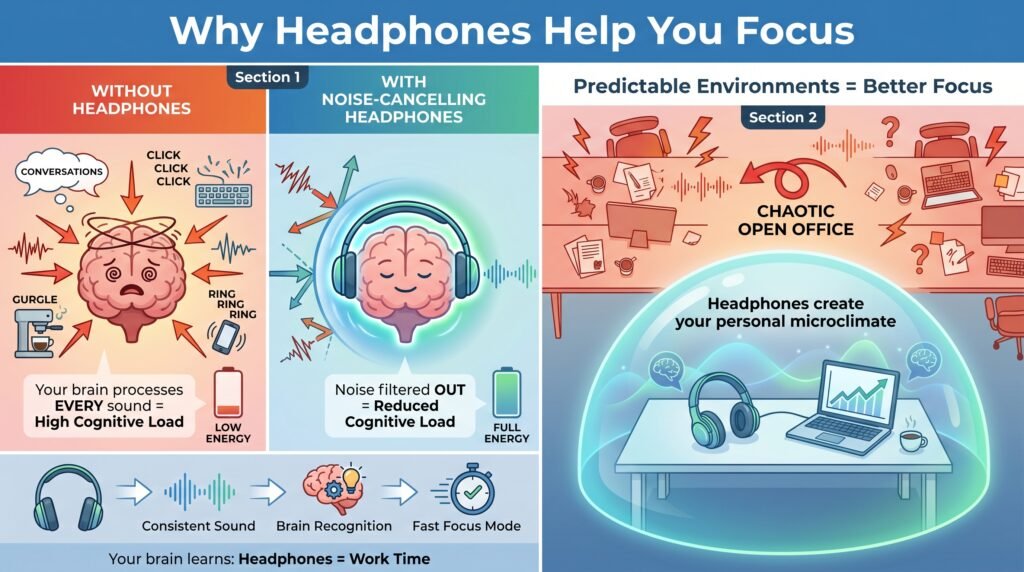
Your Brain Doesn’t Actually Ignore Background Noise
Here’s something most people don’t realize: even when you feel like you’re tuning out the noise around you, your brain isn’t. It’s still processing every conversation, every keyboard click, every coffee machine hiss in the background. That low-level processing is exhausting, and it adds up over the course of a day.
This is sometimes called cognitive load — the mental effort your brain is expending on things that aren’t your actual task. Noise Cancelling Headphones reduce that load before it reaches your brain, rather than asking your brain to manage it on the fly. The result is more mental energy available for whatever you’re actually trying to do.
Predictable Environments Make Focus Easier
Most people focus best when their environment feels stable. Open offices and shared spaces are inherently unpredictable — you never know when a loud conversation is going to start up two desks away, or when someone’s going to make a phone call right next to you.
Headphones create a kind of personal microclimate. Once they’re on, your auditory environment becomes consistent regardless of what’s happening around you. Over time, your brain starts to associate that consistency with work, and getting into focus mode becomes faster and easier.
Choosing the Right Headphones for Focus
Not all headphones are built the same, and a few features matter more than others when your goal is sustained concentration.
Active Noise Cancellation vs. Just Turning Up the Volume
A common mistake is cranking up the volume to drown out distractions. It makes intuitive sense, but high volume causes listening fatigue faster, leaving you mentally exhausted from two directions at once. It simply doesn’t work as well as people expect.
Active noise cancellation (ANC) works differently — it uses microphones to detect ambient sound and generates an opposing signal to cancel it out. This lets you listen at comfortable, moderate volumes — or even use the Noise Cancelling Headphones without any audio playing at all. For open offices, planes, and busy cafés, ANC makes an enormous difference.
Comfort for Long Sessions
Comfort is easy to underestimate until you’ve worn uncomfortable headphones for three hours straight. Subtle ear pressure, a headband that digs in, or ear cups that trap heat all have a way of creeping into your awareness — right when you need to be thinking about something else.
If you’re planning to wear your Noise Cancelling Headphones for extended work blocks, pay attention to ear cushion material (memory foam tends to do well), clamping force (lighter is better for long sessions), and overall weight. Over-ear designs generally beat on-ear for long-haul comfort, since they don’t apply direct pressure to your ears.
Battery Life and Real-World Reliability
Battery anxiety is a real thing. There’s nothing quite like your headphones cutting out mid-session, completely breaking your flow. For remote workers and frequent travelers especially, this isn’t a minor inconvenience — it’s a productivity issue.
Most premium Noise Cancelling Headphones now offer 30 or more hours of playback on a single charge, along with fast-charge features that can get you a few hours from a short top-up. Some also include a wired backup option, which is worth having on long flights or all-day work sessions.
Passive Isolation for High-Frequency Sounds
ANC handles low-frequency noise, such as engine rumble and HVAC hum, very well. But high-frequency sounds — crying babies, keyboard clicks, certain voices — can be harder for active systems to fully cancel. That’s where passive isolation (the physical seal the ear cups create) matters, which is why fit and ear cup design are worth considering alongside the ANC specs.
Best Audio Types for Focus
What you listen to matters almost as much as the headphones themselves. Not all audio is equally good for concentration.
Ambient and Instrumental Music
Ambient music works well because it stays out of your way — no lyrics to accidentally follow, no emotional peaks pulling you away from your work. It fills the sonic space without competing with your thoughts.
For coding, writing, or studying, purely instrumental tracks tend to outperform vocal tracks. Your brain’s language-processing areas light up when you hear speech, which can interfere with tasks that involve reading or writing.
Brown Noise and White Noise
Brown noise has become particularly popular, especially among people who find traditional white noise too harsh or high-pitched. It has a deeper, more natural sound — closer to heavy rainfall or a river — that many people find easier to sustain for long periods.
Both brown and white noise are good at masking inconsistent distractions, such as office chatter and keyboard sounds. They create a sonic “floor” that makes individual sounds less likely to spike through and catch your attention.
What to Avoid
Music with strong emotional associations tends to be counterproductive for focus. Songs tied to memories or strong feelings are almost designed to make your mind wander. Anything with a highly variable dynamic range — sudden quiet passages followed by loud ones — keeps your auditory system on alert rather than at ease.
Do you want to know more about focus music? Check out our complete guide for focus music.
Setup and Getting Started
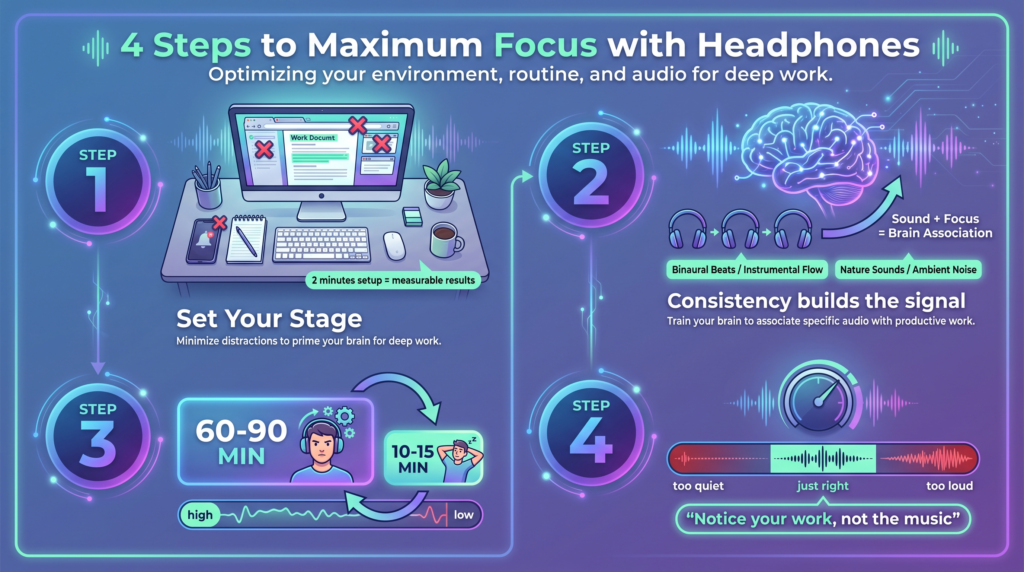
Step 1: Create a Dedicated Focus Environment Before You Put Them On
Your headphones work harder when you set the stage for them. Before starting a session, close tabs you don’t need, silence your phone, clear your desk, and open whatever you’re actually working on. The goal is to reduce the number of distractions competing for your attention the moment you sit down.
Headphones reduce environmental distractions — but internal distractions, like the urge to check email or scroll, have to be managed separately. Taking two minutes to set up properly before each session makes a measurable difference.
Step 2: Use the Same Audio Consistently
One of the most underrated focus techniques is using the same type of audio consistently every time you work. It’s a form of conditioning. When you repeatedly pair a specific sound environment with concentration, your brain starts to treat that audio as a signal to focus.
Pick one or two audio options that work for you and stick with them. The consistency is what builds the association over time.
Step 3: Work in Structured Blocks
Headphones aren’t magic — they work best within a structure that supports sustained concentration. Most people do well with focused work blocks of 60 to 90 minutes, followed by a 10 to 15-minute break. This prevents the slow accumulation of mental fatigue that makes the last hour so much less productive than the first.
During breaks, consider taking the headphones off entirely. Stepping away from the audio environment reinforces the association between the headphones and work.
Step 4: Keep Volume at a Comfortable Level
More volume doesn’t equal more focus. Listening too loudly can create its own kind of fatigue and make concentration harder. A simple rule of thumb: if you notice the music more than your work, it’s probably too loud.
Advanced Tips and Tricks
Use Headphones as a Psychological Trigger
The conditioning effect is worth building deliberately. Some people set a strict rule: these headphones only go on during deep work — not during browsing, not during meetings, only during focused sessions. The stricter the association, the faster it develops.
After a few weeks, putting on the headphones genuinely starts to feel like flipping a mental switch.
Match Audio to the Task
Not all work is the same, and your audio environment doesn’t have to be either. Heavy cognitive tasks like writing or analysis tend to benefit from minimal, very low-key audio. Repetitive tasks can often tolerate something slightly more engaging without it becoming distracting.
Pay attention to how different audio types affect your performance on different tasks. Most people find their own patterns fairly quickly.
Combine Noise Cancellation With Focus Strategies
Noise Cancelling Headphones work well alongside structured productivity methods like the Pomodoro Technique (25 minutes on, 5 minutes off) or time blocking. The headphones handle the external environment; the technique handles the structure. Together, they address the two biggest causes of distraction.
Take Silent Breaks
When you take a break, resist the urge to immediately switch to something stimulating — videos, podcasts, or loud music. A few minutes of genuine quiet helps your brain recover more effectively than swapping one type of stimulation for another. This pays off when you sit back down for your next session.
Shop our recommended Noise Cancelling Headphones for deep work sessions
Troubleshooting Common Issues
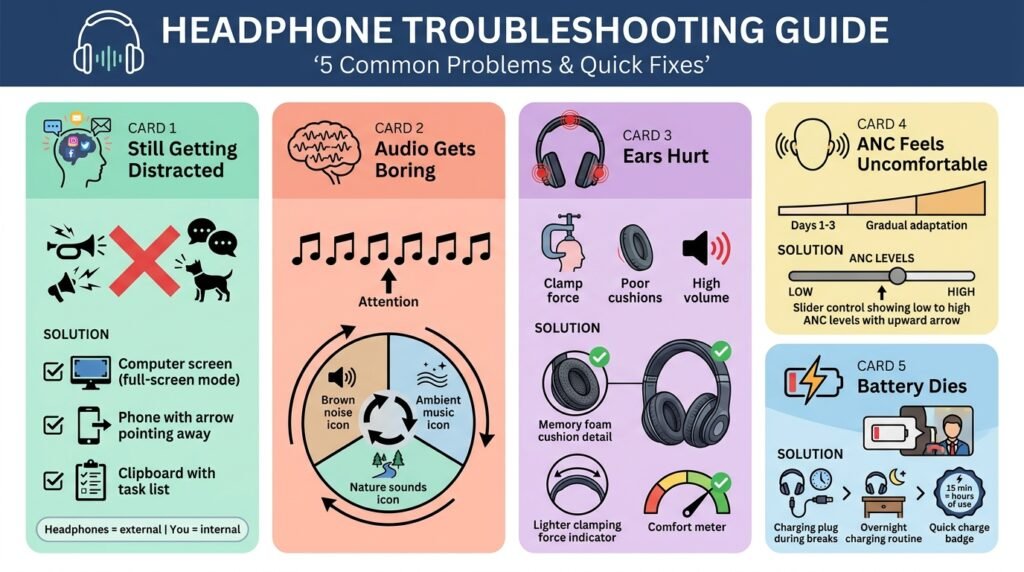
“I’m Still Getting Distracted”
If headphones aren’t solving your focus problem, the distractions are probably coming from inside your workflow rather than your environment. Internal culprits like notification habits, context-switching, and unclear task priorities are often bigger than background noise.
Try pairing your headphones with full-screen mode, phone in another room, and a clearly defined task before each session. The headphones handle the external environment; you still have to manage the rest.
“The Same Audio Gets Boring or Annoying”
This happens with repetitive playlists over time — your brain adapts to repeated patterns, and something that once faded into the background starts demanding attention again. The fix is usually switching audio types periodically (brown noise one day, ambient music the next). Non-repeating, evolving audio tends to stay useful for longer.
“My Ears Hurt After Long Sessions”
Ear fatigue from extended headphone use usually comes from high clamping force, poor-quality ear cushions, or excessive volume. If you’re working for multiple hours a day, investing in a pair with high-quality memory foam cushions and a lighter clamping force is genuinely worth it. The discomfort is subtle at first, but compounds over a long session.
“Noise Cancellation Feels Uncomfortable or Disorienting”
Some people experience a slight pressure sensation when first using active noise cancellation, particularly at high ANC levels. This is normal and usually fades within a few days of regular use. Starting with a lower ANC setting and gradually increasing it can help your brain adjust more comfortably.
“Battery Keeps Running Out at the Wrong Time”
If battery anxiety is affecting your workflow, the solution is usually a habit rather than hardware. Plug your headphones in during breaks or overnight rather than waiting until they’re critically low. Many current Noise Cancelling Headphones support quick charge, so even a 15-minute top-up can add several hours of use.
Best Situations to Use Headphones for Focus
Open-Plan Offices
Open offices are one of the hardest environments for sustained concentration. Even a conversation ten desks away is enough to interrupt a train of thought, and those interruptions add up to a significant amount of lost focus across a day. Workers in open offices tend to experience more cognitive fatigue precisely because their brains are doing so much background processing.
Noise Cancelling Headphones significantly reduce this effect. Many people also report a secondary benefit: the headphones act as a visual signal to colleagues that you’re in deep work mode and would prefer not to be interrupted.
Remote Work From Home
Home environments come with their own unpredictable noise — neighbors, street traffic, deliveries, and family members. Headphones help create a consistent “work mode” that feels distinct from being at home in a casual sense, which matters both psychologically and acoustically.
Studying in Shared Housing
Dorms and shared apartments are notoriously difficult environments for sustained study. Noise levels vary wildly depending on what everyone else is doing, and that inconsistency is exactly what breaks concentration. A good pair of headphones creates a stable sonic environment that lets you read, write, and work through problems without interruption.
Traveling on Planes and in Airports
Airports and planes are sensory overload environments — constant announcements, engine noise, and the general chaos of transit. Active noise cancellation earns its keep here more than almost anywhere else. Frequent travelers consistently report arriving less mentally fatigued when using Noise Cancelling Headphones, simply because their brains have been doing less involuntary processing throughout the journey.
Common Mistakes to Avoid
Using music with lyrics for complex work. Your brain processes language even when you’re trying to ignore it, which creates interference with reading and writing tasks. Keep vocals out of your focus audio, or at least be aware that they’re adding cognitive load.
Wearing headphones while still doing other things. Starting focus audio while browsing or checking notifications trains your brain to associate that audio with distraction rather than concentration. Put them on when you’re ready to actually start working.
Expecting results immediately. The conditioning effect takes time — most people notice it becoming meaningful after a couple of weeks of consistent use. Don’t give up on the system because it didn’t transform your productivity on day one.
Ignoring discomfort until it becomes a problem. If your headphones are uncomfortable, you’ll eventually stop wearing them, or the discomfort will become a distraction in itself. Address fit issues early rather than pushing through.
Conclusion
The appeal of Noise Cancelling Headphones for focus isn’t really about the audio — it’s about control. In environments you can’t fully manage, they give you back the ability to decide what your brain has to process. That turns out to make a significant difference to how well and how long you can concentrate.
The biggest gains come from consistency: the same setup, the same audio, the same routine, repeated until your brain just knows what to do when the headphones go on. Whether you’re coding in a busy office, studying in a loud dorm, or trying to get through your workday without feeling wrung out by 3pm, the right pair — used with a bit of structure — can genuinely change how work feels.
Ready to build your focus setup? Use the Noise Cancelling Headphone to improve your focus.
Some of the links on Best Focus Music are affiliate links. This means that if you click a link and buy something, we may earn a small commission — at no extra cost to you. We only recommend products we genuinely think are worth your time.
We are a participant in the Amazon Associates Program, an affiliate advertising program designed to provide a means for sites to earn advertising fees by linking to Amazon.com and affiliated sites. We may also work with other affiliate networks and individual brands from time to time.