
Staying focused for hours is genuinely hard. Your phone buzzes, someone walks past your desk, a random thought pops up — and just like that, you’ve lost the thread.
It’s no surprise that so many people reach for headphones the moment they sit down to work.
Quick Answer
So how does focus music work?
Focus music works by making your audio environment more predictable. Instead of your brain constantly reacting to unexpected sounds, it gets a steady, undemanding backdrop to tune out.
The less interesting the music, the better it tends to work — which is a weird thing to say, but it’s true.
Understanding the Question
Before going deeper, it’s worth being honest about what focus music can and can’t do. It won’t make you smarter. It won’t fix a bad night’s sleep or help you power through a task you’ve been avoiding for three days.
What it can do is make your environment a little easier to work in. Think of it less like a productivity tool and more like adjusting the thermostat — it won’t write your thesis for you, but the right conditions make it easier to sit down and try.
How Does Focus Music Work?
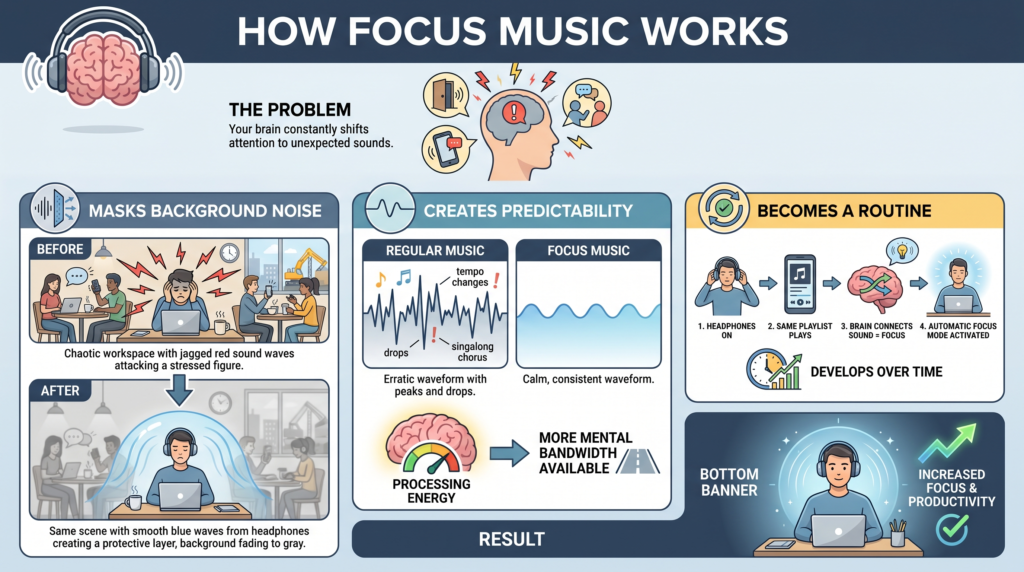
Your brain is always listening, even when you think you’re ignoring the noise around you. Every unexpected sound — a door slamming, a phone ringing, someone laughing down the hall — triggers a tiny moment of attention shift.
Those moments add up. Focus music reduces them.
It Masks Background Noise
This is the most straightforward benefit. If you’re working in a coffee shop, a busy home, or an open office, there’s a constant stream of sounds pulling at your attention.
Focus music doesn’t eliminate those sounds, but it makes them less noticeable. Your brain gets something consistent to latch onto, and the chaos around you fades into the background a little more.
It Creates Predictability
Most focus music is deliberately uneventful. No big drops, no unexpected tempo changes, no chorus that makes you want to sing along.
That sameness is the whole point. Your brain spends less energy processing what it’s hearing, which means more mental bandwidth for what you’re actually trying to do.
It Becomes Part of a Routine
If you always put on the same playlist before a work session, your brain starts to connect that sound with focus. It becomes a cue — almost like a ritual that signals it’s time to get into it.
This takes a bit of time to develop, but once it does, it’s surprisingly effective.
Different Types of Focus Music
There’s no one-size-fits-all here. Different sounds work for different people, and often for different types of tasks.
Ambient Music
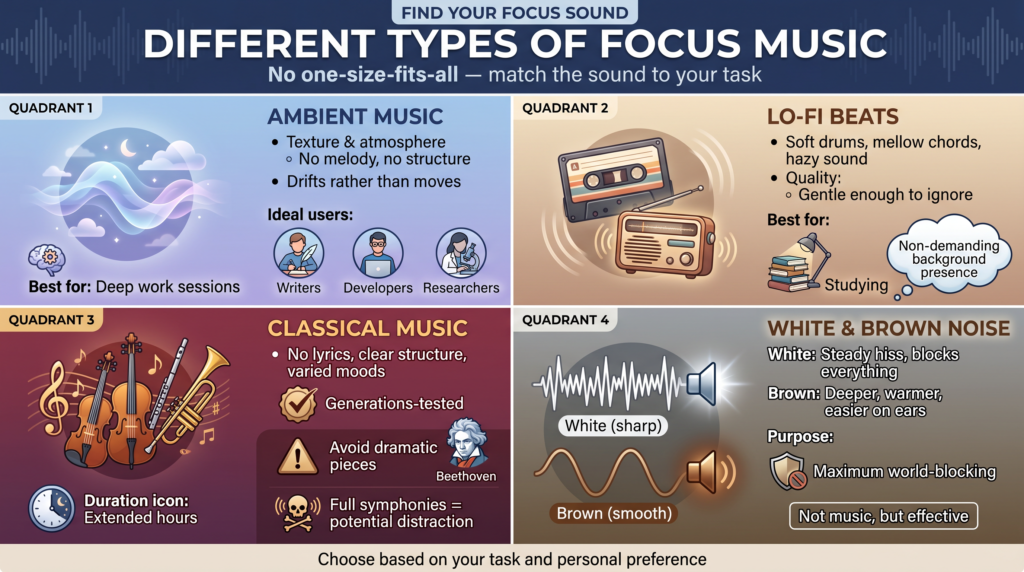
Ambient music is all texture and atmosphere — no real melody, no obvious structure. It drifts rather than moves, which is exactly why people like it for deep work.
Writers, developers, and researchers tend to gravitate toward it when they need to stay in the zone for hours.
Lo-Fi Beats
Lo-fi has become almost synonymous with studying at this point. Soft drums, mellow chords, a slightly hazy sound — it gives your ears something to rest on without ever demanding your attention.
It’s gentle enough to ignore, which is a bigger compliment than it sounds.
Classical Music
Classical music has been the go-to study soundtrack for generations, and for good reason — no lyrics, clear structure, and a wide range of moods to choose from.
Just be careful with the dramatic stuff. A Beethoven symphony at full tilt can be just as distracting as having the TV on.
White Noise and Brown Noise
White noise is that steady hiss that drowns out everything else. Brown noise is a deeper, warmer version that many people find easier on the ears over long sessions.
Neither is really “music,” but both do the job well when your main goal is blocking out the world.
Why Lyrics Are Often a Bad Idea
When you’re reading or writing, your brain is already knee-deep in language. Add a song with words, and you’ve got two streams of text fighting for the same mental resources.
Some people handle it fine — especially with music they know so well it barely registers. But if you notice yourself mouthing along or losing your place, that’s your answer.
Focus Music vs Regular Music
Regular music is designed to grab you. That’s literally the job — hooks, builds, emotional moments, lyrics that stick in your head for days.
Focus music is designed to do the opposite. It wants to be ignored. The best focus music is the kind you forget is even playing until the session ends, and you suddenly notice the silence.
That’s a completely different design goal, and it matters more than most people realize when they’re wondering why their Spotify playlist isn’t helping them concentrate.
If you’re not sure where to start, we’ve compared the best focus music apps to help you find the right option for your work style.
Does Focus Music Work for ADHD?
For a lot of people with ADHD, silence isn’t peaceful — it’s uncomfortable. Every tiny sound becomes more noticeable, not less, and the absence of stimulation can make it harder to settle into a task.
Having something consistent playing in the background can take the edge off that restlessness. Lo-fi, ambient sounds, and brown noise tend to come up most often in these conversations.
That said, ADHD is not a monolith. Some people find background audio makes things worse. The only way to know is to try.
Choosing the Right Headphones
Even the best focus playlist loses half its effect if your headphones are uncomfortable or let in half the ambient noise. Noise isolation matters a lot, especially in loud environments.
Fit and comfort matter too — if you’re pulling them off every hour because your ears hurt, they’re not doing you any favors. If you want a starting point, check out our guide on Sony headphones for focus and deep work for a breakdown of which models hold up well for long work sessions.
Common Mistakes
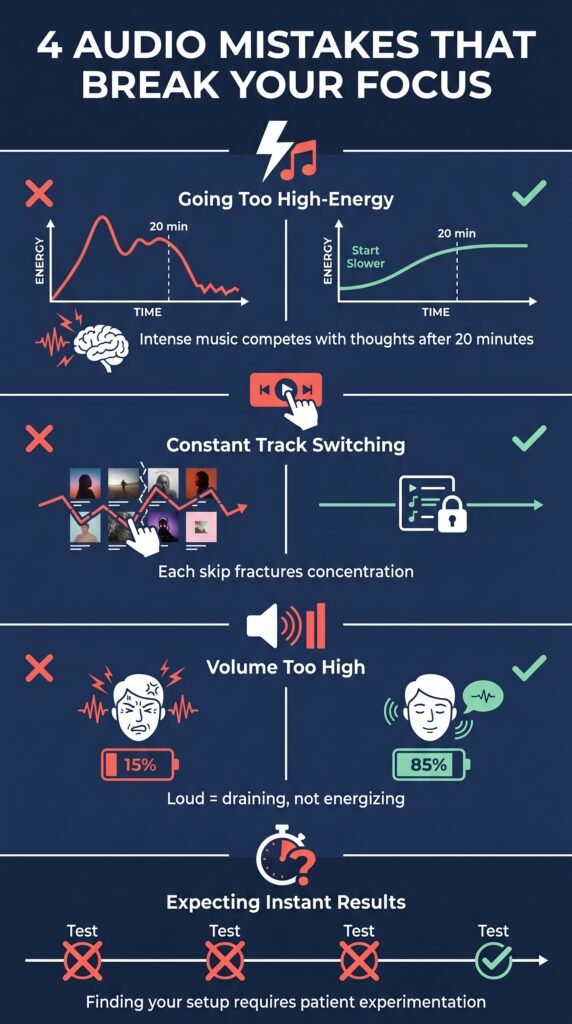
Going straight for high-energy music. It feels motivating at first, but after 20 minutes, it’s competing with your thoughts rather than supporting them. Start slower than you think you need to.
Constantly changing tracks. Every time you skip a song or go looking for something better, you’ve already broken your focus. Commit to a playlist and leave it alone.
Turning it up too loud. Louder isn’t better. High volume over long sessions is draining, not energizing. Keep it at a level where you could hold a conversation if needed.
Expecting it to work immediately. Finding the right audio setup takes some trial and error. Give each option a fair shot before moving on.
Expert Insights
Most experts who study focus and productivity are careful not to overclaim here. Audio preferences are deeply personal, and the research is more nuanced than the “Mozart makes you smarter” headline you might remember from the 90s.
What they do agree on is that your environment affects your ability to concentrate — and audio is a big part of that environment. Getting it right is worth the effort.
Additional Resources
If you’re not sure where to start, these are the most commonly recommended categories to experiment with:
- Ambient music
- Lo-fi beats
- Classical music (instrumental)
- White noise
- Brown noise
- Nature sounds
- Instrumental electronic music
It’s also worth noticing that what works for writing might not work for reading, and what helps you code might be completely wrong for a video call. Your preferences will probably shift depending on the task.
Conclusion
Focus music works — for most people, most of the time — because it makes your environment more predictable and less likely to pull you out of what you’re doing.
It’s not complicated, and it’s not magic. It’s just a small adjustment that, combined with good habits and a decent setup, can make a real difference in how long you’re able to stay in the zone.
The best sign it’s working? You finish a session and realize you barely noticed the music at all.
Frequently Asked Questions
How is focus music different from regular music? Regular music is built to engage you. Focus music is built to stay out of the way — it’s a backdrop, not the main event. If you like to know more, you can visit our complete guide to focus music.
Does focus music help with studying? For many students, yes. It creates a consistent sound environment that makes it easier to tune out distractions and stay on task longer. We have a special blog for the best focus music apps for students.
What’s the best type of focus music? Honestly, it depends on the person. Ambient, lo-fi, classical, white noise, brown noise — they all have their fans. Try a few and see what you barely notice.
Can focus music help with remote work? Definitely. A lot of remote workers use it specifically to replace the ambient hum of an office and create some separation between “work mode” and everything else at home.
How often should I use it? As often as it helps. Some people use it every single day, others pull it out only for demanding tasks. There’s no rule — just whatever works for your workflow.
Some of the links on Best Focus Music are affiliate links. This means that if you click a link and buy something, we may earn a small commission — at no extra cost to you. We only recommend products we genuinely think are worth your time.
We are a participant in the Amazon Associates Program, an affiliate advertising program designed to provide a means for sites to earn advertising fees by linking to Amazon.com and affiliated sites. We may also work with other affiliate networks and individual brands from time to time.