Introduction
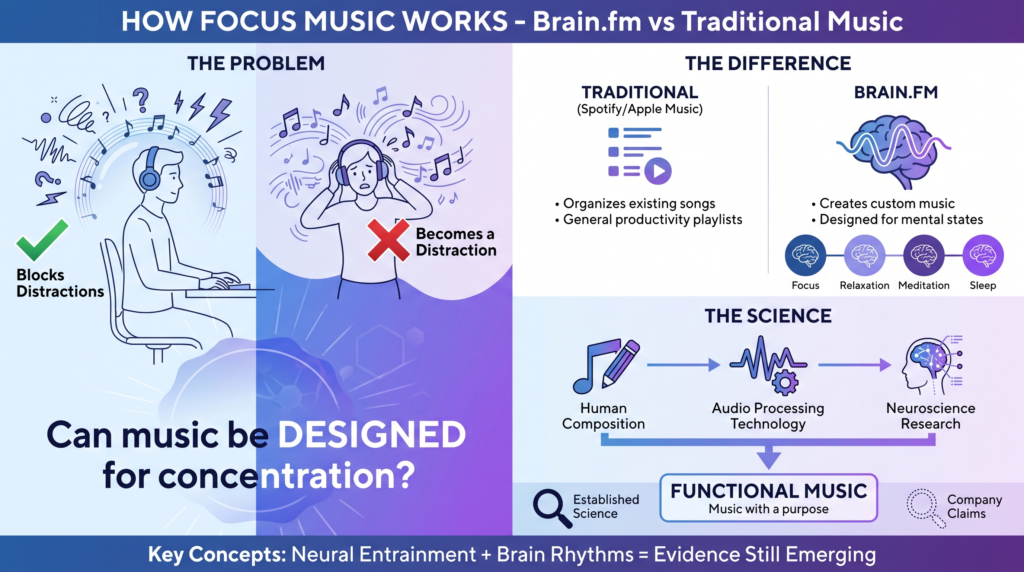
Millions of people listen to music when they are working, studying or writing. It acts as a means of blocking out distractions for some of them, while for others it becomes a distraction in its own right.
This raises an interesting question: Can music actually be designed to support concentration?
Brain.fm believes the answer is yes. Unlike Spotify or Apple Music, Brain.fm doesn’t simply organize existing songs into productivity playlists. Instead, it creates music specifically for mental states such as focus, relaxation, meditation, and sleep. The company combines human composition with proprietary audio processing techniques and neuroscience research to develop what it calls functional music.
But how does this work? More importantly, what does current research actually tell us?
In this guide, we will distinguish between established neuroscience and Brain.fm’s own assertions, explain ideas such as neural entrainment and brain rhythms in simple English, and look at what the current evidence indicates without going beyond what can be concluded. For me, as someone who researches focus and has dedicated the website to improving it, Brain.fm caught my attention with its science-based music.
Understanding the Basics
Before exploring Brain.fm specifically, it’s important to understand how the brain responds to sound.
Your brain is constantly processing enormous amounts of sensory information. Sounds compete for attention alongside visual input, thoughts, and external distractions. Music can therefore influence how demanding—or relaxing—a listening experience feels.
It is not true that all music has the same effect on attention.
Songs that have changing lyrics, sudden shifts in tempo, or highly emotional sections naturally draw in people since that is precisely what they are intended to do. Excellent songs tell stories, create anticipation, and give listeners memorable hooks.
That makes them enjoyable—but not always ideal background audio for demanding cognitive work.
Brain.fm starts from a different approach, which is science-backed.
Instead of creating music that grabs your attention, the company aims to create music that comfortably stays in the background while you focus on another task. According to Brain.fm, distracting musical elements are intentionally reduced or removed during production.
What Makes Brain.fm Different?
Many productivity applications merely suggest lo-fi playlists or ambient music which is already available elsewhere.
Brain.fm produces original music that is designed for use with cognitive tasks.
According to the company, several technologies are combined during production:
- Human-composed musical structures
- Proprietary modulation techniques
- Neural entrainment principles
- Continuous scientific testing
- Audio optimized for different mental states
Rather than relying on one technique such as binaural beats, Brain.fm says it applies multiple forms of audio modulation intended to influence how the brain synchronizes with rhythmic patterns.
If you like to try it out for yourself Brain.fm offers a 30-day free trial, so you have enough time to see if it helps you focus and grind.
Neural Entrainment Explained
One term appears frequently when reading about Brain.fm:
Neural entrainment.
Even though the name is complicated, the fundamental idea is surprisingly simple.
The brain of humans tends to respond to stimulation that is rhythmic.
Examples include:
- tapping your foot to music,
- walking in rhythm,
- clapping with a crowd,
- adhering to a steady rhythm.
Scientists have long known that rhythmic sensory input can influence patterns of neural activity, a phenomenon often referred to as neural entrainment. Researchers continue studying how these synchronized brain responses relate to attention, perception, and cognition.
Brain.fm states that its technology is designed to encourage stronger synchronization between certain musical rhythms and neural activity than ordinary music typically produces.
Importantly, this does not mean your brain is “reprogrammed” or forced into a specific state. Rather, Brain.fm’s own explanation is that carefully engineered rhythmic modulation may help support attentional networks under certain conditions.
Brain.fm Is Not the Same as Binaural Beats
A common misconception is that Brain.fm simply produces binaural beats.
The company explicitly says this is not the case.
Binaural beats work by presenting two slightly different frequencies to each ear, causing the brain to perceive a third “beat.”
Brain.fm says that its music applies direct modulation to each stereo channel rather than depending entirely on binaural beat techniques. The company explains that this leads to a greater degree of neural synchronisation than is achieved with binaural beats alone, although the final listening experience is the result of a number of proprietary methods and not just one technology.
That distinction matters because many online discussions incorrectly use both terms interchangeably.
How Does Brain.fm Test Its Music?
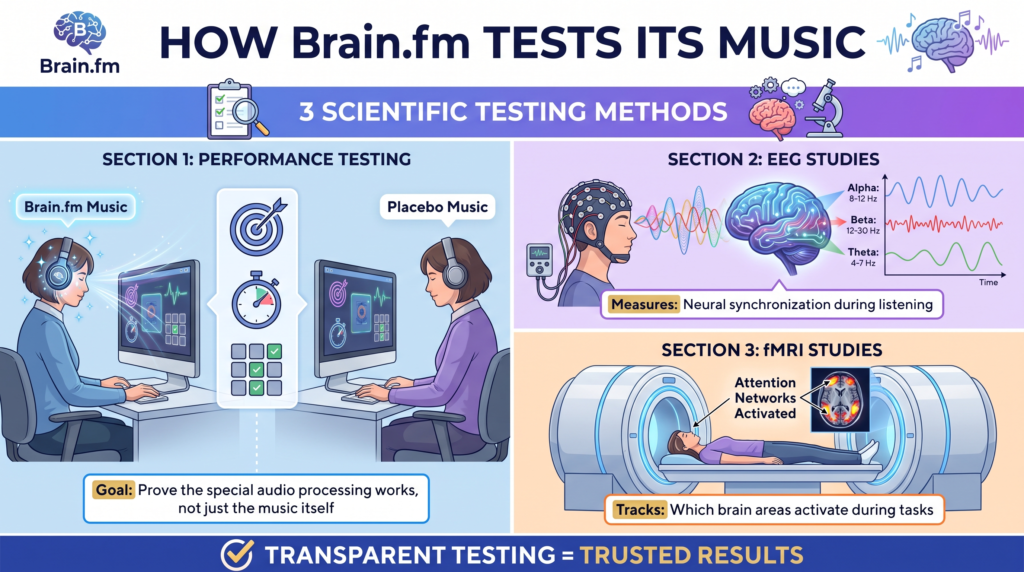
One aspect that separates Brain.fm from many productivity audio services is that the company publicly describes how it evaluates its technology.
According to Brain.fm, its testing process includes several different approaches.
1. Performance Testing
Participants carry out standardised attention tasks which are commonly used in psychological research.
Brain.fm reports comparing its music with placebo versions that contain the same underlying composition but lack the company’s proprietary processing.
The goal is to determine whether any measurable differences are attributable to the audio processing rather than to the music alone.
2. EEG Studies
Electroencephalography picks up the electrical activity from the scalp.
Researchers employ EEG in order to observe the rhythmic patterns of brain activity—patterns of brainwaves which are sometimes called brainwaves—and the way in which these patterns change as the participants listen to different kinds of audio.
The company Brain.fm states that it has carried out EEG studies in order to find out whether its music has an effect on neural synchronisation when being listened to.
3. fMRI Studies
Functional magnetic resonance imaging (fMRI) tracks the changes in blood flow in the brain.
Instead of directly recording electrical activity, fMRI determines which brain areas show increased activity when certain tasks are performed.
Brain.fm reports using fMRI research to examine how its music compares with other listening conditions in terms of activity within attention-related brain networks.
What Does Independent Research Say?
This is where it’s important to separate published evidence from marketing claims.
One peer-reviewed study involving researchers associated with Brain.fm found that adding specific amplitude modulations to background music influenced sustained attention differently depending on participants’ attentional characteristics. Another 2024 publication reported that rapid musical modulation appeared particularly beneficial for participants with greater attentional difficulty during sustained-attention tasks.
These findings are interesting and show what Brain.fm can do, but they do not prove that Brain.fm will improve focus for everyone.
Music perception varies considerably between individuals. Factors such as personality, task difficulty, background noise, fatigue, sleep quality, and personal preference all influence concentration.
Step-by-Step Guide: Getting the Most Out of Brain.fm
Brain.fm isn’t designed to replace good work habits. Think of it as a single tool that can support concentration when used in a distraction-free environment.
Step 1: Choose the Right Session
When opening Brain.fm, you’ll typically see several listening modes, including:
- Focus
- Relax
- Sleep
- Meditation
For mentally demanding work such as coding, writing, studying, or data analysis, choose Focus.
The other modes are designed with different listening goals in mind and aren’t intended for deep work.
Step 2: Match the Session Length to Your Task
Instead of playing music all day, consider matching your session to a realistic work block.
Many people work well with:
- 25-minute sessions
- 45-minute sessions
- 60-minute sessions
- 90-minute deep work blocks
Longer isn’t always better. Mental fatigue naturally builds over time, regardless of the audio you’re listening to.
Want to put this into practice? Try our free Deep Work Session Timer to customize your work sessions, breaks, and daily focus routine. It’s designed to help you apply these session lengths without having to watch the clock yourself.
Step 3: Remove Other Distractions
Even well-designed background audio can’t compete with constant interruptions.
Before pressing play:
- Silence your phone.
- Close unnecessary browser tabs.
- Turn off notifications.
- Keep only the applications you actually need.
The fewer decisions your brain has to make, the easier it becomes to maintain attention.
Step 4: Use Good Headphones
Brain.fm recommends using stereo headphones to experience the intended audio processing.
While speakers will still play the music, headphones generally preserve the stereo characteristics of the audio more accurately.
If you work in a noisy environment, active noise-cancelling headphones may further reduce background distractions.
If you’re looking for the right pair, read our guide to the best noise-cancelling headphones for focus before choosing one.
Expert Tips
Don’t Chase the Feeling
Many people expect Brain.fm to create an immediate “wow” moment.
That’s often the wrong expectation.
The goal isn’t to notice the music—it’s to stop noticing distractions.
Some users report that the audio feels almost uneventful, which is intentional. The music is designed to stay in the background rather than constantly demand attention.
Use It for Similar Tasks
If today’s session is programming and tomorrow’s is creative writing, your experience may differ.
Try using Brain.fm for similar tasks over several days before deciding whether it works for you.
Consistency makes it easier to judge whether the audio genuinely supports your workflow.
Build a Routine
Your brain benefits from routines.
Listening to the same type of audio before beginning focused work may gradually become part of your work ritual.
It is suggested by a great many productivity experts that consistent cues should be established to indicate that it is time to concentrate.
Common Mistakes
Expecting Instant Productivity
Brain.fm is not a quick way to get motivated.
No audio service will be able to make up for you being tired, distracted, or frequently interrupted.
Listening Too Loudly
Higher volume doesn’t improve concentration.
In fact, having too much volume can be distracting and lead to listening fatigue.
Select a comfortable volume so that the music becomes part of the background.
Multitasking
Attempting to deal with emails, watch videos, check social media, and carry out deep work all at the same time achieves nothing.
Brain.fm performs at its best when it is combined with one cognitively demanding activity.
Assuming It Works for Everyone
People respond differently to music.
Some prefer ambient sound.
Others work best in silence.
Some enjoy classical music.
The only reliable way to know whether Brain.fm fits your workflow is to test it yourself.
Final Thoughts
Brain.fm is an interesting combination of music production, psychology, and neuroscience.
Unlike traditional streaming services, its goal isn’t to entertain the listener but to create an audio environment that may support sustained attention. The company has invested in behavioral experiments, EEG research, fMRI studies, and peer-reviewed publications to explore this idea. While the current evidence is encouraging, it’s important to recognize that individual responses vary and no audio solution guarantees improved productivity.
The best course of action is to consider Brain.fm as just one element of a wider focus strategy. Factors such as getting adequate sleep, taking regular breaks, having a workspace free from distractions, and sticking to a consistent routine will almost always have a greater effect than music on its own. The only sure way to find out whether engineered audio helps with these habits is to try it during your own working or studying sessions.
If you’d like to try it for yourself, Brain.fm provides a 30-day free trial which gives you ample time to use it with your own activities and decide if it suits your workflow.
If you haven’t yet decided which platform to go with, you should read our comparison of Brain.fm vs Endel and also have a look at our guide to the best focus music apps before making your choice.
Frequently Asked Questions
Does Brain.fm guarantee better concentration?
Current research suggests specially designed background audio may support attention in certain situations, but no music can guarantee improved performance for every person or every task.
Is Brain.fm scientifically proven?
Brain.fm has published research, collaborated with academic researchers, and publicly describes EEG, fMRI, and behavioral testing.
The available studies are promising, but, as in many areas of cognitive neuroscience, research is still developing.
Is Brain.fm better than Spotify?
They’re built for different purposes.
Spotify is a general music streaming platform.
Brain.fm creates audio specifically intended for mental states such as focus, relaxation, and sleep.
Which one you prefer depends on your listening habits and goals. For focus Brain.fm is better.
Do I need headphones?
Not necessarily.
However, stereo headphones generally provide the listening experience Brain.fm was designed for, and headphones themselves can improve your focus.
Research & References
- Here is an overview of the research that Brain.fm has carried out, including its EEG studies, fMRI work, and functional music: https://www.brain.fm/science
- Communications Biology (2024) – Rapid modulation in music supports attention in listeners with attentional difficulties. https://www.nature.com/articles/s42003-024-07026-3
- PubMed version (same paper, easier to access for many readers).
- https://pubmed.ncbi.nlm.nih.gov/39443657/
Some of the links on Best Focus Music are affiliate links. This means that if you click a link and buy something, we may earn a small commission — at no extra cost to you. We only recommend products we genuinely think are worth your time.
We are a participant in the Amazon Associates Program, an affiliate advertising program designed to provide a means for sites to earn advertising fees by linking to Amazon.com and affiliated sites. We may also work with other affiliate networks and individual brands from time to time.