Quick Answer
Noise canceling headphones fight sound with sound. Built-in microphones pick up the noise around you, a tiny processor creates a mirror-image sound wave, and when the two meet at your ear, they cancel each other out.
The technical name is Active Noise Cancellation, or ANC. It works best on steady, low-pitched sounds like engine hum, air conditioning, and train rumble.
It’s less effective on sharp or unpredictable sounds — think a coworker laughing loudly or a crying baby two rows back.
Understanding the Question
If you’ve ever put on a pair of Sony or Bose headphones and hit the ANC button,then you know the feeling. It’s oddly satisfying. Almost a little eerie.
The honest answer is that it’s clever engineering built on a simple idea from physics. There’s nothing magic about it, but it is genuinely impressive — especially when you consider it all happens in real time, faster than you can perceive.
People who ask how do noise canceling headphones actually work tend to fall into a few camps: remote workers trying to survive an open-plan office, road warriors burned out from long-haul flights, or students trying to carve out a study bubble in a noisy shared flat. All of them want the same thing: to block out the world without moving to a soundproofed room.
Detailed Explanation
Passive Noise Isolation vs. Active Noise Cancellation
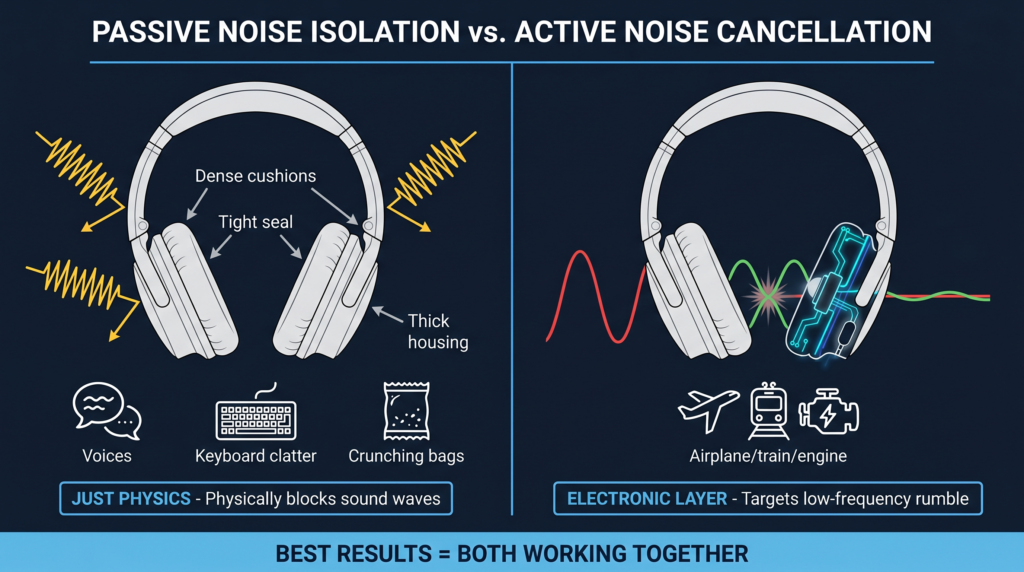
Before getting into the electronics, it helps to know that two distinct processes are at work in any pair of over-ear headphones: passive isolation and active cancellation.
Passive noise isolation is just physics. Dense ear cushions, a tight seal around your ear, thick housing — all of that physically stops sound waves from sneaking in. It works well against higher-frequency sounds, such as voices, keyboard clatter, and crunching bags.
Active noise cancellation is layered on top of that. It does the heavy lifting against low-frequency rumble that passive materials simply can’t block on their own.
How ANC Actually Works, Step by Step
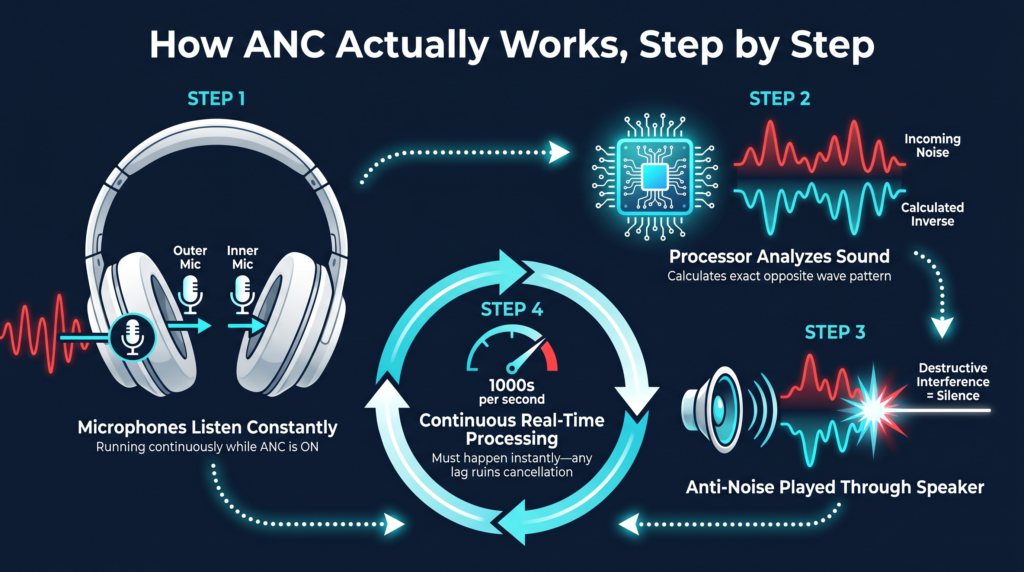
1. The microphones listen constantly. Most ANC headphones have at least two microphones — one facing outward to catch noise before it reaches your ear, one facing inward to monitor what you’re actually hearing. They run the whole time ANC is switched on.
2. A processor analyzes the incoming sound. Sound travels in waves with peaks and valleys. The onboard chip reads the incoming noise wave and calculates its exact inverse—a mirror image in which every peak becomes a valley and every valley becomes a peak.
3. Anti-noise is played through the speaker. The headphone driver plays that inverted wave simultaneously with your music, or just alone if nothing is playing. When the two waves collide, they cancel each other out — a process called destructive interference.
4. It happens thousands of times per second. This entire cycle — detect, invert, play — repeats continuously. The processor has to work fast enough that there’s no perceptible lag, the anti-noise arrives too late and makes things worse instead of better.
Why Low Frequencies Are Easier to Cancel
Low-frequency sounds have long, slow wave cycles that are consistent and predictable. That gives the processor enough time to calculate and deliver the anti-noise before the wave reaches your eardrum.
High-frequency sounds, and especially speech, change direction and pitch constantly. There’s simply not enough processing time to keep up, which is why voices come through more than background rumble.
The Three Types of ANC Systems
Feedforward ANC places microphones on the outside of the ear cups. It detects noise early, before it reaches your ear, but wind can hit those microphones directly and introduce its own interference.
Feedback ANC puts microphones inside the ear cup, right where your ear is. It’s more accurate but has a slower reaction time to sudden sounds.
Hybrid ANC combines both — external mics for early detection, internal mics for fine-tuned correction. This is what you’ll find in most premium headphones and is why the gap between a mid-range and a high-end pair is so noticeable in practice.
Key Points You Should Know
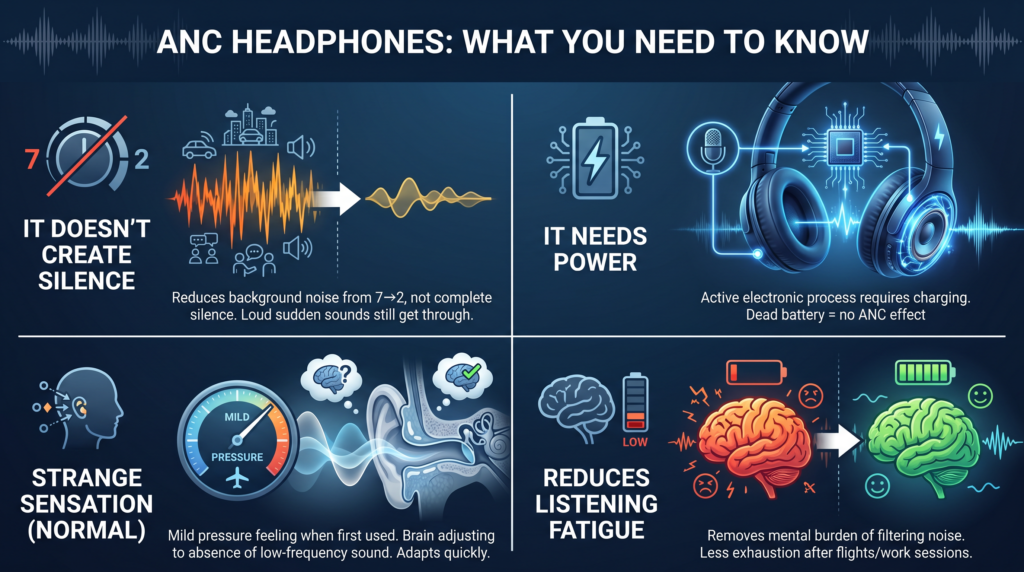
It doesn’t create silence
ANC reduces background noise, but it doesn’t erase the world. You’ll still hear loud, sudden sounds, nearby conversations, and anything above a certain frequency threshold.
Think of it as turning the background noise from a 7 down to a 2 — not muting it entirely.
It needs power
ANC is an active electronic process. The microphones, processor, and speaker all need electricity to run, which is why wireless ANC headphones need charging.
Most headphones still work passively when the battery is dead, but the ANC effect vanishes entirely.
It can cause a strange sensation
A portion of users notice a mild pressure feeling when they first use ANC, almost like the pressure change when an airplane cabin pressurizes. This isn’t harmful.
What’s happening is that your brain, used to a constant layer of low-frequency ambient sound, suddenly experiences its absence. Most people adapt within a few sessions.
Listening fatigue is real — and ANC helps
In a noisy environment, your brain works overtime to filter background noise. You’re not consciously aware of it, but it’s mentally draining over a full workday.
ANC removes that burden. Many people finish a long flight or a deep-work session noticeably less wrung out than they used to — and that’s not a placebo effect.
Examples and Case Studies
Working in a Noisy Office
You know this feeling when you work in a typical open-plan office: phones ringing, colleagues chatting, a ventilation system, and the coffee machine running all day. Imagine putting on ANC headphones. Almost entirely, the background conversation drops to a faint murmur, and they can focus without cranking the volume.
For this use case, ANC is particularly valuable because office environments are full of exactly the kind of steady, low-frequency noise the technology excels at canceling.
Noise-cancelling headphones help reduce external distractions, but many people also combine them with dedicated focus audio to create an even calmer working environment. If you’re interested in exploring different productivity audio platforms, check out our guide to the best focus music apps to compare the most popular options.
The Frequent Flyer
Aircraft cabins run at a sustained low-frequency engine roar that’s relentless over a ten-hour flight. It’s not loud enough to feel unbearable, but it’s persistent enough to be genuinely exhausting.
ANC headphones are nearly purpose-built for this scenario — their noise profiles are predictable, consistent, and low-pitched. Frequent travelers regularly report arriving at their destination noticeably less depleted, sometimes using ANC without any music at all, purely for the cognitive rest.
The Student in Shared Housing
A student living with three roommates tries to study while the kitchen is noisy and someone’s watching TV next door. The TV audio is a mix of frequencies — partially reducible by ANC, partially not.
But the overall effect still creates a quieter cognitive bubble, especially combined with music or a white noise track. The ANC isn’t doing all the work, but it makes a difficult environment workable so you can focus more on your task.
Are noise-canceling headphones something for you? Check out our full guide here: Is a noise-canceling headphone worth it?
Expert Insights
Audio engineers describe the real breakthrough of modern ANC as the miniaturization and speed of the processing chip. Early ANC systems existed decades ago — used in aviation headsets and industrial ear protection — but they were bulky and power-hungry.
Today’s premium headphones go further with adaptive or AI-assisted ANC. Rather than applying a fixed cancellation profile, they sample your environment continuously and adjust in real time.
Some models detect that you’re on a plane and shift into a different mode. Others activate a transparency mode when you start speaking, so you can hear the person in front of you without removing your headphones. For commuters and daily users, transparency mode has become nearly as important as the ANC itself.
Additional Resources
If you want to go deeper into the technology or buying decisions, these are useful areas to explore:
- Sound wave physics — understanding destructive interference at a fundamental level helps demystify ANC entirely
- Bluetooth audio codecs — relevant if you care about audio quality beyond just the noise cancellation
- Over-ear vs. in-ear ANC — earbuds with ANC have become increasingly capable, though over-ear headphones still generally have an edge in passive isolation
- Battery life trade-offs — different headphones balance ANC strength against battery endurance differently; worth checking before buying
- Hearing safety — ANC headphones can actually support healthier listening habits because you need less volume when background noise is already reduced
If you’re considering buying a pair of ANC headphones, our in-depth comparison can help you understand which models offer the best value, comfort, and noise-cancelling performance for different budgets and use cases. Read our full guide here.
Conclusion
So if you’ve ever wondered how do noise canceling headphones actually work, the short version is this: microphones detect noise, a processor flips the wave upside down, and the two signals cancel each other out at your ear. It’s a continuous loop happening thousands of times a second.
It’s not magic. It’s not silence. But for persistent low-frequency background noise — on planes, in offices, in shared housing — it’s one of the more genuinely useful pieces of consumer technology available today.
The engineering has matured considerably, and even mid-range models now deliver results that would have seemed impressive on high-end equipment just five years ago.
Frequently Asked Questions
Do noise canceling headphones damage your hearing? No. Used responsibly, they don’t. Because ANC reduces background noise, most people naturally listen at lower volumes — which is actually better for long-term hearing health.
Can noise canceling headphones block voices? Partially. ANC works best against low, steady sounds. Human speech is variable and higher in frequency, so it comes through more than the background rumble. Passive isolation helps, but voices are never fully eliminated.
Why do noise canceling headphones feel like pressure in my ears? Your brain is used to a constant baseline of low-frequency ambient sound. When ANC is suddenly removed, the absence can feel unusual — similar to cabin pressure changes. It’s harmless, and most users adapt quickly.
Are expensive noise canceling headphones actually better? Generally yes. Premium models tend to have better hybrid ANC systems, faster processors, and more sophisticated adaptive features. That said, the gap between mid-range and flagship has narrowed meaningfully in recent years.
Do noise canceling headphones work without music? Yes. ANC operates independently of audio playback. Many people use them on public transport or flights without playing anything — purely for the ambient noise reduction.
Can you sleep with noise canceling headphones on? Some people do, particularly on long flights. Comfort is the limiting factor. In-ear ANC models are generally more practical for sleeping than over-ear ones, which can press uncomfortably against a pillow.
Is ANC worth it for studying or remote work? For most people in genuinely noisy environments, yes. The reduction in cognitive load is real and measurable in terms of focus and fatigue levels across a full day.
Some of the links on Best Focus Music are affiliate links. This means that if you click a link and buy something, we may earn a small commission — at no extra cost to you. We only recommend products we genuinely think are worth your time.
We are a participant in the Amazon Associates Program, an affiliate advertising program designed to provide a means for sites to earn advertising fees by linking to Amazon.com and affiliated sites. We may also work with other affiliate networks and individual brands from time to time.