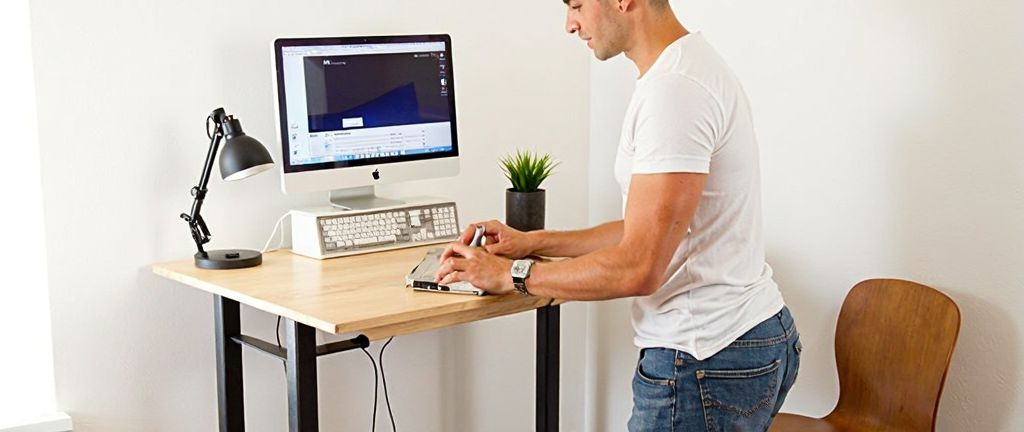
If you spend most of your working day at a desk, you have probably wondered whether sitting for hours is affecting your health, energy, or ability to concentrate. A standing desk might seem like a simple solution. Instead of remaining seated throughout the day, you can raise your work surface and continue working on your feet.
But is a standing desk worth it, or is it another piece of office equipment that sounds better in theory than it works in practice?
The answer depends on your working habits, budget, workspace, and expectations. Standing desks can help reduce the amount of time you spend sitting, but they are not a replacement for exercise, regular movement, or a comfortable ergonomic setup. Standing for too long can also cause discomfort, meaning that switching from a traditional desk to a standing desk does not automatically make your workday healthier.
In this guide, we will explore the main standing desk pros and cons, examine the possible benefits and disadvantages, and explain when investing in one makes sense. We will also look at how a standing desk compares with a traditional sitting desk, particularly for people who work from home, study, or spend long hours concentrating on demanding tasks.
What Is a Standing Desk?
A standing desk is a work surface designed to let you work while standing rather than sitting in a conventional office chair. Some models have a fixed height, while others can be adjusted to allow for various working positions.
There are three common types:
- Height-adjustable standing desks: These desks allow you to switch between sitting and standing. Electric models use a motor, while manual versions normally use a crank or another adjustment mechanism.
- Fixed-height standing desks: These are designed primarily for standing and generally cannot be lowered to a seated working height.
- Desktop standing desk converters: These units sit on top of an existing desk and raise your monitor, keyboard, and other equipment when you want to stand. If you’re doubting between a standing desk or a desk converter read our Standing Desk vs. Desk Converter article.
For most people working at a computer, a sit-stand desk is the most flexible option because it allows them to alternate between positions throughout the day.
However, the type of desk matters less than how you use it. Even an expensive adjustable desk will have limited value if you remain in the same position for hours without moving.
Standing Desk Pros and Cons: The Main Advantages and Disadvantages
Before deciding whether to invest in a standing desk, it helps to consider both sides.
The Pros of Standing Desks
1. They can reduce prolonged sitting
One of the main reasons people consider a standing desk is the amount of time they spend sitting at work.
Office workers, remote employees, and students can easily spend several consecutive hours in front of a computer. A sit-stand desk makes it easier to interrupt those long periods without having to stop working completely.
Research supports the idea that sit-stand workstations can reduce sedentary time during working hours. However, replacing sitting with standing does not mean you are suddenly engaging in substantial physical activity.
The most useful approach is to combine different positions with regular movement throughout the day.
2. They make it easier to change working positions
Remaining in one position for too long can leave you feeling stiff or uncomfortable.
An adjustable desk gives you the option to change your position when you begin to feel restless or need a break from sitting. You can stand while answering emails, sit while completing detailed tasks, and get up to walk between meetings.
This flexibility is especially useful useful when working from home, where there may be fewer natural opportunities to move around.
3. They may help some people feel more alert
Some people find that standing for part of the day helps them feel less sluggish, particularly during long afternoons at their desk.
There is also research suggesting that active workstations can support certain aspects of cognitive performance without necessarily reducing work performance. However, findings about active workstations do not mean that standing alone reliably improves concentration.
Your alertness depends on several elements, including sleep, physical activity, workload, stress, and the environment in which you work.
For people who struggle to stay engaged during long work sessions, a standing desk can be one component of a more active and comfortable workspace.
4. They can make a home office more flexible
A home office needs to support different activities, from video calls and writing to research and studying.
Being able to adjust your desk makes it easier to adapt your setup to different tasks. You might prefer sitting when writing a long article and standing when organizing your schedule or responding to messages.
This flexibility can be especially useful if you spend most of your working day at home and want to make your workspace more comfortable without completely redesigning it.
Still considering whether a standing desk is right for you? Read our guide to the best standing desks for productivity to compare three options for different budgets and home-office setups.
The Cons of Standing Desks
1. Standing for too long can cause discomfort
Standing is not automatically healthier than sitting.
Research reviewed by the US National Institute for Occupational Safety and Health (NIOSH) has linked prolonged standing at work with lower-back pain, muscle fatigue, leg discomfort, and swelling. Remaining stationary for long periods can be particularly uncomfortable.
This is why replacing an entire seated workday with a standing workday is not a good solution.
A standing desk works best when it allows you to alternate positions and move regularly rather than forcing you to stand continuously.
2. A good standing desk can be expensive
The price of a standing desk varies considerably depending on its construction, adjustment mechanism, size, and features.
A basic desktop converter may be relatively affordable, while a sturdy electric sit-stand desk can require a more substantial investment.
You may also need to consider additional equipment, such as a monitor arm, cable management accessories, or an anti-fatigue mat.
For someone who only occasionally wants to stand while working, purchasing a complete adjustable desk may not offer enough value to justify the expense.
3. Standing desks require an ergonomic setup
An adjustable desk does not automatically solve problems caused by poor posture or badly positioned equipment.
If your monitor is too low, your keyboard is too far away, or your wrists are bent at uncomfortable angles, standing can create new sources of strain.
You need to position the desk, screen, keyboard, and mouse appropriately for both seated and standing work.
If you frequently switch positions, this can require some adjustment, especially when sharing a desk with another person.
4. They do not replace exercise
Standing burns somewhat more energy than sitting, but the difference is relatively small.
A standing desk should not be viewed as a weight-loss solution or a substitute for walking, strength training, or other physical activity.
Although reducing prolonged sitting can be beneficial, standing still for several hours does not provide the same benefits as moving your body.
For people who spend most of their day at a computer, short walking breaks and regular exercise remain important parts of a healthy routine.
Standing Desk Benefits: What Does the Research Actually Say?
The potential benefits of standing desks are worth examining more closely, particularly if you are considering one for your home office.
However, it is important to distinguish between benefits supported by research and claims that are often exaggerated in product marketing.
Reduced Sedentary Time
One of the clearest advantages of a sit-stand desk is that it can help reduce the amount of time you spend sitting.
A systematic review published in 2024 examined sit-stand desk interventions and their effects on sedentary behavior. Across the included studies, researchers found reductions in sitting time both during working hours and across the day.
The size of the effect varied depending on the follow-up period and intervention.
This is an important distinction: the evidence supports sit-stand desks as a practical way to reduce sedentary time, but it does not establish that purchasing one automatically improves every aspect of your health.
What this means in practice: If you regularly work for several hours without changing position, an adjustable desk can make it easier to introduce more variety into your day.
Possible Improvements in Comfort
Some people experience less discomfort when they can change their working position regularly.
For example, someone who feels stiff after sitting through several consecutive meetings may appreciate being able to stand during the next call.
However, the effects on back pain and overall comfort aren’t the same for everyone. Alternating positions can be helpful, but standing for long durations can also cause discomfort.
Your chair, desk height, screen position, and your personal working habits all contribute to your overall experience behind your desk.
If you already have persistent back, neck, or leg pain, don’t treat a standing desk as a sure solution. If symptoms continue, consider seeking advice from a qualified healthcare professional.
Possible Effects on Alertness and Concentration
At BestFocusMusic, we are interested in how your working environment affects your ability to concentrate.
Your workspace includes more than just your computer and chair. Lighting, background noise, physical comfort, and opportunities to move may all influence how you experience a working session.
A standing desk may help you feel more engaged if changing positions makes your workday less monotonous. Some people also find it useful to stand when doing tasks that do not require extensive typing.
Nevertheless, the evidence does not support promising that a standing desk will consistently increase productivity or improve concentration for everyone.
If your main challenge is staying focused during demanding work, consider your entire setup. A comfortable chair, manageable noise levels, appropriate lighting, and structured breaks may matter as much as the desk itself. If you want to see other options, read our article about 10 Upgrades for a More Focused Workspace
You can also explore different audio environments if background noise is distracting. The right focus music may help some people create a more consistent working routine, although individual likes and the type of task matter.
Ultimately, a standing desk is a tool for changing your working position, not a direct solution to every productivity problem.
Want to put these benefits into practice? Explore our guide to the best standing desks for productivity to compare three options for your home office and find one that fits your workspace, budget, and working habits.
Standing Desk vs Sitting Desk: Which Is Better?
The choice between a standing desk and a traditional sitting desk is not necessarily an either-or decision.
Both options can support productive work when the workstation is set up correctly. The main difference is how easily you can change your working position.
| Feature | Standing Desk | Traditional Sitting Desk |
| Working position | Standing, or sitting and standing with an adjustable model | Primarily sitting |
| Initial cost | Often higher for electric adjustable models | Generally lower |
| Flexibility | High with a sit-stand model | Depends on the chair and desk setup |
| Prolonged sitting | Can help reduce sitting time | Requires deliberate breaks to interrupt sitting |
| Prolonged standing | Can become uncomfortable if used incorrectly | Not usually a concern during seated work |
| Space requirements | Depends on the model and adjustment mechanism | Often straightforward to accommodate |
| Ergonomic considerations | Requires suitable positioning in both standing and seated modes | Requires a suitable chair and desk height |
| Best suited for | People who want to alternate positions | People who prefer sitting and already have a comfortable setup |
When a Standing Desk Makes More Sense
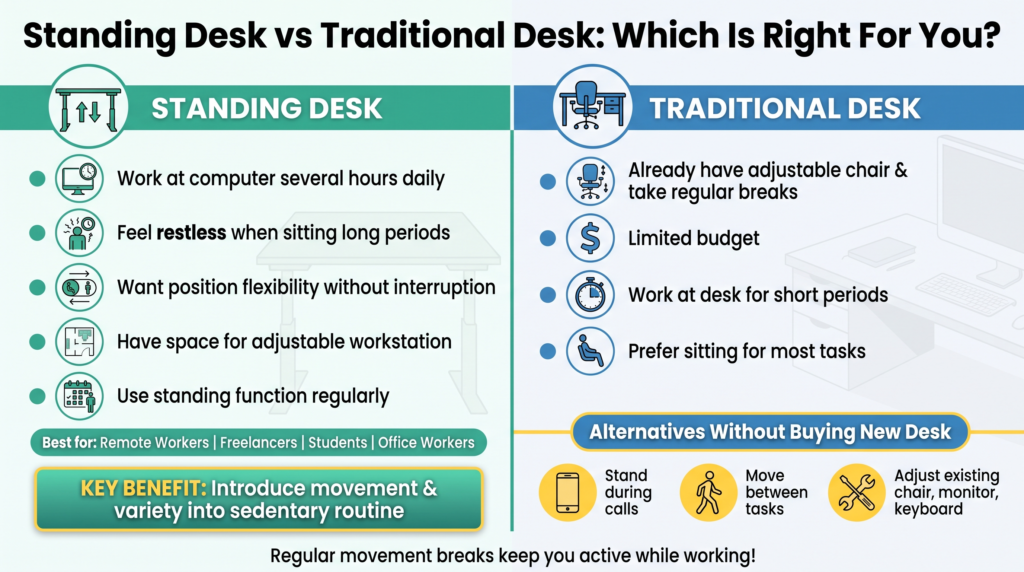
A standing desk may be worth considering if you:
- Work at a computer for several hours each day.
- Frequently feel restless when sitting for long periods.
- Want the flexibility to change positions without interrupting your work.
- Have enough space for an adjustable workstation.
- Expect to use the standing function regularly.
For remote workers, freelancers, and students, and office workers, the main advantage is the ability to introduce more movement and variety into a largely sedentary routine.
When a Traditional Desk May Be Enough?
A conventional sitting desk may be sufficient if you already have a comfortable, adjustable chair and regularly take breaks.
It may also be the better choice if you have a limited budget, work at a desk for relatively short periods, or prefer sitting for most tasks.
You can still reduce prolonged sitting without purchasing a new desk. For example, stand during phone calls or while walking between tasks. Taking regular movement breaks is a simple way to stay active while working.
If your existing setup is uncomfortable, you could adjust your chair, monitor, or keyboard. That could solve the problem before you invest in a new desk.
Is a Standing Desk Worth It for Working From Home?
For remote workers, the answer depends on how much time they spend at their workstation and how effectively they use the desk.
Working from home can make it easy to remain seated for extended periods. Without commuting, walking between meeting rooms, or getting up to speak with colleagues, some people move less throughout the day than they realize.
A sit-stand desk can help address this by making it easier to change positions while continuing to work.
However, it is important to consider what you actually need from your home office.
If your main priority is reducing prolonged sitting, an adjustable desk may be a worthwhile investment. If your primary concern is concentration, you may also benefit from improving your lighting, reducing distractions, and creating a more comfortable audio environment.
For example, people who regularly work in noisy homes may find that suitable headphones and a consistent focus routine help them manage distractions. A standing desk addresses a different part of the working environment, so the two approaches can complement each other.
Before spending money, think about your biggest obstacle to productive work. Is it discomfort from sitting, a lack of movement, distracting noise, or an unsuitable workspace?
Answering that question will help you decide whether a standing desk is the right investment or whether another change would make a bigger difference.
How to Decide Whether a Standing Desk Is Worth the Investment
If you are still unsure, consider these four questions before buying one.
How many hours do you spend at your desk?
The more time you spend working at a computer, the more opportunities you may have to benefit from an adjustable workstation. However, total desk time alone does not determine whether you need one.
Will you actually alternate between sitting and standing?
A sit-stand desk is most useful when you take advantage of its flexibility. If you expect to remain seated most of the time, a traditional desk or a desktop converter may be sufficient.
Does your current setup cause discomfort?
Identify the source of the problem before assuming a standing desk will solve it. An incorrectly positioned monitor, an unsuitable chair, or a lack of movement may be contributing to the discomfort.
Does the price fit your budget?
You do not necessarily need a premium electric desk. Consider whether a simpler adjustable model or a desktop converter would provide the flexibility you need.
Once you have answered these questions, you can make a more informed decision about the type of desk that suits your working habits.
If you decide that an adjustable desk is a good fit, our guide to the best standing desks for productivity can help you compare specific models and narrow down your options. Choose the desk that fits your space, budget, and everyday workflow rather than paying for features you are unlikely to use.
Final Verdict: Is a Standing Desk Worth It?
So, is a standing desk worth it?
For many people who spend long hours working at a computer, an adjustable sit-stand desk can be a useful investment. It provides a practical way to reduce prolonged sitting, change working positions, and introduce more variety into the workday.
However, standing desks also have disadvantages. They can be expensive, require additional space, and cause discomfort if you stand for too long. They do not automatically improve concentration, eliminate back pain, or replace regular physical activity.
The strongest reason to consider a standing desk is flexibility. Instead of being restricted to a seated position, you can adjust your workspace to suit different tasks and your comfort throughout the day.
For some people, that flexibility will justify the cost. For others, a comfortable chair, better workstation ergonomics, and regular movement breaks will be enough.
Our recommendation: Consider a standing desk if you spend much of your day at a computer and genuinely expect to alternate between sitting and standing. If you are primarily interested in improving your productivity, remember that your desk is only one part of the equation. A comfortable environment, fewer distractions, and sustainable working habits matter too.
If you have decided that a standing desk could suit your needs, take the next step by comparing the available options. Our guide to the best standing desks for productivity focuses on specific products, helping you evaluate your choices before making a purchase.
Sources and Further Reading
The following sources provide additional information and research on standing desks, workplace ergonomics, prolonged sitting, and the potential effects of standing for extended periods.
- Centers for Disease Control and Prevention (CDC) — National Institute for Occupational Safety and Health (NIOSH). Prolonged Standing at Work.
Explores the potential health effects of prolonged standing and discusses strategies for reducing discomfort through movement and workplace adjustments.
Read the research - Centers for Disease Control and Prevention (CDC) — National Institute for Occupational Safety and Health (NIOSH). The Effect of Sit-Stand Desks on Office Worker Behavioral and Health Outcomes: A Scoping Review.
Reviews research on sit-stand desks, including their effects on sitting behavior, physical comfort, health outcomes, and work performance.
Read the research review - Centers for Disease Control and Prevention (CDC) — National Institute for Occupational Safety and Health (NIOSH). Evidence of Health Risks Associated With Prolonged Standing at Work and Intervention Effectiveness.
Examines the potential health risks of prolonged standing and evaluates interventions intended to reduce discomfort and related problems.
Read the research review - Mayo Clinic. Sitting Risks and How to Reduce Them.
Explains the potential health concerns associated with prolonged sitting and provides practical suggestions for incorporating more movement into daily routines.
Read the guidance
Editorial note: This article is intended for general informational purposes and is not a substitute for professional medical advice. The benefits of standing desks vary by individual, and alternating between sitting, standing, and moving throughout the day is generally more practical than staying in one position for long periods.
Some of the links on Best Focus Music are affiliate links. This means that if you click a link and buy something, we may earn a small commission — at no extra cost to you. We only recommend products we genuinely think are worth your time.
We are a participant in the Amazon Associates Program, an affiliate advertising program designed to provide a means for sites to earn advertising fees by linking to Amazon.com and affiliated sites. We may also work with other affiliate networks and individual brands from time to time.