Quick Answer
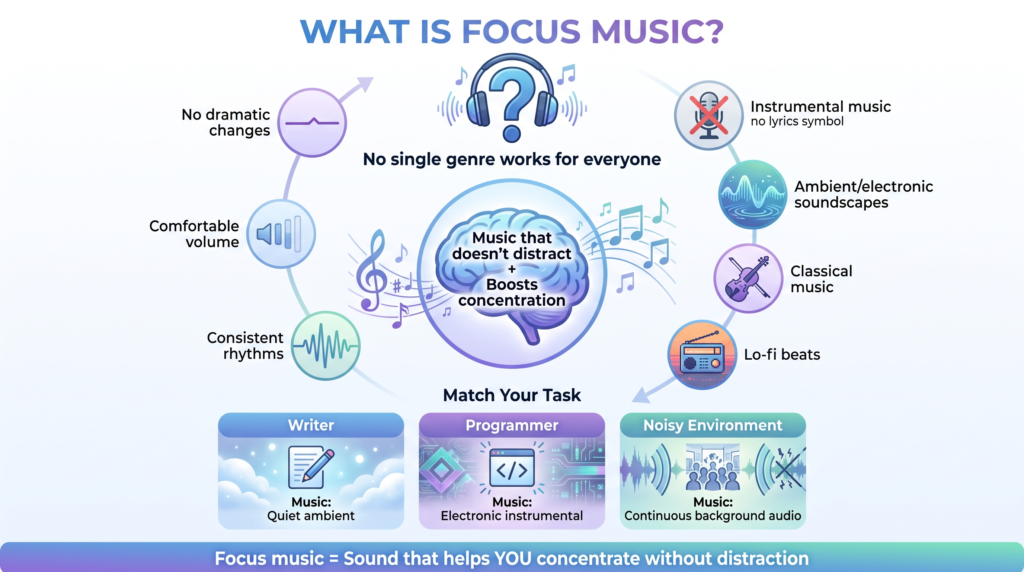
If you’re wondering what kind of music is focus?, there isn’t one specific genre that works best for everyone. The kind of music that is most helpful for concentration tends to have characteristics that make it less likely to pull your attention away from the task.
For many people, that means:
- Instrumental music without lyrics
- Ambient or electronic soundscapes
- Classical music
- Lo-fi beats
- Consistent, predictable rhythms
- Music at a comfortable volume
- Audio that doesn’t contain frequent dramatic changes
The correct choice will vary according to the particular task and the person involved; for example, a person writing an article might prefer quiet ambient music whereas a programmer could enjoy electronic instrumental music and someone working in a noisy environment would probably get more benefit from continuous background audio that covers up unpredictable noises.
The key thing is that ‘focus music’ doesn’t belong to one particular genre; it’s more accurate to think of it as music or sound which you can listen to without it acting as a further distraction and that can boost your focus and productivity.
Understanding the Question
When someone is looking for music to help them concentrate, they are usually seeking something quite particular—music which can stay in the background as they are working.
That’s different from choosing music simply because you enjoy it.
Your favourite song could be great when you’re driving, doing exercise, or relaxing, but it might compete for your attention in the same way when you’re writing a difficult report, trying to memorise information, or working on a programming problem.
Lyrics are a clear example.
While you are reading or writing, the words in a song may compete with your own thoughts, and a dramatic chorus can draw your attention, whereas a sudden change in tempo might cause you to lose focus.
This doesn’t mean that music with lyrics is automatically bad for concentration. It simply means that the characteristics of the audio matter more than the genre label alone.
What kind of music is suitable for concentration?
When selecting audio for focused work, there are a number of characteristics that are worth taking into account.
1. Instrumental Music
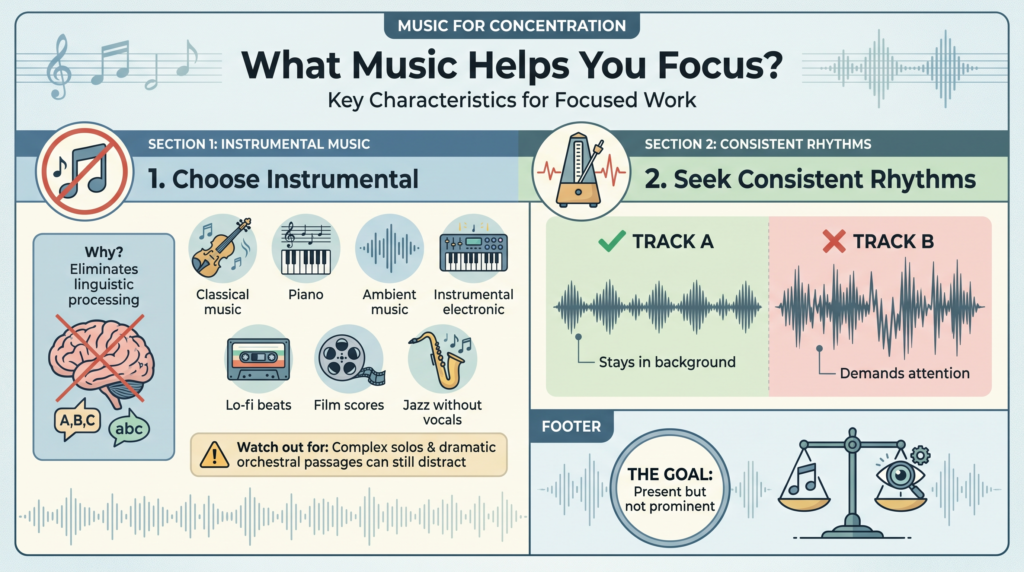
Instrumental music is usually a good choice since it gets rid of the extra linguistic information found in the lyrics.
If you’re writing, reading, or studying, this can be particularly useful because you’re already processing language as part of the task.
Instrumental music can include:
- Classical music
- Piano
- Ambient music
- Instrumental electronic music
- Lo-fi beats
- Film scores
- Jazz without vocals
That doesn’t mean it’s free from distractions. For example, a complicated guitar solo or a dramatic orchestral passage can still capture your attention.
2. Consistent Rhythms
A feature that is favoured by many people when they are working concentrated is consistency.
A steady rhythm can offer a stable background without continually requiring attention.
Compare two hypothetical tracks.
Track A:
A steady beat, limited variation, gradual changes.
Track B:
Frequent tempo changes, dramatic drops, sudden volume changes, and a constantly changing arrangement.
Track A could be easier to keep in the background while you are working.
It does not follow that repetitive music is better in all cases; in fact, if a track becomes so repetitive that you begin to listen to it consciously, it may have the contrary effect.
The aim is to have the audio be there without it becoming the main feature.
What Genres Are Best for Focus?
We cannot say that one genre is the best choice in all cases, since various styles have features that may be appropriate for different individuals and situations.
Classical Music
Classical music is one of the most frequently suggested choices for studying and concentrating.
It offers a great variety of listening experiences; for instance, a quiet piano piece is quite different from an intense orchestral one.
For focused work, you may want to experiment with:
- Piano compositions
- Baroque music
- Minimalist classical music
- Slow orchestral pieces
If you find that you are attending to the melody instead of focusing on your task, then select a simpler option.
Lo-Fi Music
Lo-fi has gained especially great popularity amongst students and people working from home.
Typical lo-fi playlists combine:
- Repetitive beats
- Soft melodies
- Ambient textures
- Limited vocals
- Relatively predictable arrangements
A reason why it works well for certain listeners is that it offers a constant background noise without needing active concentration.
The problem is that all lo-fi playlists are not equally appropriate; some include vocal samples, have distinct melodies, or feature frequent changes which can be distracting.
Ambient Music
Ambient music is another strong option for people who don’t want a prominent beat.
Instead of focusing on melody or rhythm, ambient music often creates a continuous atmosphere using sustained tones and sound textures.
This can work particularly well when you want to reduce the perception of background noise without adding a strong musical structure.
It can be especially useful for:
- Reading
- Meditation
- Writing
- Long study sessions
- Quiet office work
Electronic Instrumental Music
Electronic instrumental music can be useful if you prefer something that has more energy.
A steady electronic rhythm is something that some people discover helps to build up momentum when carrying out repetitive tasks.
The important point is to steer clear of tracks that become too interesting.
If you start paying attention to the production, waiting for the drop, or anticipating the next section, the music may no longer be functioning as background audio.
What About Music With Lyrics?
This is one of the most common questions surrounding concentration.
The answer isn’t simply “never listen to lyrics.”
The effect depends heavily on:
- The type of task
- The language of the lyrics
- How familiar the music is
- How much you enjoy the song
- Your individual preferences
Lyrics are more likely to interfere with your attention when the task you’re carrying out involves a great deal of language processing.
For example, if you are writing an essay while listening to a song which has very noticeable lyrics, your brain has to handle two sources of language at the same time.
Does Familiar Music Work Better?
Sometimes, familiar music can be easier to ignore because you aren’t actively trying to understand what’s happening.
You already know the song, so there may be less curiosity about what comes next.
But familiarity can work both ways.
If you love a particular song, you might still automatically sing along, anticipate the chorus, or become emotionally engaged with it.
A useful test is simple:
Are you listening to the music, or is the music simply playing while you work?
If you regularly catch yourself focusing on the song, try something less engaging.
What About Focus Music Apps?
Traditional music streaming services give you access to enormous libraries. That can be useful, but it also creates another problem: finding something suitable can take time.
It could take you ten minutes looking for the right playlist before you actually start working.
Dedicated focus-audio platforms take a different approach. Instead of asking you to browse thousands of songs, they create or organize audio specifically around activities such as concentration, relaxation, or sleep.
For instance, Brain.fm employs specially designed audio and terms its method as “functional music”. The platform offers focus sessions as well as other types of listening modes.
If you’d like to compare the different options, consult our article on the Best Focus Music Apps to find out how specialized platforms stack up against conventional music services.
Can Brain.fm Be Considered Focus Music?
Brain.fm is specifically designed around listening goals such as Focus, rather than being a general music streaming service.
The company states that its audio is produced on the basis of principles informed by neuroscience and involves the use of its own audio processing technology; it has furthermore released research into its method of addressing attention.
If you want to find out, it’s better to try the product out during a number of actual work sessions than to make your decision on the basis of its advertising.
If you’d like to give Brain.fm a try, you might start with the 30-day free trial and try its Focus sessions as part of your usual study or work routine.
How Should You Choose Music for Different Tasks?
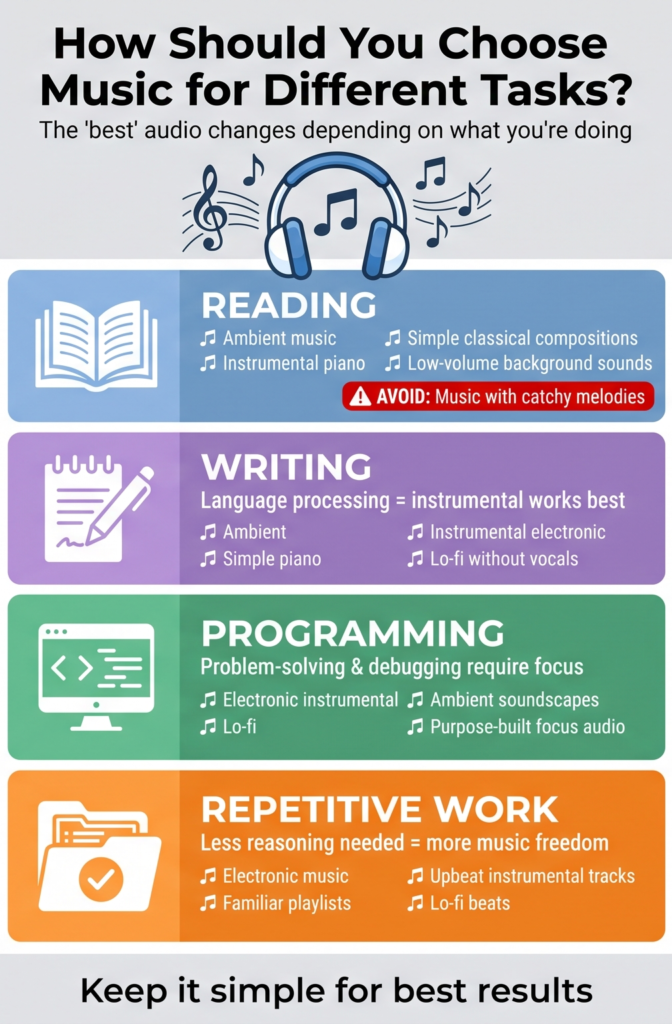
The “best” audio can change depending on what you’re doing.
Reading
When reading complicated material, try:
- Ambient music
- Instrumental piano
- Simple classical compositions
- Low-volume background sounds
Do not choose music that causes you to want to follow the melody.
Writing
Since writing involves a great deal of language processing, it is usually sensible to start with instrumental audio.
Try:
- Ambient
- Instrumental electronic
- Simple piano
- Lo-fi without vocals
Programming
Programming often means spending a lot of time solving problems and fixing bugs.
Some programmers prefer:
- Electronic instrumental music
- Ambient soundscapes
- Lo-fi
- Purpose-built focus audio
Repetitive Work
So what kind of music is focus when it comes to some work? For repetitive tasks such as organizing files or performing administrative work, more energetic music may be perfectly appropriate.
You can experiment with:
- Electronic music
- Upbeat instrumental tracks
- Familiar playlists
- Lo-fi beats
Because the task requires less continuous reasoning, the music may have less opportunity to interfere.
Volume Matters More Than You Might Think
Good background music can be distracting if it is too loud.
Your goal should generally be to keep the volume at a level where the music remains part of the environment rather than becoming the primary thing you’re experiencing.
Reduce the volume so that you are able to work comfortably without having to actively listen.
This can also make long listening sessions more comfortable.
Headphones can also form part of the solution in a noisy environment. Our guide on how noise-cancelling headphones actually work explains the technology behind active noise cancellation and how it can help reduce unwanted background noise.
Should You Use Headphones?
Not necessarily.
Speakers can work perfectly well if you’re working somewhere quiet.
Headphones become more useful when:
- You are in an open-plan office.
- The people nearby are talking.
- You are working in a café.
- The noise from around the house is interfering with you.
- You want to create a steady listening environment.
Noise cancellation is especially useful when it comes to unpredictable noises like conversations or traffic.
How to Find Your Own Focus Sound
Instead of searching endlessly for the “perfect” playlist, run a simple experiment to find out what kind of music is focus for you:
Step 1: Choose one type of audio
Start with instrumental, ambient, or lo-fi music.
Step 2: Use it for the same type of task
Try it during several comparable work sessions.
Step 3: Keep the volume consistent
Don’t change multiple variables at once.
Step 4: Track your experience
After each session, ask yourself:
- Did I stay focused?
- Did I notice the music?
- Did I get distracted?
- Did I feel mentally tired?
- Did the music help mask background noise?
Step 5: Change one variable
If the music wasn’t useful, try changing the style, volume, or presence of headphones.
This gives you a much better indication of what works for you than simply choosing whatever playlist has the most views.
Common Mistakes When Choosing Focus Music
Choosing Music You Love Too Much
Your favorite music can be your biggest distraction.
If you find yourself singing along or waiting for your favorite part, choose something less engaging.
Changing Playlists Constantly
Searching for new music every 20 minutes interrupts your workflow.
Choose something beforehand and start working.
Turning the Volume Up
Louder doesn’t automatically mean better.
Keep your volume comfortable.
Assuming Silence Is a Failure
Some people genuinely work better without music.
If silence gives you the best concentration, there’s no reason to force yourself to listen to anything.
Using Lyrics During Language-Heavy Tasks
If you’re reading or writing, try instrumental audio first and compare the experience.
A Simple Focus Music Experiment
Want to find out what actually works for you?
Try this five-day experiment.
Day 1: Silence
Work without music.
Day 2: Instrumental
Use simple instrumental music.
Day 3: Lo-Fi
Have a lo-fi playlist that is fairly consistent.
Day 4: Ambient
Use an ambient soundscape.
Day 5: Purpose-Built Focus Audio
Try a dedicated focus-audio service.
After each session, rate:
Concentration: 1–10
Distraction: 1–10
Mental fatigue: 1–10
Enjoyment: 1–10
Don’t simply choose the option you enjoyed most. Look at which environment helped you complete the task with the fewest distractions. What really boosts your focus and holds your attention?
Frequently Asked Questions
What music is best for concentration?
There isn’t one universally best genre. Instrumental, ambient, classical, and lo-fi music are reasonable options to test, particularly when they don’t contain distracting lyrics or dramatic changes.
Is classical music better than lo-fi for studying?
Not necessarily. Both can work for different people. The specific composition and your personal response may matter more than the genre label.
Is music with lyrics bad for studying?
Not automatically. However, lyrics may compete with tasks involving reading, writing, or other language processing.
Is silence better than music?
For some people, yes. Music isn’t inherently necessary for concentration.
Should I use headphones?
Headphones can help create a consistent listening environment and reduce external distractions, but they aren’t required.
Does focus music actually improve productivity?
It can help some people create a consistent work environment or mask distracting background noise, but music isn’t a guaranteed productivity tool. Your response depends on the task, environment, and individual preferences.
Final Thoughts
We hope that after reading this guide, you know better what kind of music is focus means for you. Remember there isn’t one genre that deserves the title of “the best” music for concentration.
Look for audio that supports your work without demanding your attention. For many people, that means instrumental, ambient, classical, or lo-fi music. Others may prefer silence or dedicated audio platforms designed specifically around concentration.
The most useful approach is to experiment rather than follow a universal rule. Try different styles, keep your volume comfortable, use headphones when your environment is noisy, and pay attention to how you actually perform.
Ultimately, the best audio is the one that helps you stay engaged with the task in front of you rather than the music in your ears.
Some of the links on Best Focus Music are affiliate links. This means that if you click a link and buy something, we may earn a small commission — at no extra cost to you. We only recommend products we genuinely think are worth your time.
We are a participant in the Amazon Associates Program, an affiliate advertising program designed to provide a means for sites to earn advertising fees by linking to Amazon.com and affiliated sites. We may also work with other affiliate networks and individual brands from time to time.