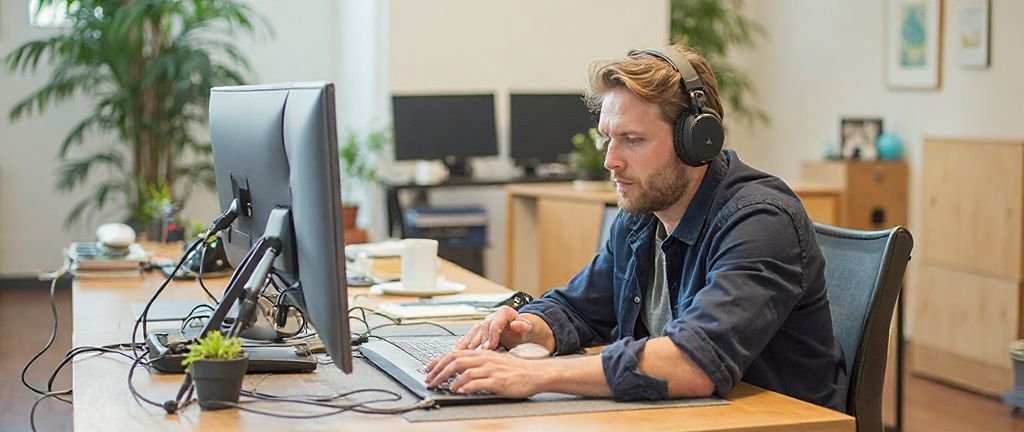
Do Noise-Cancelling Headphones Actually Work? The Short Answer
Yes, noise-cancelling headphones work, but they don’t block every sound equally well.
Active Noise Cancellation (ANC) is particularly effective at reducing steady, low-frequency sounds, such as airplane engines, train rumble, and air conditioning. These noises can become much less distracting when ANC is switched on.
Sudden sounds and nearby conversations are harder to eliminate. You may still hear a colleague talking on the phone, someone typing nearby, or a door slamming. The amount of noise you hear depends on the headphones, how well they fit, and the type of sound around you.
The key takeaway: ANC can make a noisy environment more comfortable, but it cannot turn an ordinary office, train, or coffee shop into a completely silent room.
In this guide, we’ll look at what ANC can realistically reduce, where it struggles, and whether paying more for noise-cancelling headphones makes sense for your situation.
Why Noise Cancellation Works Better on Some Sounds
Active Noise Cancellation uses microphones and electronic processing to create sound waves that reduce incoming noise. This process works particularly well against sounds that are relatively steady and predictable, such as engine hum or air conditioning.
More varied sounds, including speech and sudden noises, are harder to cancel completely. Their changing frequencies and patterns make them more difficult to reduce consistently.
The physical design of the headphones also matters. Ear cups and ear tips help block sound from reaching your ears in the first place. This passive isolation works alongside ANC, rather than replacing it.
The result is a combination of electronic noise cancellation and physical sound isolation. How effective that combination feels depends on the headphones, their fit, and your surroundings.
For a deeper explanation of the technology, read our guide to how noise-cancelling headphones actually work.
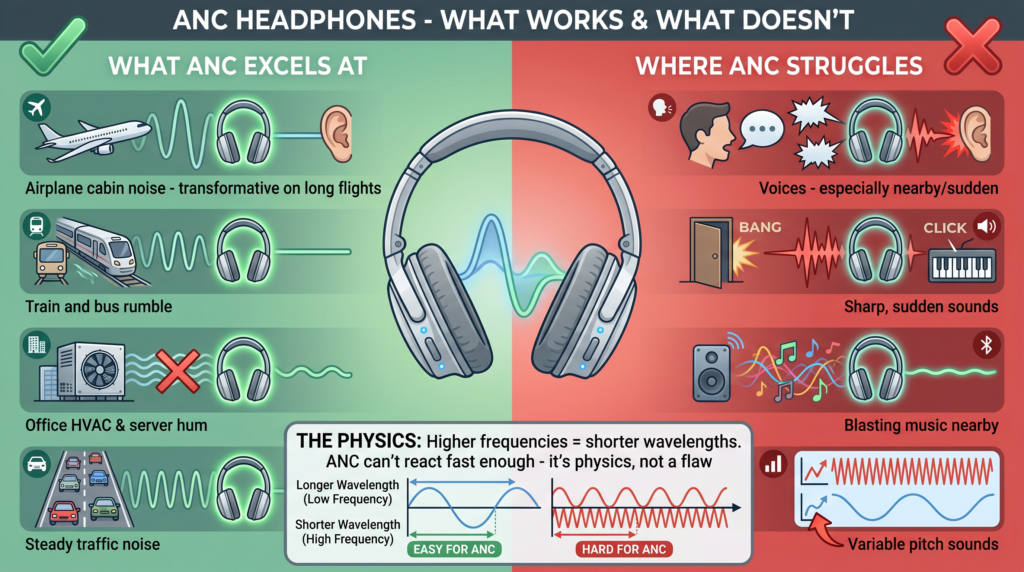
What ANC Is Actually Good At
Here are a few examples where Noise cancelling headphones (ANC) are a good fit for:
- Airplane cabin noise (genuinely transformative on long flights)
- Train and bus rumble
- Office HVAC and server hum
- Steady outside traffic noise
Where It Lets You Down
- Voices: especially nearby or sudden ones
- Sharp sounds: keyboard clicks, a door slamming
- Someone’s Bluetooth speaker is blasting next to you
- Anything that jumps around in pitch
Higher frequency sounds have shorter wavelengths. The headphones just can’t react fast enough.
Passive Isolation
A huge chunk of what you experience as “quieter” has nothing to do with ANC. It’s literally just foam and plastic pressed against the sides of your head. That is passive isolation, Physical blocking of sound. The seal does more work than people realize.
What Noise-Cancelling Headphones Can and Can’t Block in Real Life
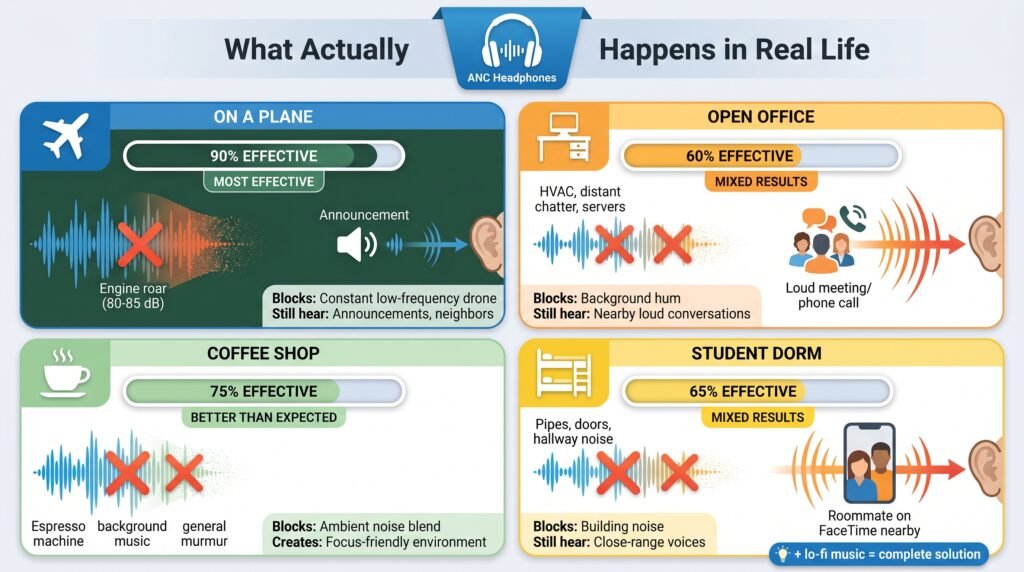
ANC performance becomes easier to understand when you look at everyday situations. The same pair of headphones may work extremely well on a train but leave you noticing conversations in a shared office.
On a Plane or Train
This is one of the situations where ANC can make a noticeable difference. The steady rumble of engines, wheels, and ventilation is generally easier to reduce than sudden noises.
You may still hear announcements, nearby passengers, and other distinct sounds, but the constant background rumble can become less distracting.
In an Open-Plan Office
ANC can reduce background hum from ventilation and other equipment. It may also make surrounding conversations less noticeable, depending on the headphones.
However, don’t expect it to eliminate a colleague’s voice when they’re sitting nearby or speaking loudly on a call. If office conversations regularly interrupt your concentration, look for headphones that combine effective ANC with good passive isolation and a comfortable fit.
If you regularly work in a office, see our guide to the best noise-cancelling headphones for office work to compare models based on noise cancellation, comfort, and call quality.
In a Coffee Shop
Coffee shops contain a mixture of steady background noise and changing sounds. ANC may soften the overall atmosphere, including ventilation and some of the lower-frequency noise from equipment.
Voices, cups clinking, and sudden sounds may still come through. ANC can make the environment more manageable, but it won’t necessarily remove every distraction.
At Home or in a Shared Workspace
ANC may help reduce sounds such as air conditioning, distant traffic, and some household background noise.
It is less reliable when someone is talking nearby, a door closes, or a sound changes suddenly. A good physical seal around your ears can help reduce additional noise, although results vary between models.
What this means: Noise-cancelling headphones are most useful when the sounds bothering you are ones that ANC can reduce effectively. Consider both your environment and the type of noise you want to minimize before buying.
Are More Expensive Noise-Cancelling Headphones Worth It?
More expensive headphones can offer stronger noise cancellation, better comfort, improved call quality, or additional features. However, a higher price doesn’t automatically guarantee that a model will perform better in every situation.
When comparing headphones, consider:
- Noise cancellation: How effectively does the model reduce the types of sounds you encounter most often?
- Comfort and fit: Can you wear it comfortably for several hours, and do the ear cups create a good seal?
- Microphone quality: Can other people hear you clearly during calls?
- Battery life and features: Does the battery last long enough for your routine, and are features such as multipoint connectivity useful to you?
A mid-range model may be sufficient if you mainly want to reduce everyday background noise. Premium headphones may be worth the extra cost if you need stronger noise cancellation, better call performance, or greater comfort during long sessions.
Rather than choosing based on price alone, compare independent measurements and reviews of the models you’re considering. Your working environment and personal priorities should determine how much you’re willing to spend. We also have our own comparison: Sony WH-1000XM5 Wireless Noise Cancelling Headphones vs Alternatives: Best Choice?
Are Noise-Cancelling Headphones the Same as Hearing Protection?
No, Noise-cancelling headphones are designed primarily to make listening and everyday environments more comfortable. They should not be treated as certified hearing protection.
ANC can reduce certain background sounds, but the amount of protection depends on the device and the situation. In environments with potentially hazardous noise, use hearing protection specifically rated for that purpose and follow the relevant safety guidance.
For everyday settings such as offices, public transport, and coffee shops, ANC can make background noise less intrusive. In very loud workplaces, however, don’t rely on ordinary consumer headphones as a substitute for proper hearing protection.
Why Do Noise-Cancelling Headphones Feel Strange at First?
Some people notice an unusual pressure-like sensation when they first use ANC headphones. Others barely notice it at all.
The sensation doesn’t necessarily mean that the headphones are physically increasing the air pressure around your ears. The experience can vary with the individual, the fit of the headphones, and the way the noise cancellation feels.
If you find ANC uncomfortable, try lowering the cancellation level or switching to an awareness mode, if your headphones offer one. You can also try a different fit or another model.
You don’t need to force yourself to use ANC if you find the sensation unpleasant.
Still doubting ANC? FAQ
Do noise-cancelling headphones actually work?
Yes, if you’re using them in situations they’re designed for.
Flights and trains, yes. Open offices and cafes, mostly. Complete silence from everything around you, no.
Does the headphone work without music playing?
Yes. ANC runs on its own regardless of what you’re listening to. Plenty of people just wear them in silence.
Can noise-cancelling headphones block voices?
They can reduce some voices, but they rarely eliminate nearby conversations completely. ANC is generally more effective against steady, low-frequency sounds than changing speech. A good physical seal can add isolation, so both ANC performance and fit matter.
Can they damage your ears?
The ANC itself won’t. Some people find the pressure sensation annoying. Listening at high volumes is a different issue, just like with any headphones.
What about sleeping?
Tricky. Over-ear models are uncomfortable to wear. Some people manage on planes. There are dedicated sleep earbuds (like Bose Sleepbuds) if that’s what you’re after.
If you’re considering noise-cancelling headphones for nighttime use, the type of noise matters too. Our guide to noise-cancelling headphones for snoring explains what ANC can realistically reduce, why snoring can be difficult to block, and which types of headphones may be more comfortable for sleeping.
Is a premium model worth it?
It depends on what you need. Premium headphones may offer stronger noise cancellation, better comfort, or improved call quality, but more affordable models can also be suitable for everyday use. Compare independent reviews, features, and fit rather than assuming that the most expensive option is always the best.
Do they help with ADHD?
Noise-cancelling headphones may help some people with ADHD manage distracting background noise, but the experience varies from person to person. ANC is not a treatment for ADHD, and it won’t eliminate every sound. If you’re easily distracted by noise, it may be worth testing a comfortable pair during your usual work or study routine.
Some of the links on Best Focus Music are affiliate links. This means that if you click a link and buy something, we may earn a small commission — at no extra cost to you. We only recommend products we genuinely think are worth your time.
We are a participant in the Amazon Associates Program, an affiliate advertising program designed to provide a means for sites to earn advertising fees by linking to Amazon.com and affiliated sites. We may also work with other affiliate networks and individual brands from time to time.