
Short Answer
Yes, they work. Just not the way most people expect.
Plane engines, AC hum, office ventilation – massive difference. Your loud coworker on a call two meters away – not so much. Most disappointment with these things comes down to that gap.
What People Are Really Asking
Honestly, most people googling this have either just bought a pair and feel let down, or they’re standing in a store trying to justify a €300 purchase to themselves.
Fair enough on both sides.
The problem is “does it work” is kind of too broad. ANC is a tool. It’s really good at some things and pretty useless at others. Once you understand which is which, it all clicks.
How the Tech Actually Works
Tiny mics on the outside of the ear cups listen to what’s around you. The headphones then create the exact opposite sound wave and play it back into your ears. The two waves cancel each other out – that’s destructive interference.
It happens constantly. In real time. Every second you’ve got them on.
But here’s the thing – it only works well on sounds that stay predictable. Low, steady, repetitive. A plane engine sounds basically the same from takeoff to landing. That’s ideal. A colleague suddenly laughing? The algorithm doesn’t see that coming.
What ANC Is Actually Good At
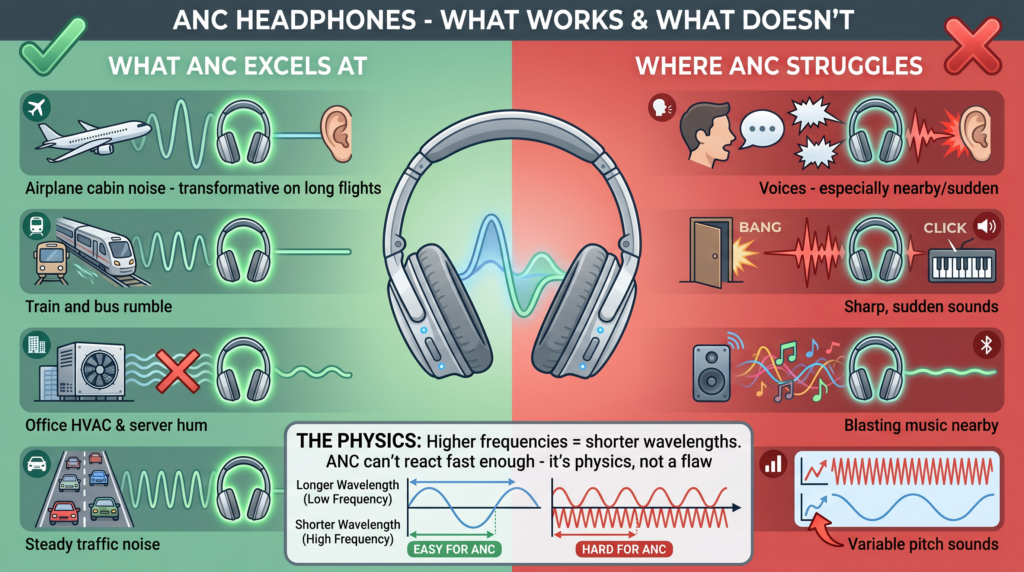
Here are a few examples where Noise cancelling headphones (ANC) are a good fit for:
- Airplane cabin noise (genuinely transformative on long flights)
- Train and bus rumble
- Office HVAC and server hum
- Steady outside traffic noise
Where It Lets You Down
- Voices, especially nearby or sudden ones
- Sharp sounds – keyboard clicks, a door slamming
- Someone’s Bluetooth speaker is blasting next to you
- Anything that jumps around in pitch
Higher frequency sounds have shorter wavelengths. The headphones just can’t react fast enough. Not a flaw in any specific model – just physics.
Passive Isolation: The Thing Nobody Mentions
A huge chunk of what you experience as “quieter” has nothing to do with ANC. It’s literally just foam and plastic pressed against the sides of your head.
Passive isolation. Physical blocking of sound.
Ear cup depth, how soft the padding is, how tight the clamp – all of it matters. A lot. It’s why a good over-ear closed-back pair beats cheaper in-ear ANC options even when the chip inside is the same. The seal does more work than people realize.
What Actually Happens in Real Life
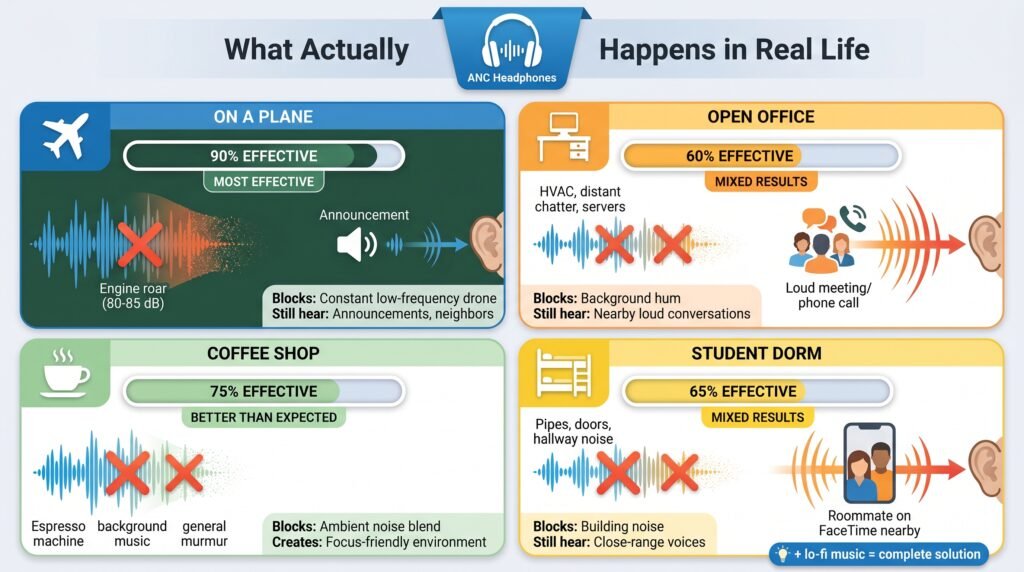
On a plane: This is genuinely where these things were made for. The constant engine roar, sitting at around 80-85 dB, fades down to something almost comfortable. Announcements still get through. The person next to you still exists. But that bone-deep fatigue from hours of low-frequency drone? Way less of it. Ask anyone who flies regularly – most won’t get on a long-haul flight without ANC anymore.
In an open office: Mixed bag, honestly. The background hum, like the ventilation, distant chatter, servers – does get knocked down. But if someone near you is having a loud meeting or on a call, you’re still catching most of it. Think of it as turning the volume knob down on the room, not hitting mute.
In a coffee shop: They work better than you’d think. The espresso machine, background music, and general murmur. It all kind of blurs together and softens. Loads of remote workers swear by this combo. There’s something about low ambient sound plus ANC that just works for focus.
In a student dorm: Good against building noise – pipes, doors, whatever’s happening in the hallway. Not so useful if your roommate is literally on FaceTime next to you. Throwing on some lo-fi in the background usually fills that gap.
The Price Gap Is Real and It Matters
Budget ANC – we’re talking anything under €80 – often creates a faint hiss when active. Some people find that hiss more distracting than whatever noise they were trying to cancel. The pressure sensation also tends to be worse on cheaper models.
Sony’s WH-1000XM5 and the Bose QuietComfort line keep topping independent tests year after year. Multiple generations of refinement. It shows. If you’re trying to figure out which model makes sense for your situation, we compared the main options in our noise-cancelling headphone comparison.
Mid-range has improved a lot though. Anker Soundcore Q45, some of the Jabra lineup – decent ANC for $100-$150. You don’t need to drop $450. But you probably need to spend at least $100 to avoid the hiss problem.
What Sound Professionals Actually Say
Audio engineers are impressed at how far consumer ANC has come. But they’re quick to point out one thing: this is comfort tech, not hearing protection.
Loud environments – construction, concerts, anything sustained above 85 dB – still need proper earmuffs or high-isolation plugs. ANC headphones aren’t built for that and aren’t rated for it.
For offices and travel, though? The difference adds up. Even if you don’t feel it moment to moment, avoiding hours of constant low-frequency noise has a real effect on how you feel at the end of the day.
That Weird Pressure Feeling
First time with ANC, some people rip the headphones off immediately. Feels like pressure in the ears, like something’s pushing inward.
That’s real. It’s the anti-sound waves, not actual air pressure. Most people get used to it after a few wears. Some genuinely never do.
If that’s been your experience before, look for a model with adjustable ANC levels. The Sony XM5 has a slider for it. Bose QC45 has a transparency mode. You can dial things back and still get some benefit without the full effect.
Bottom Line
Do noise-cancelling headphones actually work? Yes – if you’re using them in situations they’re designed for.
Flights and trains, yes. Open offices and cafes, mostly. Complete silence from everything around you, no. A conversation happening right next to you, not really.
The other thing: don’t buy the cheapest pair and expect premium results. The jump from €60 to €200 is bigger here than with most other headphone features. ANC quality scales pretty directly with price, at least up to a point.
Still doubting ANC? FAQ
Does the headphone work without music playing? Yes. ANC runs on its own regardless of what you’re listening to. Plenty of people just wear them in silence.
Can they damage your ears? The ANC itself won’t. The pressure sensation is annoying for some but harmless. Listening at high volumes is a different issue, just like with any headphones.
What about sleeping? Tricky. Over-ear models are uncomfortable to wear. Some people manage on planes. There are dedicated sleep earbuds (like Bose Sleepbuds) if that’s what you’re after.
Is a premium model worth it? $200 to $250 – usually yes. $300 to $450 – marginal. The sweet spot for most people is around $300- $450.
Do they help with ADHD? A lot of people with ADHD say yes. Cutting the unpredictable noise load in a room helps some people focus significantly. Not a medical claim, but the anecdotal evidence is pretty consistent.
Some of the links on Best Focus Music are affiliate links. This means that if you click a link and buy something, we may earn a small commission — at no extra cost to you. We only recommend products we genuinely think are worth your time.
We are a participant in the Amazon Associates Program, an affiliate advertising program designed to provide a means for sites to earn advertising fees by linking to Amazon.com and affiliated sites. We may also work with other affiliate networks and individual brands from time to time.