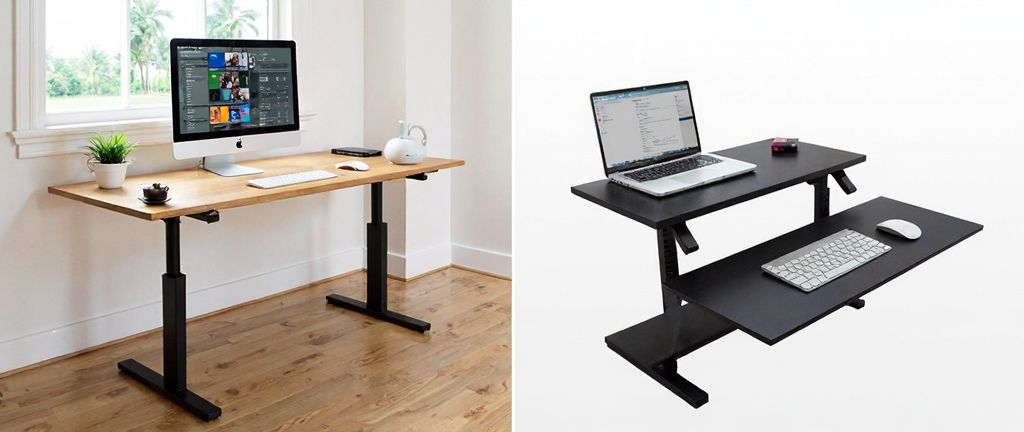
If you want to create a more flexible home office, you may be wondering whether to buy a complete standing desk or add a desk converter to your existing setup.
Both options allow you to work while standing, but they solve the problem in different ways. A standing desk replaces your existing desk with a height-adjustable work surface, while a desk converter sits on top of your current desk and raises a platform for your monitor, keyboard, and other equipment.
The right choice depends on your budget, available space, existing furniture, and how you use your workspace throughout the day.
In this guide, we compare a standing desk vs desk converter across the factors that matter most, including cost, desk space, adjustability, stability, and everyday convenience. By the end, you should have a clearer idea of which option fits your home office.
If you already know you want a complete adjustable desk, you can also explore our guide to the Best Standing Desks for Productivity: 3 Top Picks for 2026, where we compare specific products.
Standing Desk vs. Desk Converter: What’s the Difference?
Before comparing the advantages and disadvantages, it helps to understand how each option works.
What Is a Standing Desk?

A standing desk, also called a sit-stand desk, is a complete desk with a work surface that can be raised and lowered. Many modern models use an electric motor, while others rely on a manual crank or another mechanical adjustment system.
An electric standing desk usually allows you to adjust the height using a control panel. Some models also include memory presets, allowing you to save preferred sitting and standing heights.
Because the entire desktop moves, your monitor, keyboard, mouse, and other equipment can stay on the same surface as you change positions.
This can make a standing desk a convenient choice for people who want to switch between sitting and standing without rearranging their workspace.
What Is a Desk Converter?
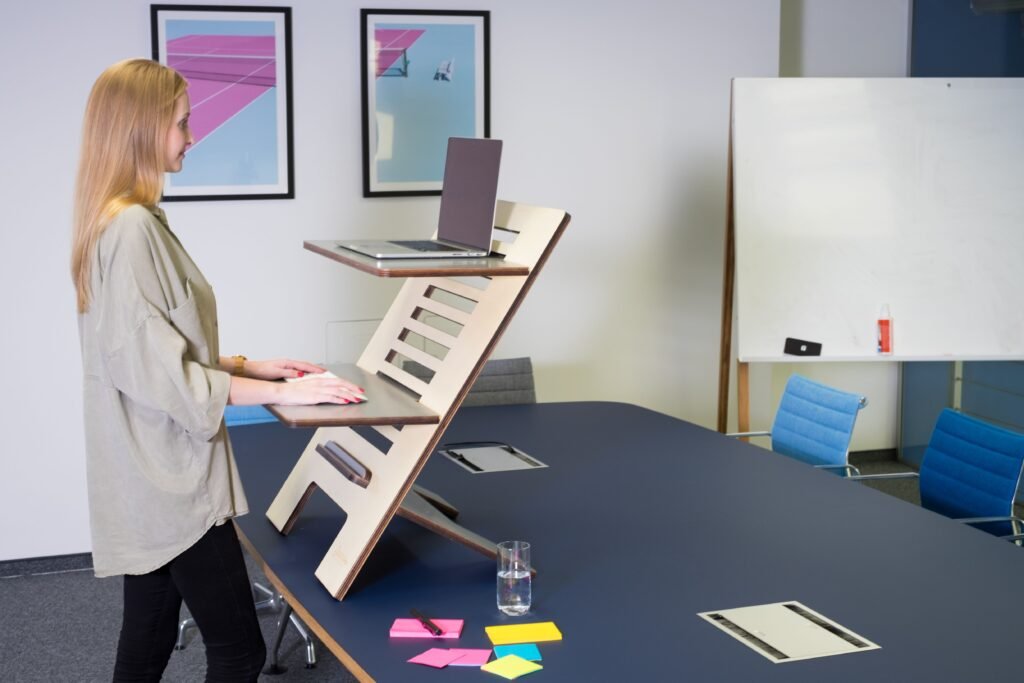
A desk converter is an adjustable platform that sits on top of an existing desk. Instead of replacing your furniture, it adds a raised work surface that can move between sitting and standing positions.
Many desk converters include a separate keyboard tray, while others use a single platform for your monitor, laptop, and accessories.
Depending on the model, adjustment may be manual, spring-assisted, or electric.
A desk converter can be useful if you already have a desk you like and want to add standing functionality without replacing it. However, make sure the existing desk and the converter work together comfortably.
Standing Desk vs. Desk Converter: Quick Comparison
| Feature | Standing desk | Desk converter |
| Installation | Replaces your existing desk | Sits on top of your current desk |
| Workspace | Uses the full adjustable desktop | Uses part of your existing desktop |
| Height adjustment | Manual or electric, depending on model | Manual, assisted, or electric, depending on model |
| Sitting position | The whole desk can be lowered | The added platform may remain too high for comfortable seated work on some setups |
| Equipment placement | The whole work surface moves | Equipment must fit securely on the converter |
| Space requirements | Requires floor space for a complete desk | Requires enough room on your existing desktop |
| Setup | May require assembly and cable planning | Usually involves positioning the converter and checking compatibility |
| Best suited for | People replacing a desk or building a new workspace | People who want to keep a suitable existing desk |
Neither option is automatically better for everyone. The important question is which one can accommodate your equipment and allow comfortable positioning in both sitting and standing modes.
1. Cost: Which Option Offers Better Value?
Price is often one of the first things people consider when comparing a standing desk vs desk converter.
A desk converter may seem like the cheaper choice because you do not need to purchase a complete desk. If your current desk is stable, large enough, and already at a suitable height, adding a converter can be a practical way to modify your workspace.
However, the price difference is not always as large as you might expect.
Some premium converters can cost several hundred dollars. Meanwhile, entry-level electric standing desks may be available at comparatively accessible prices, depending on their dimensions, motor system, and features.
Before deciding, compare the total cost of both options rather than assuming that a converter is always less expensive.
Consider:
- The price of the converter or complete standing desk.
- Whether you need to purchase a separate keyboard tray or monitor stand.
- Whether your existing desk needs additional accessories.
- Delivery, assembly, and return costs.
- The warranty and expected durability of the specific model.
A converter may offer better value when you already own a suitable desk. If you need to replace your current desk anyway, buying a complete adjustable desk may make more sense.
Want to compare complete desks before making a decision? Take a look at our Best Standing Desks for Productivity: 3 Top Picks for 2026 for a closer look at specific models and their features.
2. Desk Space: Which Option Fits Your Home Office?
The amount of available space can make a significant difference to your decision.
When a Standing Desk Makes More Sense
A complete standing desk can be a better fit if you need a larger work surface or want to organize several devices in one place.
For example, you might use:
- Two monitors.
- A laptop and docking station.
- A full-size keyboard and mouse.
- A microphone or speakers.
- Notebooks and other work materials.
Because the whole desktop moves, you can arrange these items across the available surface without having to fit everything onto a smaller raised platform.
You still need to check the desk’s dimensions and weight capacity, but a complete desk offers more flexibility when planning your workspace.
If you’re working with limited space, explore our guide to the best standing desks for small spaces, featuring five compact options for your home office.
When a Desk Converter Makes More Sense
A desk converter can be a practical option if your existing desk is already large enough and you want to avoid replacing it.
It does not require a separate floor footprint, although it occupies some of your existing desktop space.
This distinction is important if you work in a small bedroom, shared office, or apartment.
Before purchasing a converter, measure the available width and depth of your desk. Check whether the converter leaves enough room for your keyboard, mouse, documents, and other essentials.
If the platform takes up most of the usable surface, you may find that a complete standing desk is more convenient.
3. Adjustability: Electric Standing Desk vs. Desk Converter
Adjustability is another important factor when comparing an electric standing desk vs converter.
Electric Standing Desks
An electric standing desk allows you to raise and lower the entire desktop using a motor.
Depending on the model, you may be able to save multiple height presets. This can make it easier to return to your preferred sitting and standing positions.
An electric model can be particularly convenient if you expect to change positions regularly throughout the day.
However, the desk’s height range matters more than the presence of a motor alone. Check whether the minimum height suits you when seated and whether the maximum height allows comfortable standing work.
Desk Converters
Desk converters offer different adjustment mechanisms.
Some use a manual lifting system, while others have spring assistance or electric controls. Their range of movement varies by model.
A converter can be easy to use when it moves smoothly and keeps your monitor and keyboard in suitable positions. However, the combined height of your existing desk and the converter must work for your body.
A converter that raises the keyboard to a comfortable standing height might leave it too high when you sit down.
This is one of the most important checks to make before buying.
Our recommendation: If you are setting up a permanent home office and want the entire surface to move, compare electric standing desks first. If you want to keep your current desk, look for a converter with an adjustment range that works for both positions.
4. Comfort and Ergonomics: Which Is Better?
Neither a standing desk nor a desk converter automatically creates an ergonomic workstation.
Your monitor, keyboard, mouse, chair, and desk height all need to work together.
When sitting, your shoulders should be relaxed, your elbows close to your body, and your wrists in a comfortable position. Your feet should be supported, and your monitor should be positioned so that you can view it without repeatedly bending your neck.
When standing, the same general principles apply. Your keyboard should be positioned so you can type with relaxed shoulders, and your monitor should be at a comfortable viewing height.
Ergonomics With a Standing Desk
A full standing desk gives you more flexibility to adjust the height of the entire work surface.
This can be helpful if your current desk is too high or too low, or if you are building a workspace from scratch.
You still need to select a desk with a suitable height range. Not every adjustable desk will fit every user’s height or equipment arrangement.
Ergonomics With a Desk Converter
A converter can also support a comfortable setup, but the existing desk remains part of the equation.
For example, if your desk is already high, adding a converter may make it difficult to achieve a comfortable seated keyboard position.
The converter’s keyboard tray, monitor platform, and adjustment range should therefore be considered together.
If possible, measure your current setup before buying. Do not rely solely on a product’s maximum lifting height.
One final point: standing all day is not the goal. Alternating positions and taking regular movement breaks is generally a more sensible approach than replacing all sitting time with standing.
5. Stability and Equipment Compatibility
Stability is particularly important if you use multiple monitors, heavy accessories, or a large keyboard and mouse setup.
A complete standing desk supports its equipment through the desktop and frame. You should still check the manufacturer’s stated weight capacity and consider how stable the desk remains at different heights.
A converter adds another layer to the existing furniture. Its platform, lifting mechanism, and base must all support the equipment securely.
Do not assume that a converter can support every combination of monitors and accessories. Check the capacity of the specific model and account for all the equipment it will carry.
If you use a monitor arm, verify that the converter or desk supports your intended mounting arrangement. Some configurations may require a different solution.
6. Setup, Assembly, and Everyday Convenience
Another difference between a standing desk vs desk converter is the amount of work involved in changing your workspace.
A complete standing desk may require assembly, the removal of your existing furniture, and a little planning for cables and power outlets.
Once installed, however, the whole work surface can move together.
A converter can be simpler to introduce into an existing office. You keep your current desk and add the adjustable unit, provided that it fits securely and your furniture can support it.
The trade-off is that you need to work around the converter’s dimensions and moving parts. Depending on the model, cables may need to be reorganized, and the raised platform may affect how you use the remaining desk surface.
Think about your daily workflow, not just the initial installation.
If you frequently switch between computer work, writing, and other tasks, make sure the arrangement remains practical in both sitting and standing positions.
7. Standing Desk Converter Pros and Cons
A desk converter is not simply a cheaper version of a standing desk. It is a different type of solution, with its own advantages and limitations.
Advantages
- Keep your existing desk: You do not need to replace furniture that already works well.
- Avoid adding another floor-standing desk: The converter sits on your current work surface.
- Flexible product options: Different sizes and adjustment mechanisms are available.
- Useful for upgrading an existing setup: You can add sit-stand functionality without completely redesigning your workspace.
Disadvantages
- Reduced desktop space: The converter occupies part of the surface you already have.
- Potential seated-height problems: The lowest position may still be too high when combined with your existing desk.
- Equipment limitations: The platform must support your monitors and accessories securely.
- Additional cable planning: Cables must accommodate the moving platform without becoming trapped or stretched.
A converter makes the most sense when your current desk is worth keeping and the dimensions work for your equipment.
8. Standing Desk Pros and Cons
A complete standing desk can be a better long-term solution when you want to replace your existing furniture or build a new home office.
Advantages
- The whole work surface moves: Your equipment can stay arranged across the desktop.
- More flexibility when planning a workspace: You can choose a suitable desk width and depth.
- A wider range of complete setups: Options include different frames, desktops, controls, and accessories.
- Potentially simpler equipment arrangement: You do not need to fit a separate converter on top of your desk.
Disadvantages
- Higher total purchase cost in some cases: You may need to replace your existing desk entirely.
- Assembly and installation: A complete desk usually requires more setup than adding a converter.
- Floor-space requirements: You need enough room for the desk and its frame.
- Model-specific limitations: The height range, load capacity, and stability still need to suit your needs.
A complete standing desk is particularly worth considering if your existing desk is too small, unstable, or difficult to adjust to a comfortable working height.
If you would like to learn more about the pros and cons, read our article: Standing Desk Pros and Cons: Is a Standing Desk Worth It?
If you’re already interested in a standing desk, we have a comparison where we look at different models. Check out our best standing desks for 2026.
Final Verdict: Standing Desk vs. Desk Converter
When comparing a standing desk vs desk converter, there is no universal winner. The better option depends on whether you need to replace your desk or simply want to make your current workspace adjustable.
A complete standing desk is worth considering if you need more space, want the entire work surface to move, or are building a new home office.
A desk converter can be a practical alternative if your existing desk is stable, spacious enough, and worth keeping.
Whichever option you choose, focus on the complete setup. Check the dimensions, adjustment range, equipment capacity, and comfort of both sitting and standing positions before buying.
Ready to compare specific desks? Explore our Best Standing Desks for Productivity: 3 Top Picks for 2026 to see which complete standing desks may suit your workspace.
A good workspace is only one part of a productive routine. Lighting, audio, and distraction management can also influence how comfortable your work environment feels. If you are building a setup for deep work, explore our guides to focus music apps and noise-cancelling headphones.
Affiliate disclosure: Some links on this website may be affiliate links. If you purchase through them, we may earn a commission at no additional cost to you.
Some of the links on Best Focus Music are affiliate links. This means that if you click a link and buy something, we may earn a small commission — at no extra cost to you. We only recommend products we genuinely think are worth your time.
We are a participant in the Amazon Associates Program, an affiliate advertising program designed to provide a means for sites to earn advertising fees by linking to Amazon.com and affiliated sites. We may also work with other affiliate networks and individual brands from time to time.